February 20, 2026

Have you been saved? Perhaps you have been asked this question. For some of you, it may cause you to break out into hives! We can attempt to answer the question, though it may not be the answer expected by someone who would boldly pose such a question. Have you been saved? Well, we are always in the process of being saved. Salvation is a process, not a moment in time.

The original Greek of the word “to save” has valences of being made whole, even of being healed. Rather than a simple rescue from something that is bad, salvation can be likened to something that restores goodness, or at the least, unites and repairs what is fractured. Maybe even more surprising to the fervid evangelical posing the question, “have you been saved?” is the rather more catholic claim that God saves us in the liturgy itself. The Western—especially protestant mindset—might be inclined to think of the Church’s liturgy as either a reenactment of past events or, alternatively, as a word-heavy intellectual exercise. The Church’s liturgy is neither. Indeed, the Church doesn’t really have a liturgy. The liturgy is Jesus Christ himself, God’s own act of beneficence, God’s work for us, God’s gesture of love toward the world God created. In the Church’s liturgies, we participate in the saving events of Christ’s life himself—his life, death, and resurrection—and so we assume a Christlike identity.

Considering the liturgy in this way gives an entirely new response to the age-old question, “why should I go to church if I don’t get anything out of it?” One response is that we don’t go to church to get anything out of it. We go because it is our only proper response to what God has done in love for us. In the liturgy, we meet Christ himself in a particular way that is bound up with our salvation, our being made whole and one with God and each other. The late Roman Catholic liturgist Robert Taft put it this way: “liturgy is not just ritual, not just a cult, not just the worship we offer God. It is first of all God’s coming to us in Christ. Nor is it individual, or narcissistic, for it is also a ministry of each one of us to one another. It is only through our faith that Christ can be visibly present to others in the present dispensation. The commonly heard contemporary complaint, ‘I don’t go to church because I don’t get anything out of it,’ the summit of a selfish narcissism suitably expressive of our age, shows how little this is understood, this gift of Christ only we can bring to one another by the shining forth of the intensity of our faith in the life of the assembly!” [“What Does Liturgy Do? Toward a Soteriology of Liturgical Celebration: Some Theses” in Primary Sources of Liturgical Theology: A Reader, Collegeville, MN: Liturgical Press, 2000, p. 146]. Striking is Taft’s emphasis on the corporate dimension of worship, of our presence to one another, of our ministering to one another in the liturgy. Salvation is a corporate affair, not a solo one.

To that end, as we embark on this Lenten journey, we may wish to reconsider our participation in the liturgy in relation to being made whole—indeed, healed—by God and with an eye toward how the saving event of liturgical participation is essential to the world’s healing. If we are troubled by our age— of heinous government-sanctioned cruelty, of fearful rhetoric, of senseless violence, of immigrants being treated as refuse, of the meek being denied a voice, and so much more—then the liturgy is the place where the Church strives to be herself most fully, where the light of the Gospel shines as a counter to the world’s darkness. The liturgy’s purpose is never educative, but it does have ethical ramifications. In the liturgy, we rehearse what it is like to be a people of peace, of reconciliation, of selflessness, of service, of holiness, even as we struggle to be so outside of the Church. Even when we don’t feel any of those things, our encounter with Christ in the liturgy can’t help but affect us for the salvation of the world, so that the world can become so much better than it currently is.

And this raises a final chilling question: how do some people go to church so much and yet live as if their encounter with Christ in the liturgy has had no impact on their lives? This is where faith comes into the picture. If our eyes are opened by faith, if the liturgy is not a self-serving human creation or a mindless individual affair but, instead, a historically-rooted ordo that shapes us rather than our shaping it, then something about us must surely change over time. That is the hope. That is the prayer.

If you are interested in the connection between our salvation and the liturgy, I encourage you to attend our next online adult formation presentation/discussion on Thursday, March 5, at 7 p.m., which I will be leading. We will talk about the liturgies of Holy Week and how in those very liturgies, through our encounter with Christ crucified and risen, we, with God’s grace, work out our salvation with fear and trembling. Look for the Zoom link in the weekly email.

As we go deeper into the forty days of this Lenten season, I invite you not to underestimate our corporate encounter with God in Christ in the liturgy or its saving effect on the world. If our previous understandings of salvation have traumatized us, then the answer is not to reject any talk of salvation but rather to reframe it. The Church, as Christ’s very body to the world, is essential for the world’s wholeness and healing. I close with more words from Robert Taft: “since we are that Church in whom Christ lives, the liturgy, as the common celebration of our salvation in him, is the most perfect expression and realization of the spirituality of the Church” [“What Does Liturgy Do? Toward a Soteriology of Liturgical Celebration: Some Theses,” p. 147]. May it be so.

Yours in Christ,
Father Kyle
February 13, 2026

This year, with an early beginning to the season of Lent, we may need an especial reminder that the word “Lent” comes from the Old English word for “spring.” With snow only beginning to melt and many more days of cold weather ahead of us, I’m sure, 2026 might be a worthy year to reflect on Lent as a time when spring awakens among and within us. Lent may very well be about penitence, fasting, abstinence, spiritual practices, and self-discipline, but all those things are a means to an end. The end is spiritual spring cleaning.

What coldness within our hearts needs to melt this Lent by the warm fire of the Holy Spirit? What hardness of heart needs softening through prayer and self-discipline this Lent? When viewed in this way, spiritual practices, prayer, and pious acts are not intended to burden us with discomfort. They are necessary for turning our hearts of stone into hearts of flesh.

I have become convinced that most people don’t need reminding of their sinfulness and of the ways in which they fail to live into the likeness of God. Even despite this, some people are unwilling to own up to their sins or believe they need to change, and this may very well be because they don’t really believe that God forgives. Or maybe God forgives with a whole host of strings attached. Many people simply don’t know how to deal with their sinfulness. The danger is always that we throw up our sinfulness in a kind of general way in the confession at Masses and move on without really engaging in thorough and prayerful self-examination. In other words, we too often neglect the very medicine our soul needs to find healing.

Each year during Lent, I write about the beauty of the Sacrament of Reconciliation. This sacrament is a gift of our prayer book and of the Church, which enables us to move toward a proper, honest acknowledgment of the ways in which we have fallen short of God’s desire for our lives. The outcome of a good confession is a release from all the sin that burdens our hearts. Yes, God forgives before we even ask, but if we don’t ask for forgiveness, then we will never fully recognize that God does forgive. If we do not amend our ways and turn to the Lord again and again, we will be stunted in our spiritual growth. Sometimes the tangible assurance of God’s forgiveness in the absolution is precisely what we need for our spiritual healing. Confession to a priest is not a vaccine or spiritual pill, nor is it an end in and of itself. It is a means to an end, and that end is restoration to wholeness with God and one another.

In my own practice of confession, I have had wise counsel from priests who have helped me to find patterns in my own tendency to sin. Making one’s confession (and hearing confessions as a priest) is humbling. The more one is honest about one’s own sins and refuses to excuse one’s own spiritual blind spots, the less likely one is to judge others, and the more one is able to see with full clarity that God is perfect love.

We inhabit both an unforgiving world and an unforgiving Church. Anyone who is in prison and released will probably tell you that they are never truly free again, and this reality wounds the heart of God. There are some in the Church who have been held accountable for their actions and who, likewise, never feel free again—even in the Church. And this wounds the heart of God, too. By practicing confession and keeping ourselves honest before God and one another, we practice what we preach, which is forgiveness. The Church should be the most forgiving place in the world, and is there any better news than that the God we worship and adore is One who never stops forgiving, who makes everything new, and who is perfectly boundless in mercy?

I invite you to observe a holy Lent and encourage you to mark this season of renewal by attending Mass on Ash Wednesday, February 18. The ashes that will be placed on your foreheads—in the same shape and place that many of you were anointed with oil in baptism—are a sign that we are marked as Christ’s own forever, not as condemned sinners but as redeemed, beloved children of God, held in the embrace of his mercy and forgiveness. Let those ashes on your foreheads—for all the world to see—be a testament to the good news of Christ, that he has lived among us to heal us, to make us whole, to set us free, and to reconcile us to God and one another.

Yours in Christ,
Father Kyle

February 6, 2026

This past Wednesday at Low Mass, I especially needed to hear words from the Letter of James, which was an appointed reading that day:

Be patient, therefore, brothers and sisters, until the coming of the Lord. The farmer waits for the precious crop from the earth, being patient with it until it receives the early and the late rains. You also must be patient. Strengthen your hearts, for the coming of the Lord is near. Brothers and sisters, do not grumble against one another, so that you may not be judged. See, the Judge is standing at the doors! As an example of suffering and patience, brothers and sisters, take the prophets who spoke in the name of the Lord. Indeed, we call blessed those who showed endurance. You have heard of the endurance of Job, and you have seen the outcome that the Lord brought about, for the Lord is compassionate and merciful (5:7-11).

James’s words remind me that patience is a virtue in the Christian life. We live in an impatient age, but our life in God must be rooted in patience. God’s time is not our time. At the same time, I think the author of the Letter of James would agree that being a faithful Christian must also assume a sense of urgency. We are ambassadors of the Gospel, and that calling should not be taken lightly. There are times, in fact, when we need to be impatient: when we are confronted with injustice or when a wrong needs righting or calling out. The Christian life is one of balance, requiring patience as God brings fruit from our labor and also demanding our proactive response as we strive to be doers of the word and not merely hearers.

Over the coming months as we labor together in ministry, what things are urgent? In what ways can we act now because we already have what we need to do so? What concrete steps should we take in faithful response to God’s call on our lives? On the other hand, what things will require our patience? This is a time of discernment: of gaining clarity on what we can and are called to do, and of knowing what things we must wait for God to give.

As we navigate this time of transition, waiting for more clarity on when I will move on from Good Shepherd, I hope that concrete steps forward may be of comfort. Might I suggest some of those, which I believe will be important for the strengthening of our parish family in the weeks ahead?

  1. Gathering weekly for worship on the Lord’s Day is the center of our parish life. During times of transition, our unity and grounding in worship is especially significant. Come to Mass in good times and in bad ones to hear God’s Word proclaimed and receive the Sacrament that brings us wholeness and health and binds us to God, one another, and the the company of heaven. When anyone is absent, that person is missed. The vibrancy of Sunday worship will be a necessary rock in the parish’s times of transition. Ultimately, our worship of God will become the only proper response we can make to a recognition of God’s ceaseless love and care for us. The perfection of that response is not fully realized in this life, but as we journey here on earth, we can at least make worship our priority even when it feels like a chore. Although it is bitterly cold outside, the church is warm and the congregation is, too! Allow a bit of extra time to find parking while the snow remains with us.

  2. In what ways can we renew our ministry commitments? How can we be proactive in addressing areas of need in our parish life? Please do ask for help when you need it. We are all in the work of ministry together.

  3. It is the duty of the entire Christian community to care for old and young alike. Even those of us with grown children or no children have a responsibility for the nurture of the children among us. And those who are younger must care for those who are older. If you cannot get to church for good reason, please let me know. It is always a privilege to bring the Sacrament of the Eucharist to you.

  4. Would you prayerfully consider participating in a ministry if you are not already? Would you consider taking another one on if you can? Here’s a form to indicate your interest. We need your help and your gifts! If you are intimidated by the prospect of joining a ministry, please talk to me first. We will work through this together. We are a community. Indeed, we are a family, the family of God.

  5. If you notice that someone is absent from worship for a while, please reach out to them. That is my practice, but I encourage you to do so as well. When one person is missing, we are all the weaker for it.

Please reach out to me with ways that I can be helpful in this time of transition. I am here to pray for and with you and, of course, to help in whatever way I can. But it will require all of us, with God’s help, to realize the fruits of ministry. We are a community, and this parish’s future depends on our joint efforts aided by God’s wondrous grace. I will keep you posted as I know more about my plans for leaving Good Shepherd. I am grateful for your patience with me during this time of uncertainty.

Finally, recall that when Jesus sent the disciples out initially, he sent them out two by two, not alone. We need each other. And if you are feeling despair or hopelessness as you ponder the tragedies of our hurting world, know that the Church is precisely the place where you can belong and offer your gifts to make a difference. Perhaps right now, if we are depressed by world or national news, we should recommit ourselves to the Church. The world needs the Church now more than ever because the world needs the light of Christ. The world and this local community need Good Shepherd. With all of us working together, this corner of Montrose and Lancaster Avenues will be a beacon of light for many generations to come.

Yours in Christ,
Father Kyle

January 30, 2026

Over the past few days, I have found myself in grief over the death of my mother on Sunday morning. If you have lost a parent, you will know that there are no words to describe it. I feel deep gratitude for the mercy of God in that my mother is no longer suffering from a disease that incapacitated her body and her mind. While I shed tears at unpredictable moments as I remember my mother’s sweet smile, I also rejoice that her smile, which was less frequent in recent years, has undoubtedly returned in the nearer presence of God. As St. Paul tells us, death has lost its sting. Although death creates great sorrow for us still on earth, it is freedom for those who suffer in the final days of their lives. I cannot imagine a life without the truth of the resurrection.

Here in my father’s apartment in San Antonio, I have also been grieving as I follow national events through the news media. I was horrified to watch footage of the last earthly moments of Alex Pretti. I was dismayed by attempts to diminish the worth of his life by blaming the victim. I was deeply disturbed to observe how humans will easily resort to physical violence in the heat of an emotionally-charged moment. In times of discord, it is alarming to notice the quick unleashing of human savagery, which must lurk below the surface more than we care to acknowledge. We are seeing the emergence of lawlessness as a means of reinforcing an unholy grasp on power. Regardless of where each of us stands politically, as Christians, we must resist such lawless violence. Eschewing violence should not be a partisan issue. We must honor the dignity of every person. We must seek the path of peace, not division.

In my own lifetime, I am not sure I have ever experienced a time where the Church’s very mettle has been tested quite so strongly. Before the Emperor Constantine’s own conversion led to the general acceptance of Christianity as a religion in the fourth century, Christians were always in defiance of the law to some extent. Being a Christian was not legal. Now, if we choose to live as disciples of Jesus Christ, we may find ourselves needing to choose with whom we side: Caesar or Christ. In a just world, this decision may be less pronounced, but we are not living in a just world. It is very easy for us to write off the current state of affairs as something we simply have to accept because we inhabit an imperfect world, but that seems cowardly. We should not be forced to compartmentalize our “secular” lives and our “sacred” lives. When we follow Christ, we are in this world but not of this world.

I do not have easy answers to the state of crisis in our nation. But I do know that the Church is most fully herself when she is with the poor, and by poor, I mean those living in poverty as well as the oppressed, the suffering, the hurting, the abused, the refugee, the homeless, and any one who is cast aside as mere refuse. In the days ahead, it will take courage and perhaps defiance to continue to care for the stranger, the immigrant, the poor, and the suffering when government policies are working against these timeless acts of Christian charity.

This past week, The Most Rev. Sean Rowe, Presiding Bishop of the Episcopal Church, wrote a message encouraging us to persevere in the work that Christ has called us to do. You can read his words here. At Good Shepherd, we will persist in remembering the poor. We must not allow one person to remain lost if we can help in some way. If things continue the way they have been, we may be required to make bold, risky choices to be faithful disciples of Christ.

Our own diocese is sponsoring a Vigil for Peace at Philadelphia Episcopal Cathedral on Saturday, January 31 beginning at 10 a.m. At Good Shepherd, we will pray for justice, peace, and righteousness to prevail in our nation and across the world. Our elected leaders and the citizens of this nation need our prayers. We must start with prayer, but such prayer should empower us with the necessary strength to stand up courageously for a world in which no person is shot carelessly by agents of the government and where unity and not division is the norm.

Psalm 51:18 tells us that “the sacrifice of God is a troubled spirit.” In times of grief and dismay, the Holy Spirit prays within us with sighs too deep for words. Our troubled spirit is prayer enough, but such prayer must also move us to action. In this time of my own grief, I am deeply grateful for your gestures of kindness and compassion. I ask for your continued prayers for the repose of the soul of my dear mother, Nanette, as well as for my family and me. Please pray for the repose of the souls of all who are the victims of violence. Pray for people across the world where there is no peace. Pray for the coming of the peace of God that passeth all understanding.

Yours in Christ,
Father Kyle

January 23, 2026

Back in college when I was studying music, I began to experience some discomfort in my arm. I chalked this up to hours of practice at the organ each day. I assumed that the area of pain in my body was the area that had been overworked. But as I began to learn more about how bodies work and of the complexity of human anatomy, I realized that the focal point of my discomfort was likely triggered by another place in the body that was being strained. Tension in the neck would prompt soreness in the elbow. Slouching shoulders caused lower back pain. I quickly learned that no part of the human body is unrelated to even the remotest part.

St. Paul must have intuitively known a few things about human anatomy, for his theology of the body of Christ is a brilliant use of metaphor to convey a theological reality. In short, Paul tells us that no part of the body can disregard another. If the right hand is injured, we will probably put extra strain on the left hand. If we overuse one part of the body, another part will atrophy. It is the same in ministry. If one part of the body—one person or one group of people—decide to lie low and not use their gifts, then another part of the body will wear out. The overcompensating part of the body will get tired and possibly burn out. If the Church is to be healthy and vibrant, then she needs to constantly attend to Paul’s theology of the body of Christ.

Although it can be unwise to make assumptions, there is one assumption that we can make without any regret. Every single one of us has gifts that God gives us and that God intends for us to use in ministry. Full stop. None of us is let off the hook! Of course, we make excuses. I’m too busy in extracurricular activities. I live too far from the church. Parish ministry is “not my thing.” I don’t have enough time. But God doesn’t want us to make excuses! God calls us to respond by making good use of our gifts.

This season after the Epiphany is an appropriate time during which to focus on our God-given gifts. The thrust of this season is from Christ’s manifestation in historical time as the Messiah toward the way in which Christ is manifested in our own lives to the world. One such way that Christ is manifested through us, his chosen body, is through the use of our gifts.

At this moment in the life of our parish, there are unused gifts. Some parts of the body are overfunctioning, and we should notice this and correct it so that we do not witness burnout. There is so much life in this parish, but to sustain this activity and vibrancy, all of us need to play a part. Our own portion of Christ’s body here at Good Shepherd is weaker than it needs to be if each of us is not giving selflessly of our time and gifts.

As a new vestry is seated this week, it is an opportune time to look ahead to strengthening ministry in the parish and to recalibrating the body. Like going to a body worker to realign our spine, we, as a parish, need to constantly realign our parochial energy. Are their areas of ministry that you can take on to help those who are on the verge of fatigue? What gifts are you hiding under a bushel that God is calling you to let shine?

At last Sunday’s parish meeting, I mentioned some specific ministry areas in which we need help. I am confident that the gifts to assist with these ministries are already here. For those of you who were not at the annual meeting or who didn’t see the signup sheet, I have created a digital version. Would you please take a look at this signup and pray over the ministries listed? Please consider signing up to help with one or more of these ministries. We will gladly provide training, and I will do everything I can to help you as you seek to use your God-given gifts for the health of the body here at Good Shepherd.

Even as we engage in personal discernment of the ways in which God is calling us to serve for the sake of the Gospel, please continue to join me in praying for those, as yet unknown to us, whom the Holy Spirit will send to this parish to participate in the life-giving ministry that is already happening. And please continue to pray for our existing parish ministries as we seek to realign the body for its full flourishing.

Yours in Christ,
Father Kyle

January 16, 2026

Our parish bylaws specify that each year, at a date and time determined by the vestry, an annual meeting will be held. This is standard practice in Episcopal parishes. Our 2026 annual meeting will take place this Sunday, January 18, immediately after Sung Mass in the church nave. Annual meetings are far more than mere business meetings. There is business to conduct: new vestry members will be elected; and delegates to diocesan convention and local deanery meetings will also be elected (please see the ballot here). But there is much more. The vestry will introduce the proposed 2026 budget and entertain your questions. I will give a report on the state of the parish. We will look ahead to upcoming leadership transitions. And your questions will be entertained.

Annual meetings in some places can be contentious. Thankfully, in our recent past at Good Shepherd, annual meetings have been moments of celebration. The parish vestry strives to be as transparent as possible about parish operations. An annual meeting should be a moment to understand how the parish functions well, to learn about challenges and joys, and to prayerfully discern ways in which every member of Christ’s body can use their particular gifts for the flourishing of ministry. Your presence is not only requested; it is needed. As I have said before, the parish is not as strong as it can be if everyone is not using their gifts in ministry.

If you are tempted to eschew the meeting for whatever reason, please think again! The vestry and I earnestly hope that you will bring your questions to Sunday’s meeting. This meeting will, above all, be an opportunity to celebrate God’s many blessings upon this parish. Refreshments will be served in the cloister before and after the meeting in lieu of coffee hour in the retreat house. A list of eligible voters for the parish elections is posted online. If you are not an eligible voter, please come to the meeting anyway! Elections are only a small part of the annual meeting.

I hope that you will read our 2026 annual report in advance of Sunday’s meeting. Parish staff and leadership have thoughtfully prepared reflections on ministry, and I ask you to read what they have written. There is much to celebrate and give thanks for in the past year. In my own reflections in the annual report, I tell, through words and images, the story of this parish over the past five and a half years. If you are new to Good Shepherd, I pray that you will find this story illuminating as we celebrate all that God has done through faithful, prayerful people. And I pray that the past five and a half years will give us extraordinary hope for the next five years!

If you are unable to attend the annual meeting in person, please watch online. I will look forward to worshipping with you this Sunday and to giving thanks for God’s abundant blessings in the past year.

Yours in Christ.
Father Kyle

January 9, 2026

I can only begin this week’s message with profound thanks. Over the past four months, we have navigated a challenging pledge campaign. Pledge giving is rarely a consistent phenomenon: people move on to other parishes, their financial circumstances change, or they relocate to a different geographical region. 2025 was no exception. While we lost about $30,000 in returning pledged income from 2025 to 2026, about $15,000 more was pledged in 2026 than in 2025. More than half of returning pledges increased, some significantly. 17 new pledges were added, for a total of 60 total pledges (3 more than in 2025). Among these pledges are new parishioners, children, and college students. All I can say is THANK YOU!

Generosity is a marker of spiritual health, whether in how we give of our money or of our time. The stronger our relationship with Christ becomes, the more willing we are to give of ourselves to support God’s ministry. The more generous we are, the less fearful we usually are, too. Sacrificial giving, as with true love, does not count pennies but offers everything back excessively to God. God’s love, of course, is excessive, spilling over and out from the life of the Trinity into our world.

In our annual parish report, which will be published in just a week’s time, I will offer a more detailed recounting of the changes I have seen at Good Shepherd over the past five and a half years. But perhaps the most significant change I have witnessed is a near miraculous shift from fear and scarcity to hope and abundance. This metamorphosis has resulted in operational budgets that are generous in supporting ministry that is key to the proclamation of the Gospel and to furthering parish growth, as well as in offering just compensation to parish staff. Our budgets have been generous in assuming continued growth in our future, trusting that, even when we face major challenges, God will provide.

It goes without saying that the rest of the world rarely operates in this fashion. Most people are happy to spend extravagantly when it primarily benefits themselves and their comfort, but fewer are willing to give in excess to causes that benefit others, although thankfully there are still philanthropists among us! But in the realm of the Church, we are told to do something extraordinary: put God first and then figure the rest of our finances out afterwards. This might mean foregoing a big vacation one year or buying fewer books, cups of coffee, or fancy clothes. But by engaging in such a spiritual practice, we soon learn that we are, in fact, able to live without all those things. True joy finds us when God is at the center of our lives.

I realize that in my time as rector, I have talked a lot about money. I have done so primarily because I believe that our Christian faith requires that we give to God first. I have also spoken frequently about money because this parish has faced, and still faces, financial challenges. These challenges are not the result of our own imprudence, however. They are the result of decisions made before most of us ever came to Good Shepherd, and those unfortunate decisions were more about fostering factionalism than encouraging unity. Blessedly, that is in the past, and yet, we are left with the responsibility of carrying on with the Gospel amid certain obstacles. We are and will continue to do this by encouraging unity and reconciliation, not division and conflict.

But what I have noticed is that the more we have talked openly about money and the spiritual practice of sacrificial giving, the more generosity has been evidenced in this parish. As the priest says in blessing the offerings of money at Mass: “all things come of thee, O Lord, and of thine own have we given thee.” It’s counterintuitive. We receive from God and then give it back to God. As an employee of this parish, I accept a paycheck, and then I give ten percent of that net income back to the parish. Why not just withhold it to begin with? Well, I think there’s a lot of value in seeing the money in one’s checking account and then reckoning with its imminent departure from that same account.

I feel so strongly about sacrificial giving that I have already discussed it with children in Sunday formation. I want them to know from an early age that they should live in hope, love, and trust, rather than in fear. If they learn this at an early age, they will be a part of a new movement that chooses to see the world with eyes of abundance rather than scarcity. And I am deeply moved that two of our children choristers have more than tithed on their chorister stipends to support ministry in 2026.

As I said initially, I have nothing but thanks for your generosity as we respond to God’s call to rebuild this parish for the sake of the Gospel. To date, about $254,000 has been pledged towards ministry in 2026. This is about $11,000 short of our goal of $265,000. If you are able to give more, will you help us reach this goal? I believe we can! It is never too late to pledge, and so if you have not yet made a pledge, please consider doing so as soon as possible. You may do so easily online. Our giving tree remains in the retreat house for browsing on Sundays. And if you have already pledged but wish to increase it (as many already have), you can simply email Mary Campbell, our Financial Administrator. The parish vestry will meet on January 17 to finalize a proposed 2026 budget before the annual meeting, so please consider making your pledge before then. Please remember that as the parish looks towards preserving its historic buildings and addressing deferred maintenance in the future, any grant-awarding organizations that we might court will look at the health of our congregational giving. Now is the time to get it right! Each of us who cherish this parish have a responsibility to do our part in moving the parish towards greater financial strength. As I’ve said before, there are no unnamed major philanthropists who will bail us out. That is magical thanking! The financial burden of supporting parish ministry lies with all of us who call Good Shepherd home.

I’ll end this message the way I started, with thanks. Thank you for trusting in God’s gracious provision. Thank you for trusting Good Shepherd’s leadership with making wise and faithful decisions for the well being of the parish. Thank you for all you do to make this parish a shining witness of the Gospel in a hurting world. And thanks be to God for his many gifts.

Yours in Christ,
Father Kyle

January 2, 2026

We have turned the page in our secular calendars. 2026 is here. Although the Church began its new year on November 30, there is still something for us to mark as 2026 begins. We need not divide secular and sacred. The beginning of a new calendar year is for us Christians a moment to begin anew.

I am inherently suspicious of New Year’s resolutions. Maybe that’s because we live in an age of shallow commitments, filled with Facebook likes and reactions that rarely translate into action. New Year’s resolutions seem delightful in the first few days of 2026 and often dissipate into the ether shortly thereafter. But for those of us who are Christians and practice Christianity, this turn of the calendar page is a ripe moment.

I use that word “practice” quite deliberately because being a Christian is far more than clicking “like” or “love” icons on a Facebook post. Being a Christian is something we practice, something that we live out both in word and deed. While I don’t subscribe to the narrative of Church decline, I do think that some of the malaise in the Church stems from a neglect of practicing what we preach.

So, now that the calendar page has turned into a new year, we have a rich moment to recommit ourselves to Christian practices. After all, at the center of our Christian faith is a theology of newness. Christ makes everything new. With God anything is possible. In Christ, sins are forgiven, and every instance of shame and guilt can be converted by his grace into a new future released from the burden of that shame and guilt.

But for those of us who were raised in Christian traditions where duty and practices stifled generosity and grace, we may balk at a return to those practices. And yet, there is a way to claim Christian practices without being unduly legalistic. Christian practices should not be idolized, nor should they be used as magical charms to obtain salvation or favor with God. Christian practices protect us from our own tendency to lapse into laziness or to cave to our modern tendency to do only what we feel like doing.

As we begin 2026, might we revisit the value and joy that can be found in committing ourselves to a rule of life? A Christian rule of life is the spiritual equivalent of a New Year’s resolution. A rule of life is not inflexible, but it should be demanding enough to challenge us. Imagine trying a new physical workout regime that never pushed oneself through a bit of pain and discomfort into greater strength.

If you have never developed your own rule of life, I would love to sit down with you and help you with one. It’s important to remember that any lapse in following one’s rule of life is not a sin. It is either an invitation to go deeper with God or perhaps an indication that a rule is too stringent, especially if there are frequent lapses. For now, might I suggest a few actions to consider for a rule of life as we begin a new year? These suggestions are grounded in the Church’s ancient tradition while considering ways that our own parish’s rule of life might be beneficial to you. Remember that a rule of life is a helpful counter to our modern culture’s tendency only to do what we feel like doing. A rule of life protects us from following Christ based solely on how we feel. Indeed, it exhorts us to do things that we often don’t feel like doing but that are very good for us (rather like taking a bitter medicine). A rule of life reminds us that there are objectively good things in the Christian life that give us life, spiritual health, and make us whole. Perhaps in our modern world we have focused too much on the subjective side of existence.

In 2026, I invite you to consider the following practices for your own rule of life.

  1. Cultivate a habit of daily prayer. Pray before meals. Beginning on p. 136 of the Book of Common Prayer, there are lovely, short devotions for individuals and families that are a perfect starting place for daily prayer at other times. If you are longing for a more fulsome practice, tune in to the Daily Office livestream from Good Shepherd or join us in person. If you are a parent, encourage your children to pray. Set an example for them, remembering that what you do will form your children’s spiritual lives.

  2. In all things, give thanks. Set aside time each day to recall all the blessings in your life. Even if times are rough, there are usually at least one or two occasions for gratitude.

  3. Prioritize the Lord’s Day. This may be the hardest thing to do in a culture of waning Church attendance and of doing things as we feel like it. Let’s be honest: there will be occasions when you don’t feel like going to church. Do it anyway. It will feel onerous, especially when the weather is bad or you are tired or feeling a bit under the weather. But I would argue that these are the times in which we need the sacrament of the Eucharist the most. Never forget its objective properties, which defy any subjective appreciation on our part and which transcend any online viewing of the Mass. If you have family or friends visiting, bring them to church or let them know that you will be going so that they are clear about it. If you’re traveling or can’t get to Good Shepherd, find a church in which to worship. If you can’t physically get to church or are ill, please let me know, and I will happily bring the Sacrament to you at home.

  4. Consider a ministry at Good Shepherd in which you can put your faith into action. Our Social Concerns Committee is involved in numerous outreach endeavors in the local community and would love to expand their efforts. Remember the poor, and find ways to be in relationship with them through service and outreach.

  5. Set aside time for reading and studying the Bible and/or doing some spiritual reading. I am always happy to make recommendations!

  6. Take a spiritual retreat to a monastery or get away for a period of prayer.

  7. Put your money where your mouth is, which means giving sacrificially to God. This will undoubtedly require conversations with your family about how money is spent, which may be difficult at first. If you are a parent, talk to your children about the practice of tithing and sacrificial giving. Try giving to God first and then figuring everything else out. This is a spiritual practice.

  8. In a relentlessly busy and chaotic world, care for your own physical body, which is a gift from God. Take sabbath time, exercise, and care for your own well being.

I have some wonderful resources for constructing a rule of life that I would be happy to share with you. Above all, when creating a rule of life, do it prayerfully. Let God show you the ways in which you need to grow. Don’t be overambitious with your rule of life, while keeping in mind the things that are most important, such as weekly attendance at Mass and daily prayer. May this year of 2026 be a blessing to you. And may God give you the strength to live a life of abundance, for as St. John tells us, Jesus came so that we might have life and have it abundantly.

Yours in Christ,
Father Kyle

December 26, 2025

In my ideal world, the Lady Chapel would be filled with people on the Major Holy Days following Christmas. It is significant that on December 26, the Feast of St. Stephen, deacon and martyr, the Church commemorates one who died for following Christ. We can’t have the joy of Christmas without acknowledging that sorrow and pain are wrapped up in it, too. On Monday, we will celebrate another feast that commemorates the massacre of the Holy Innocents. Again, the true meaning of Christmas lies in God’s willingness to burrow into the sorrow of the human condition. This is good news to all who suffer, to the lonely, and to those who find this season of the year to be difficult.

The days following Christmas Day are a bit like the days leading up to Easter. To appreciate the feasts of Christmas and Easter, one must participate in the liturgies that surround them. To understand the true meaning of the joy of Christmas and Easter, one must understand the suffering that is intrinsically tied up with those feasts.

It is a gift that our parish is committed to celebrating the feasts that follow Christmas and that are so often neglected. I encourage you to make some time to attend Mass on the remaining days before us: Saturday, December 27, the Feast of St. John the Evangelist, Monday, December 29, the Feast of the Holy Innocents (transferred), and January 1, the Feast of the Holy Name. Morning Prayer will be said at 9 a.m., followed by Mass at 9:30 a.m. on all these days. Low Mass lasts no more than 45 minutes. I hope to see many of you at Mass in the days ahead.

I also want to express my gratitude to all who have worked so hard to support the liturgies of Christmas, especially our staff, acolytes, musicians, those who decorated the church last Sunday, and all liturgical ministers. And I hope that you will make a point of celebrating the Feast of the Epiphany with us on Tuesday, January 6, at 7 p.m. as we close out the Christmas season. We will bless chalk for the chalking of doors at home. And we will bless all donations received to benefit the Clare Project. A potluck supper will follow in the retreat house. January 6 is also the day on which we plan to wrap up our 2026 pledge campaign. Reaching our goal this year is more important than ever, and it will only occur if each of us commits to giving sacrificially. There is still time to browse our giving tree in the Tower entrance or online. Thank you, in advance, for your generosity!

May these days of Christmastide be a blessing to you and your family as we meditate on the mystery of a God who becomes like us, with all its trials and sorrows, so that we might become like God and one day share in the divine life. What a wondrous mystery!

Yours in Christ,
Father Kyle

December 19, 2025

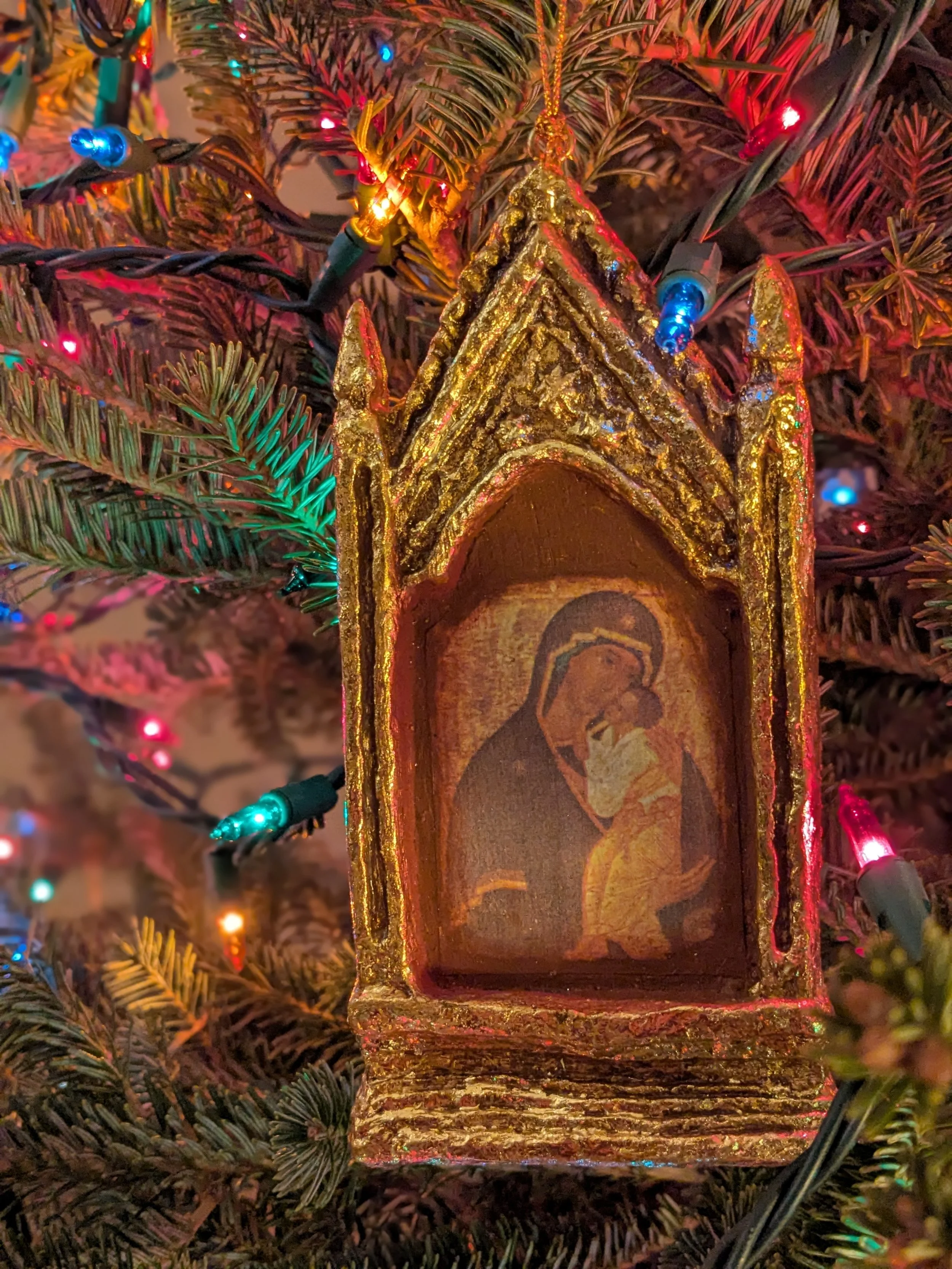
An eleousa icon

We are now squarely in the last few days before Christmas. The “O antiphons” have begun, and with those ancient words attached to the Magnificat in the seven days preceding Christmas Eve, I always feel a kind of intensified waiting. The King is almost at the door, hand poised close to the wood, ready to knock. And we are invited to let him in.

In these last days leading up to the Feast of the Nativity, it is helpful to pause for a minute to behold the mystery before us. This mystery cuts through tinsel and frantic last-minute shopping. At the risk of sounding trite, this mystery is what this season is all about. This season is all about God coming close to us, closer than we could ever imagine.

For me, this is most powerfully visualized in a pattern of icon from the Eastern Orthodox tradition. In this eleousa icon, Mary cradles the infant Jesus in her arms, and Jesus cranes his neck up towards Mary’s face, pressing his own face tightly against her cheek. His arms hug her. In this image, God is closer to humanity that we could ever imagine. God is scandalously close, and I dare say that in the Catholic and Orthodox traditions (and Anglicanism draws heavily from these), it’s not considered presumptuous to imagine God being so close to us. But in the extreme Reformed traditions, it’s, sadly, almost blasphemous to imagine God being so close, and perhaps even more blasphemous to imagine our ability to share in the divine life because God drew so close to us in the incarnation. But as we prepare for Christmas, I want to focus our minds and hearts on God’s drawing close to humanity in Christ.

This drawing close says everything about who we are in God’s eyes. While we are sinners, still God has not pulled away from us. God comes close, every day. It’s we who often draw back, shameful or perhaps proudly wallowing in our frailty, a kind of perverse logic for holding ourselves back from God’s embrace.

Right now, in the ever-darkening days before Christmas, let’s focus on God drawing close so that we might draw closer to God. I recently explored what this looks like in thinking of the eleousa icon and the life of the Blessed Virgin Mary in a sermon preached at the Church of Saint Mary the Virgin, New York City for the Feast of the Conception of the Blessed Virgin Mary. If you’re interested, you can listen to that sermon here. As I said in that sermon, God’s call in the garden to Adam and Eve was “where are you?” when they attempted to hide from him. God still calls us to us, “where are you?” The question we might ask this Christmas is, “why do we try to hide from the One who is closer to us than we are to ourselves? “

At Christmas, we might be tempted to hide: hide from our unwieldy lives by binge shopping, hide from others by withdrawing into ourselves, hide from God because we are angry at God, hide from joy because we are feeling sorry for ourselves. It’s true that for many this season is a difficult one. That should not be denied. But the good news of this season is that, although we may try to hide from God, God still reaches out to us, drawing us close.

In the coming days, I encourage you to spend some time in quiet prayer with God. Perhaps the eleousa icon will be helpful. Imagine Jesus cradling his face against yours. If you feel ashamed or harmed by the Church in the past, stay with this beautiful image. If you are worn out by this overfunctioning season, rest in the arms of the God who always holds us close. At least for a few days, try not to run away from God.

If you are in town this Christmas, I do hope you will make time to celebrate this great feast of God drawing close to us by attending Mass on Christmas Eve at 6 p.m. and/or on Christmas Day at 10:30 a.m. Both Masses will feature choral music, and the readings and music for these Masses are different. If you can, attend both! I am grateful for all who are working so hard to make our liturgies happen once again this year: our staff, acolytes, choir, liturgical participants, and those who decorate the church for the feast. Thank you. This year, however you may be feeling and in whatever situation you may be, I pray that you may know the unending, unimaginable love of God who always reaches out to us and will hold us close forever. And may God bless you and yours during this Christmastide.

Yours in Christ,
Father Kyle

December 12, 2025

Mission and outreach are always fraught endeavors. While they are hopefully rooted in altruism and good intentions, the history of the Church’s mission endeavors is a checkered one. Perhaps the most significant danger lies in avoiding any personal contact or relationships with those to whom one ministers. Ministry, after all, is really a two-way street. As we minister to others, we must be prepared to be ministered to by them.

But decades of well-intentioned youth mission trips and parish service projects have disturbed healthy balances in mission. Privileged youth from wealthy suburbs spend one week in a third world country and mistakenly think they have changed the world, while at the same time neglecting the real poverty in their own neighborhoods back home. This does not, of course, deny real good that is done by going to other countries. But it takes a lot of work to maintain a healthy perspective in such efforts. In many cases, the privileged who undertake ministry are taking the initiative, maybe without even asking what is needed of those to whom they minister. Spiritual pride runs rampant unless the more privileged do their own prayerful work in discerning how they are also poor.

Thanks to our growing and strengthening Social Concerns Committee at Good Shepherd, we are expanding our own parish’s efforts in outreach. Our first major initiative was the Rosemont Community Retreat House, and there are still many ways in which this ministry needs to be stabilized and set up for sustainable ministry. Many possibilities for outreach through the retreat house remain unexplored, which can add to our existing partnership with Hosts for Hospitals. Our Social Concerns Committee has also been quietly providing assistance for immigrants and refugees, collecting items for the Ardmore Food Pantry, and considering ways in which we can partner with Family Promise of the Main Line. Speaking of the Ardmore Food Pantry, please note the envelopes at the back of the church. In each envelope, you may 1) place a previously-purchased $25 gift card to Acme, Trader Joe’s, or Giant; 2) $25 in cash towards the purchase of gift card(s) to any of those stores; 3) cash towards purchase of gift card(s); and 4) a check made payable to Good Shepherd (memo line: Ardmore Food Pantry) for the purchase of gift card(s). All donations must be received by this Sunday, December 14.

And as we enter the bitterly cold winter months, two of our youth, who were recently confirmed, are leading an effort (in partnership with the Social Concerns Committee) to collect items for the Clare Project, a ministry to those living on the streets of Kensington in Philadelphia who are suffering from the opioid epidemic. Through January 6, we are collecting the following items:

white tube socks;
beef jerky (Slim Jims); and
hot hands (chemical warmers, two each).

You can either bring any of these items to church and place them in the baskets in the Tower entrance and retreat house, or you can purchase them online through our Amazon wishlist, and they will be shipped directly to the church. Items will be blessed at Sung Mass on the Feast of the Epiphany, assembled, and then given to the Clare Project for distribution to those living on the streets of Kensington.

In this time of the year, as our 2026 pledge campaign continues, we must remember that when we give money to the parish, we are giving not only to support the parish’s operations but also to enable the parish’s ministries. While your generous gifts do ensure that we can heat the church, keep the lights on, and pay our staff, by doing all those things, we are able to move outwards from the walls of the church to bless our neighbors in the name of Christ and, maybe most importantly, to receive their blessing on us. Our several ongoing outreach ministries are visible reminders that giving to the Church and giving to outreach are not competing endeavors; they work together! It’s both/and, just as we are called to give generously of our time and our money to support the ministry that God has called us to do.

During this time, while we continue to receive pledges to support ministry in 2026 and while we work to collect donations to minister to the poor and needy among us, we are reminded of the balance required of us in the Christian life. We gather to worship our Lord, and then we are sent from that worship, energized to greet those whom we meet in the name of Christ and ready to be touched by their lives. Thank you for your generosity during this time of year! This Sunday, please plan to attend another Parish Conversation immediately after Sung Mass. A robust coffee hour should help placate your hungry stomachs so that you can stay on to attend Advent Lessons and Carols at 3 p.m. While you are in the church and retreat house this Sunday, please offer your own tangible support of the Ardmore Food Pantry and Clare Project. I will look forward to celebrating Gaudete Sunday with you, as we rejoice in God’s many blessings.

Yours in Christ,
Father Kyle

December 5, 2025

When Bishop Gutiérrez met with our vestry on November 23, during his visitation to the parish, he told the vestry that God has already chosen Good Shepherd’s next rector. He was fielding questions about the upcoming transition process after my departure (as of yet, still undetermined), and his point was that God is already ahead of us, so to speak. God is, of course, beyond time, so I interpret our bishop’s helpful comment to mean that the parish’s task is to catch up to where God is. Or put another way: we are intended to discern God’s call to us.

During our Parish Visioning Conversation last February, one of our parishioners said something that has been frequently quoted in recent months. With regard to living into our future vision as a parish, he said that we shouldn’t “mess it up.” (I am paraphrasing his words.) I have recently been thinking about how we can turn this around in a proactive spirit. As we move into ministry in 2026 as priest and parish working together, how do we “get it right”?

Getting it right means being proactive. It does not mean telling God what we want to do or thinking that we can realize a vision on our own. I see “getting it right” as doing our part to respond to God’s call. This requires prayerful listening to God, followed by active response. Remember how busy Jesus was in his own ministry and how he retired frequently and regularly to be alone in prayer. Although Advent is a season of intentional waiting, the persistent Gospel messages at Mass are about waiting with expectant urgency. We must be prepared for our Lord when he comes. Our proactivity will enable us to “get it right,” so that we catch up to what God is already doing among us. God acts first in the sense that God enables us to do what we are asked to do, but we must do something! Advent (and indeed the Christian life) is all about balancing waiting and listening with a sense of urgency towards action.

At last Sunday’s parish conversation, another parishioner made a helpful point, and it is a point that I think we all need to hear and take seriously. As we prepare for transitions and new leadership, the months ahead are the golden moment to “get it right.” And getting it right means that every single person in the parish is being called to serve in some capacity. Living more fully and deeply into God’s vision for us cannot be done by the priest or staff or a handful of leaders alone. We all must share that joyful burden. If you are not participating in some ministry, please know that God has given you gifts that Good Shepherd needs. If you are already doing something and have room to spare more time, I invite you to consider that prayerfully. Meanwhile, I am working with the vestry to build towards more sustainable, shared ministry.

Getting it right has two parts in the coming year. The first is financial. As was announced at last Sunday’s parish conversation, the decision has been made to lower our pledge goal to $265,000, which is still $30,000 away from where we currently are. I believe this goal is achievable. Stay tuned for more information on the extension of our pledge campaign, culminating in the presentation of a 2026 budget at the January 18th annual meeting, with the vestry officially approving it on January 22. Reaching this $265,000 goal is essential to supporting staffing and ministry needs that will enable us to “get it right” so that ministry continues to flourish at Good Shepherd. So, thinking proactively, if you have not yet made a pledge towards ministry in 2026, please consider doing so as soon as possible so that our vestry and finance committee can plan well for 2026 budgeting. You can pledge right now online. Thank you, in advance for your generosity, and thank you to all who have given generously so far!

The second part of getting it right involves sharing our gifts in ministry. If you are unclear about what ministries exist at Good Shepherd, I direct your attention to this document. I can also highlight certain ministries in which we have an acute need at the present moment:

  • laundering altar linens—This may be done at home and is perfect for someone who lives a distance from the church! This can also be done at your convenience, too.

  • assisting with Mass and service livestreams—In 2026, we will be relying solely on volunteer efforts for this ministry. And we need more helping hands!

  • sacristans guild—Members set up vessels and vestments and prepare the church for Sunday Masses. Training is provided, and members serve in teams.

  • pastoral care and hospitality—It would be helpful to have a committed group of parishioners to organize and provide meals (and rides) for parishioners who are recovering from surgery or illness.

As we approach 2026, you will be hearing more about other ways to serve. While Good Shepherd is growing, our rich liturgical life and numerous ministries require more help than might be imagined. Would you join me in praying during this intentional season as we seek to catch up to what God is already doing among us? How will you give of your money and time so that, in response to God’s call, we at Good Shepherd can “get it right”?

Yours in Christ,
Father Kyle

November 28, 2025

I have never liked waiting, especially when it involves waiting for certain knowledge about the future. Presently, I am doing a lot of waiting. I am waiting on clarity about where God is calling me to serve after I leave Good Shepherd. With the announcement last month about Robert McCormick’s late January departure from Good Shepherd, and my ensuing departure, the parish has entered a time of waiting. We are waiting through the discernment towards a new Organist and Director of Music. You are patiently waiting with me as we determine the timeframe for my departure. I am grateful for your patience. Waiting is never easy.

But I have been pressing myself to settle more into this period of waiting. There is a real gift in waiting, for it requires that we relinquish control and listen for God’s will to be done, not ours. Waiting is a gift to live in the present moment, a supremely difficult task for our impetuous culture. So much information is at our fingertips, but our future always remains elusive and beyond our control.

Advent, of course, is a season for waiting. Though we are waiting for Christmas, we do know exactly when it will arrive. But we are also waiting for our Lord to come again in power and great glory and to establish God’s kingdom for all time. We are waiting for the final consummation of all things, where Christ will be all in all. And as Sunday’s Gospel reading will tell us, we do not know when this will be. We are not meant to know, which seems to be the point. But we know that it will happen, and it will be glorious.

The Christian journey is always about waiting. We never fully arrive where we hope to be in this life, and so we must be patient with our daily struggles. We take two steps forward and then one step back. Nothing is a straight line. There are no easy answers. Following Christ is murky, messy, and circuitous. But the fullness of life that he offers us is abundantly clear. Being open enough to receive that life is another matter.

I suspect that this Advent at Good Shepherd will have a particularly acute meaning for us. As we wait for our Lord to come at Christmas, into our daily lives, and at the completion of all things, we wait on God to show us where to go next. We wait on God to send this parish new leaders, new challenges, new opportunities, and new faithful people who will be a part of the vision God has in store for this parish. We don’t know what the end will look like, but we do know that, because God is good and gracious, it will be wonderful.

On Sunday, November, 30, the First Sunday of Advent, I encourage you to attend our next Parish Conversation, which will have everything to do with waiting. How can we be faithful, patient, and open to the Holy Spirit’s murmuring voice in this season of waiting? If you are traveling for Thanksgiving, I invite you to consider coming back to town a bit early to be present for Sunday’s Parish Conversation. Your presence and your voice matter as we wait on God to give us direction and clarity. May this season of Advent be a holy time of expectation and hope. What we know is that God is faithful to us, and God is good. What we are waiting for is how we will be called to respond to God’s generosity and love.

Yours in Christ,
Father Kyle

November 21, 2025

The mission of the Church, according to our prayer book catechism, is “to restore all people to unity with God and each other in Christ” (p. 855). Technically speaking, the Church herself does not really have a mission. Mission is always God’s mission, in which the Church is invited to participate. Our particular calling as the body of Christ, “to restore all people to unity with God and each other in Christ,” is a lofty one.

We might get hung up on “all people” and “unity.” Our calling is universal: the Gospel must reach to the ends of the earth. And we are surely all too aware of the lack of unity in our own society, where divisions and rancor are rampant, and this disunity pervades even the Church. In short, the Church’s calling is not only lofty, it is deeply challenging.

Of course, we need the grace of God to accomplish what we are being called to do. But perhaps it also helps to look for visible signs. We seek out and treasure those signs of our partially realized or aspirational unity. And one such sign for the Church is the episcopacy. As the name suggests, the Episcopal Church is a church “of the bishops.” Episcopal comes from the Greek word episkopos, meaning overseer. From the earliest days of the Church’s existence, there were apostles, “walking sacraments” (to use the image given by the late Anglican theologian Austin Farrer) who journeyed to the ends of the earth to spread the Gospel and witnessed to the sacrificial calling of that same Gospel. The word “martyr” comes from the Greek word for "witness.”

St. Ignatius of Antioch said this: “Wherever the bishop shall appear, there let the multitude [of the people] also be; even as, wherever Jesus Christ is, there is the Catholic Church” (https://www.newadvent.org/fathers/0109.htm). Around the bishop, the Church gathers, as a visible sign of the Church’s call to perfect unity. Bishops are guardians of the faith, loving stewards of the mysteries of God and of holy doctrine, ensuring that this treasure of the Church is handed down from age to age. Bishops are pastors, hence the bishop’s staff or crozier, which is shaped like a shepherd’s crook. The bishop is him or herself a shepherd.

In the earliest days of the Church, there were simply bishops and deacons. Only the bishop celebrated the Eucharist, and deacons served. But as the Church expanded, bishops could no longer be the sole celebrants of the Eucharist, and so presbyters or priests were ordained to celebrate the Eucharist on behalf of the bishop. Accordingly, the exercise of my own priestly vocation is always done with the permission of the bishop. I am not a free agent. In order for the Episcopal Church to be truly episcopal, parishes must not be congregational, worlds to themselves. This is why our canon law points everything back to the episcopacy. The episcopacy is not so much an office of power as it is a visible, sacramental sign of the unity to which God calls us.

According to canon law, the bishop of a diocese must visit every parish in his or her diocese at least once every three years. This Sunday, our own bishop, the Rt. Rev. Daniel Gutiérrez, will visit Good Shepherd. This visitation is a reminder that every Mass celebrated at Good Shepherd is an extension of the bishop’s own ministry. A strong and healthy relationship with our bishop is essential, for it is a part of the vocation of the Church to gather around bishops as a sign of our unity. This is a particularly important witness in our own divided age and in a time when, especially within Anglicanism, splinter groups and alternative episcopal oversights are established that weaken the visible unity of the Church gathered around bishops, the successors to the apostles.

In addition to celebrating our call to unity as a Church, I hope that Sunday’s Mass will be an occasion of thanksgiving for how far Good Shepherd has come as a parish. We are growing in faith, hope, and love, and one visible sign of this will be the large number of parishioners coming forward to receive the laying on of hands by the bishop for Confirmation and Reception into the Episcopal Church. Ten people will be confirmed and four received, and two other persons will be joining us from other parishes in the diocese for Confirmation and Reception.

Through Good Shepherd’s difficult times, our bishop has lovingly journeyed with this parish, calling it back into unity with the larger Church. And still, through his gracious support, we receive some modest funding towards my own salary to support outreach through campus ministry. We have much to be grateful for in the support of our bishop and offices of the diocese. This Sunday, I hope you will take a moment to personally offer this thanks to Bishop Gutiérrez. I am personally thankful for his constant support in my time as a priest in this diocese.

I hope you will plan to be present this Sunday as our parish celebrates its visible ties to the wider Church catholic. Come to pray for and support our fellow members of the body of Christ as they are confirmed and received into this communion of the one holy catholic and apostolic Church. Come and celebrate God’s gracious blessings upon this parish as we move forward as a hopeful, visible sign of the power of the Gospel in our own day.

Yours in Christ,
Father Kyle

November 14, 2025

The stock definition of a sacrament, offered by our prayer book, is “an outward and visible sign of an inward and spiritual grace.” God’s grace is, of course, not limited to the sacraments, but in the sacraments we receive assurance of God’s grace in a particular way. The sacraments are God’s gifts to us, tangible reminders of his unending love for us and gracious provision in our lives. In any good relationship, such gestures of comfort and assurance are important. It should not be surprising, then, that God has chosen to give us hope in the visible, material world through the Church’s sacramental life.

This Sunday is Commitment Sunday. Accordingly, in today’s message, I want to focus on the meaning of commitment, for I believe that Commitment Sunday is about far more than our financial commitment. Commitment Sunday is about the commitment of our entire selves to God and his Church, and particularly, to the Church of the Good Shepherd. In one of our Eucharistic prayers, we come to God’s altar, offering “our selves, our souls and bodies.” In other words, we offer all of us—not a part, but the whole. The offering of our money and time to the Church is a visible expression of this all-encompassing commitment to God. Just as God shows us sure and certain signs of his grace in the sacraments, in the faithful living of our lives, we demonstrate our own commitment to God. We show that we are “all in.”

Of course, God does not need or require our commitment, but the showing forth in our lives of our devotion to God—of our love for God—is a visible sign of the depth of our relationship with God. In a very real way, money is a true test of this devotion in the willingness of each of us to give abundantly from whatever resources we have. The meaning of the Scriptural story of the widow’s mite is not that she gave a ton of money but that in giving a small amount, she, as a poor woman, gave essentially all that she had. Surely, this was the ultimate demonstration of her devotion to God, a devotion that probably seems both nonsensical and frightening to us.

Commitment Sunday is a spiritual practice, because in our willingness to part with something that is integral to our lives (money), we testify in action that we are willing to relinquish something material as a tangible sign that our primary loyalty is to God. The security of God’s provision is greater than our anxiety about not having enough in this earthly life.

As we approach Commitment Sunday, I invite you to consider in prayer the ways in which God has laid a claim on your heart, specifically in parish life at Good Shepherd. It is natural that we should find a specific community in which to live out our relationship with God. Over the course of our pledge campaign, thanks to the efforts of parishioner Allen Crockett, we have had the opportunity to hear voices from Good Shepherd in a series of short videos. Several parishioners have spoken eloquently about how God has touched their own lives through ministry at Good Shepherd.

Peter Riley spoke about how he was first drawn into deeper relationship with God through the beauty of worship at Good Shepherd. And then as he spent more time at Good Shepherd, he found a place of real belonging. This is a central part of Good Shepherd’s mission, as we honor our namesake. We are a place of welcome and belonging for all who are seeking relationship. We are all lost sheep who are found by God, and as such, we are constantly seeking out other lost sheep and welcoming them into God’s loving sheepfold.

Will Hillegeist explained how his gifts of money and time are ways in which he visibly expresses the gladness of being a part of the worshipful community at Good Shepherd. Gladness about God’s generosity to us and gratitude for God’s unending love is something that prompts us to return to God what God has given to us.

Emma Simpson told us that in her search for a place to deepen her relationship with God, she was captivated by this beautiful community, its gorgeous worship and music, the formation she experienced while participating in Pilgrims in Christ, and the warmth of the community. Indeed, in our lives in Christ, we are often drawn by a “hook” into a particular community. Once we find such a community, it is usually something else that compels us to stay as we continue to grow in relationship with God in Christ.

Jack Burnam described his financial contribution to Good Shepherd as an important part of his belonging to Christ’s body, the Church. His pledge is one of the ways in which he lives out his commitment to the local expression of Christ’s presence in the world, as it is concretized in the Church of the Good Shepherd.

Jeannette Burnam talked about returning to God what God has already graciously given to her in the form of a financial contribution and time to the parish, which is a “vehicle” through which God works.

And Melinda Burrows noted her excitement about being part of a parish that puts worship and prayer at its center. This faithful rhythm of prayer is what sustains our common life. It is the impetus for all we do in Christ.

Our commitment to the Church of the Good Shepherd is one way of signaling our loyalty to almighty God, of saying in deed (not just in word!) that God is at the center of our lives. A wise priest once told me that the more our relationship with Christ deepens, the more our clutch on our purse strings loosens. I love this image, for Scripture tells us that love drowns out fear. The more we can let go of fear (for example, of not having enough), the more we can settle into love. Love, as exemplified on the cross, is principally about letting go of all our claims for control. On the cross, love itself is shown in Jesus’s offering of his life, even for those who hated him.

Your commitment to the Church of the Good Shepherd is not just a commitment to a local parish. It is a commitment to God’s work in the world. First and foremost, your contributions of time and money allow us to put worship and prayer at the heart of our existence. Only by doing so can we properly discern what God is calling us to do in ministry. Your commitments of time and labor ensure that we maintain a beauty of worship that is a “hook” for many people, drawing them into the Church’s life—perhaps to their surprise—so that they can be formed and then sent out into a hurting world with the Gospel’s healing power. Your contributions of money and time ensure that our 15,000 square feet of property are utilized as fully as possible for Gospel ministry, which includes the healing work of our retreat house, social outreach to the hungry through our gifts to the Ardmore Food Pantry, and ongoing work for the support of immigrants and refugees. In a moment when relief efforts for the vulnerable are being drastically cut, your support helps us live into our Christian commitment (the promises we made in Baptism) to “seek and serve Christ in all persons” and to “strive for justice and peace among all people, and respect the dignity of every human being.” Your financial contributions enable our campus ministry to go into the mission field bearing the Gospel, especially to communities of young people who may wonder if the Church is a safe place for them. Your commitments to Good Shepherd are supporting a chorister program for young children, giving them the gift of music in a demystified age and also exposing them to Christ’s good news. Your pledges are keeping the doors of our church open seven days a week, providing a holy space in which our neighbors can come to pray, a visible witness to the infinite inclusivity of the Gospel message. In short, your commitments of money and time are ensuring that ministry at Good Shepherd is changing lives.

Ostensibly, Commitment Sunday is the day on which we are invited to offer a financial commitment (pledge) to ministry at Good Shepherd in 2026. There is certainly a practical dimension to this: a primary means of supporting ministry in this parish is through financial contributions. If you are new to the Episcopal tradition, you may wish to know that we are essentially a financially self-sustaining parish, with a modest amount of monetary support from the diocese, which we are weaning ourselves off of in the near future. Whatever we do not receive in pledged income must come from rental income (which is limited and fixed) and from our endowment (around $460,000, small by the standards of many churches). Obviously, it is not financially sustainable to continue to draw heavily from our endowment, which could be needed in the future for capital projects and other major needs. The endowment principal can also fluctuate dramatically depending on the market. But on a spiritual level, relying so much on an endowment does not encourage us to strengthen our own commitment to the life of the parish.

In the next two days, I invite you to spend some time in prayer, considering the ways in which God has laid a claim on your heart through this parish church. Give thanks for God’s generosity towards you. And prayerfully ask God to challenge you (as two of our parishioners said they did a few weeks ago) as you consider what God is asking you to contribute of your financial resources and time to ensure that the Gospel message remains alive in a fearful, skeptical age.

This year’s Commitment Sunday is perhaps even more notable than those in years past, for we are on the verge of major leadership transitions. Your tangible demonstrations of commitment to this parish are a vital part of how ministry will be sustained as the parish transitions to new leadership. Your commitments in action to ministry here are utterly essential in supporting the new creation that God continues to build (through our efforts) from the challenges of decades past.

If you will be out of town this weekend, please make your pledge commitment online before Sunday, as this will help with our planning. If you are in town, please come to Mass and bring your completed pledge card and place it in the offering plate as a celebration of what God has done for you. Commitment Sunday is a day of celebration! Extra cards will be available at the Tower doors when you arrive. Thank you in advance for your support of this parish. Above all, let us thank almighty God for what he has done for us in recent years. And remember, when we give to God first, remarkable things happen!

Yours in Christ,
Father Kyle

November 7, 2025

As I have continued to ponder our shared parish life in light of upcoming leadership transitions, as well as in light of our ongoing pledge campaign, I keep returning to the story of the Israelites and God’s provision of manna in their wilderness wanderings. If you recall, these wanderings occur just on the other side of the Red Sea. The Israelites are newly freed and are at risk of taking this freedom for granted. And so, God provides manna for his grumbling children both as a way to satisfy their hunger but also as a way to teach them to rely on God alone.

If you have a moment, take out a Bible and read Exodus 16. (It is a short chapter!) Notice that, first and foremost, the manna is God’s gift, and as such, it cannot be controlled by the Israelites. Notice, too, that the manna appears in quantities and at times that are on God’s terms, not on human terms. Also, the manna appears in quantities that are just enough for those gathering it, for “those who gathered much had nothing over, and those who gathered little had no shortage; they gathered as much as each of them needed” (v. 18). None of it is to be wasted. It cannot be hoarded either. The Israelites must gather and eat it on God’s terms, not on their own. And in the midst of gathering manna, the Israelites are still required to rest on the Sabbath day.

Old Testament scholar and Anglican priest R.W.L. Moberly says that the manna “can be seen to function as a symbolic concretization of divine grace. It testingly challenges Israel to learn to live from an unfamiliar resource; it nourishes the Israelites irrespective of their varying abilities; it resists being accommodated to conventional human desires; it is designed to enable Israel to develop a particular rhythm of life, encompassing both the working week and rest on the Sabbath. In all these ways the manna inducts Israel into the divine pattern for life” (Old Testament Theology: Reading the Hebrew Bible as Christian Scripture, Grand Rapids, MI: Baker Academic, 2013, 84).

We are no longer taught by God with literal manna, but each week in the Mass we are fed with bread from heaven. And the Church has given us spiritual practices that help to “induct us into the divine pattern for life,” to borrow Moberly’s insightful words. The story of the Israelites and the manna should have great resonance in our own day because, if we are honest, we will see that we can be like God’s people of old, grumbling in ingratitude, trying to do things our way, failing to trust that God will provide, and seeking to control the gifts that God freely bestows upon us. For this very reason, we, too, like our ancestors of ancient days, need spiritual practices to invite us into “the divine pattern for life.”

Such practices guard us against what a parishioner recently called “magical thinking.” Magical thinking discourages healthy parish ministry. An example of magical thinking is noticing problems and saying something about them rather than proactively attempting to rectify them. The more positive version of this is articulating an idea or vision for something without being an active part of its realization. Magical thinking assumes that others will take care of ministry needs that need to be done. “Someone else will do it” is the unstated assumption of magical thinking. Some unidentified group of persons will cover the rest of the shortfall needed to meet the pledge goal. I’m sure that we’re all familiar with the temptation towards magical thinking.

But the problem with magical thinking is that it avoids the particulars of real life in Christ. Remember that R.W.L. Moberly described the manna as the “concretization of divine grace.” God does not just talk about doing things; God does them. And when Jesus talks about the rigors of following him, he asks us to do the same. “You give them something to eat,” he told the disciples who were anxious about feeding 5,000 people and who assumed that Jesus would magically take care of it for them. Of course, Jesus does feed them through a miracle, but he also draws in his disciples to take some responsibility, too. We are an incarnational people, which means that for the Gospel to be proclaimed and for ministry to happen, we can’t live only in our heads. We must embody our ideas in reality. When we have a vision for something in the parish or see a need that must be met, perhaps it’s God’s invitation to you and me to do something about it.

In relying on God’s manna, the Israelites are forced to rely on God alone and also rely on one another. The entire group of people in the wilderness must learn to live in intentional community so that all may be shaped by “the divine pattern for life.” And so it is with us in parish life. When we refrain from using our own God-given gifts for Gospel work, then we burden others with too much responsibility. Our life in Christ is a shared endeavor. We must all learn to assume our piece of the burden so that ministry can flourish and thrive.

The spiritual practice of sacrificial giving is another way of being shaped into “the divine pattern for life.” It is also a tactile way of sharing the very specific financial cost of sustaining ministry at Good Shepherd. It is a gift that invites us into a stronger sense of community and our need to support one another. Just as the Israelites had to reckon with manna as a gift that they could not control, so we must reckon with “our” money as something that we should not control but, instead, treat as a gift from God. Maybe we question the value in talking about a tithe on net income as a spiritual practice. It is true that we could over-literalize 10% of one’s net income as the only way to give sacrificially. On the other hand, a tithe is simply what it is: a Biblical injunction to give back to God what God has already given to us and what is ultimately not ours. Tithing assumes that all members of a spiritual community are doing their part of the large task of enabling Gospel work to happen. If everyone is tithing, everyone is sharing in the work of the community. I have no doubt that the appearance of the manna at specific times and the detailed instructions on when to gather it seemed arbitrary to the Israelites. Perhaps a tithe seems so to us. But the point is to live by God’s expectations, not by our own desires. God’s ways will always seem arbitrary if we live only according to our own will. Money holds great power for us for two principal reasons. The world tells us that there isn’t enough, and so we are scared of not having enough money. And second, it is one of the few things that we think we can control in our lives.

But if we live towards “the divine pattern for life,” we will live towards a trust in God’s gracious provision. We must assume, in this divine pattern, that God has given us just what we need and that maybe if we do tithe or work towards a tithe on net income, the walls of our reality might not necessarily crumble. I am not naive as to the great demands that sacrificial giving will make on our lives. I am also deeply aware of the fragility of the current economy and the fact that bills must be paid and mouths fed. But just because sacrificial giving to the Church seem onerous does not mean that it is not an important part of living into a “divine pattern.” It is likely that the call to tithe seems too weighty simply because our culture, even within the Church, has largely forgotten the rigor of living within the “divine pattern for life.”

My invitation is for all of us to do our part in learning to accept a move towards tithing on net income as part of a “divine pattern.” This may not be the year that you can reach a full tithe. Maybe it will take a few years, but now is a great time to start. (As you prayerfully consider what God is calling you to pledge towards ministry in 2026, I encourage you to consult this tithing spreadsheet, put together by our Advancement Committee. It can help you in moving towards a tithe on net income.) As this parish enters a period of transition, my other invitation is for us to refrain from magical thinking. The task of living into a “divine pattern” is the task of each of us. And the task of supporting the ministry to which God has called us, both financially and through our labor, is the task of each of us. Avoiding magical thinking is one way to ensure that we “don’t mess it up,” to paraphrase the words of one parishioner that emerged from our Visioning Conversation last February. In the body of Christ, there are no “other people” who will carry the weight of making things happen. That is magical thinking! The weight of proclaiming a Gospel to a hurting world is the responsibility and duty of every Christian. I invite you to an all-ages formation session this Sunday from 9:30 to 10:15 a.m. in the Parish House formation room. We will be discussing a rule of life. A rule of life is one way in which we can prayerfully cultivate habits and disciplines that shape us into “the divine pattern for life.” As we enter a period of transition in this parish, it can be a helpful exercise for all of us to develop our own rule of life, which will ensure that we are sharing the labor of ministry and sacrificial giving to which we are called.

For our ancestors in the faith, the story of the wilderness wandering and God’s gracious provision and teaching of his people would sustain them through great challenges in the future, including an exile in Babylon. It will be so with us as we face uncertainties and troubles in the rest of our lives. Now is the time to learn to live into the “divine pattern for life,” which will give us strength and courage to live hopefully and abundantly in a world that is fearful and anxious. To begin to live into this new, hopeful life in Christ, we must start with spiritual practices. It requires a radical prioritization of our lives so that we live not by bread but by God alone. And this means nothing less than putting God at the very center of all that we do. And that is no magical thinking.

Yours in Christ,
Father Kyle

October 31, 2025

Over the past few weeks, as I have walked my dog, Beau, throughout the neighborhood, I have been fascinated with the prevalence of Halloween decorations on houses. Many of these decorations are extensive—not just a pumpkin or two, but life-sized ghouls flapping in the wind and fake displays of gravestones with skeletons emerging from the ground. I have not only found some of these displays to be curious; some are downright humorous. While there is a Christian precedent for mocking death (one can see glimpses in the Día de los Muertos tradition in Mexico), I do wonder how many of my Rosemont neighbors even know what Halloween is.

It is, of course, the Eve of All Saints’ Day (All Hallows’ Eve, hence “Hallowe’en”). Amid all the fascination with dressing up in costumes and displaying graveyards in front yards, we live in a death denying culture. Death long ago moved out of the home. People don’t die at home as much as in the past. Funerals are outsourced to the funeral home industry. Bodies are less frequently present for funerals in churches. We are, quite simply, scared of death. If the great secular feast of Halloween were a religious mocking of death, a sound theological statement might be made. But I fear that Halloween is just another occasion with religious origins that has been co-opted by a death denying society.

But of course, within the Church, we are meant to talk about death. Every day of our lives is one day closer to our deaths. We don’t need to meditate on that morbidly but, instead, with honesty and hope in life that perdures beyond death. And talking about death is all the more important in a culture that doesn’t know how to talk maturely and wholesomely about bodies. We either idolize a particular version of bodies and then scorn those that don’t fit the coveted mold, or we are ashamed of our bodies. We treat other people’s bodies with disrespect, and we fail to honor the dignity of other human beings. And this means that we don’t know what to do with dead bodies, because we imagine an immortal soul continuing to live while the body just hangs around like an empty shell. We forget, too easily, that one day, God will raise body and soul together. If the Word became flesh and dwelt among us, then our bodies, surely, are deeply important.

It’s a bold statement we make this time of year when we celebrate first All Saints’ Day and then All Souls’ Day. Low Mass will be celebrated at Good Shepherd on Saturday, November 1, at 9:30 a.m. for All Saints’ Day, but we will keep the feast within its octave (as the prayer book allows) on Sunday, when, appropriately, Sloane Mills will be welcomed into the Body of Christ through the Sacrament of Baptism. On All Saints’ Day, we remember the communion of saints, all those, living and dead, who are bound together as part of the Church. We especially give thanks for those saints whose lives bore vivid witness to a love for Jesus Christ, who testified to the Gospel in their lives, some of whom are known by name and appear on our Church’s liturgical calendar, others of whom we will never know by name. Tradition has spoken of the Church Triumphant (those who have made it into the nearer presence of God), the Church Expectant (those who are still in their pilgrimage towards that nearer presence after death), and the Church Militant (those of us still on our earthly pilgrimage). The communion of saints witnesses to the inability of death to fracture the Church. In each Mass and in our regular prayers, we are “knit together. . . in one communion and fellowship,” as the collect for All Saints’ Day tells us. Death has lost its sting.

And then on All Souls’ Day, we pray for those who have died and are beloved of us, and we ask for God’s mercy as they continue to grow more into the likeness of God in their continuing pilgrimage in Christ, even though we can’t see them any longer. the living and the dead. For me, the All Souls’ Day Requiem Mass is one of the most moving liturgies of the year. As I read the parochial necrology, I read the names of people I have never met, former rectors of this parish, your own loved ones, and the names of my own family members. In its old-fashioned form, the Requiem Mass focuses primarily on the souls of the departed and on the hope, in Christ, that their bodies will one day be raised in glory, too. We believe that those loved ones can and do pray for us as well in our earthly pilgrimage.

In a time when even our liturgies can tend towards self-obsession, the All Souls’ Day Requiem moves us away from ourselves and towards those we love but see no longer and, ultimately, towards the unending mercy of God. We hear a glorious setting of the Requiem Mass not as a concert but within the liturgical context for which it was originally written. For the congregation, the Requiem Mass may seem like a more passive affair than usual, but this is so only if we literalize a need to vocalize words. The Requiem Mass actually allows space for us to offer actively the deepest prayers and gestures from within our hearts, as we mourn the loss of our loved ones and hand them completely over to the care of almighty God.

I’m touched, when reading the necrology each year, that on paper and in our prayers, lay people, priests, and bishops all exist on one plane in Christ. Death is the great humbling experience of life, when the mighty are brought low and the lowly lifted high. In death, “there is no longer Jew or Greek; there is no longer slave or free; there is no longer male and female, for all . . . are one in Christ Jesus” (Galatians 3:28). In the All Souls’ Day Requiem, both the living and dead are united intimately in the Eucharistic feast. At this time of year, as we approach All Saints’ and All Souls’ Days, the veil between this world and the next seems more porous, thinner than usual. And in a world terrified of death, this is a beautiful thing.

However busy your lives may be, I heartily encourage you to be present on Sunday for the Lord’s Day and the celebration of All Saints’. Come to pray and offer your support for Sloane, who will be “sealed by the Holy Spirit in Baptism and marked as Christ’s own forever.” And then join us again on Monday at 7 p.m. to acknowledge the reality of death in a death-denying culture and to give thanks that death has lost its sting. God’s mercy is far greater than death will ever be. Thanks be to God.

Yours in Christ,
Father Kyle

October 24, 2025

In a recent Sunday formation class, some of our older children and I recently discussed the story of the Israelites’ wilderness wanderings after being delivered from slavery in Egypt. We noted how soon God’s people lapse into complaining after treading through the Red Sea. Their heels are hardly dry when the grumbling against Moses and Aaron starts. “If only we had died by the hand of the LORD in the land of Egypt, when we sat by the pots of meat and ate our fill of bread, for you have brought us out into this wilderness to kill this whole assembly with hunger” (Exodus 16:2-3). Of course, God provides manna for his children. The real issue in the desert is trust, not a lack of God’s gracious provision.

But what is most striking to me is God’s constant injunction to remember. God very well knows that his chosen ones will complain when the going gets tough. And God very well knows that the antidote to grumbling and despair is gratitude, which involves remembering. It’s no coincidence, then, that a few chapters later, God gives the Ten Commandments to Moses on Mount Sinai. These commandments are to be committed to memory, because these commandments will be a necessary moral compass in times of ingratitude. Indeed, the commandment to honor the Sabbath day is to remember the Sabbath day. By remembering a day of rest, the Israelites are renouncing the anxious culture of overproduction and slavery to which they were subject in Egypt. Remember your time of slavery, and then remember the Sabbath so that you can rest in God.

Later, in chapter 23, God gives a striking commandment that enjoins his children to consider the cause of the resident alien among them. It’s not just a command. It’s a command that has special meaning for the Israelites. “You shall not oppress a resident alien; you know the heart of an alien, for you were aliens in the land of Egypt” (Exodus 23:9). In other words, do not become so complacent in your freedom that you forget that you once were slaves. Remember, remember, remember. The key to right relationship with God is gratitude for what God has done, and this requires remembrance.

The wilderness wanderings (forty years!) of the Israelites are a time of testing and trial. They are confronted with thirst, hunger, and threats from enemies. The point of these wanderings is for God’s people to be strengthened in learning to rely solely on God. Back in Exodus 13, “[w]hen Pharaoh let the people go, God did not lead them by way of the land of the Philistines, although that was nearer, for God thought, ‘If the people face war, they may change their minds and return to Egypt.’ So God led the people by the roundabout way of the wilderness bordering the Red Sea” (17-18).

I am moved by how this story of the wilderness wanderings is such an astute appraisal of the human condition. We are so prone to amnesia when things are good. And when things are bad, we may also be prone to forgetting how God has come to our aid in the past in dire circumstances. By remembering, we learn to trust that because God has helped us in the past, we believe that he will continue to do so, even if the conditions of our lives don’t seem to bear witness to that.

It seems to me that the approaching time of transition for Good Shepherd may seem like a wilderness wandering. We don’t know how long it will take, and some, if not many, will probably want to reach the “Promised Land” as soon as possible. But perhaps memory will be the best companion in a time of uncertainty. At Good Shepherd, a remembrance of our parish’s own exodus is necessary, which was God’s deliverance from a time of conflict and into a land of new possibilities and freedom. When the going gets tough, remember. Remember that God brought a parish that was near death into a new life of growth in spiritual maturity, ministry, and people. Remember that when each year a lofty pledge goal was established by parish leadership, people were moved by what God had done for them in their lives and gave generously. Remember that when a new rector in 2020 was told that the parish’s lifespan was five years if nothing changed, God gave five years of life that far exceeded any expectations. There was more than enough to do what God was asking us to do. Remember that even when there seems to be no bread or water, God will provide. When the Israelites gathered the manna that God provided, “those who gathered much had nothing over, and those who gathered little had no shortage; they gathered as much as each of them needed” (16:18). They had enough! And when the wilderness wandering for us seems circuitous and tiresome, there will be an end in sight.

Time in the wilderness will require a renewed sense of identity. The Israelites had to learn who they were and whose they were in the wilderness. To live rightly, they had to remember their past so that they could be hospitable to the aliens among them. So, too, we need to remember how we were once lost sheep and found by God so that we can trust that when we seem lost and wandering, God will deliver us from the valley of the shadow of death and into green pastures again.

Moses never made it to the Promised Land. There will come a time at some point in the future (yet unknown) when leadership will change hands. But the Israelites’ arrival in the Promised Land wasn’t ultimately the work of any leader (such as Moses or Aaron). The arrival was made possible by God. It will be so with Good Shepherd. The good people of this beautiful place will embark on a journey together, strengthened by worship, prayer, fellowship, and core values that point to a shared love of Jesus Christ. In times of challenge or perceived scarcity, the key is to remember. Remember that once we were no people, but now we are God’s people. Remember that once we were lost and now are found. Remember, above all, that in Christ everything old has become new, and one day, all the tears from our eyes will be wiped away by the hand of God.

Yours in Christ,
Father Kyle

October 17, 2025

Chapter four of the Letter to the Ephesians presents us with a helpful “word cloud” describing the Body of Christ functioning as it is intended. Here are some of the characteristics that the author of Ephesians considers integral to a healthy group of Christian disciples: humility, gentleness, patience, bearing with one another in love, unity, peace, maturity, and honesty. As I ponder those words from Ephesians, the image that comes to my mind is the Church of the Good Shepherd. It’s almost as if this parish visibly embodies the Body of Christ as envisioned in Ephesians.

In the past five years that I have known this parish, I have seen great humility, which I think is a direct product of the trials and tribulations this parish has experienced. Parish life in some parts of the Church can easily be skewed towards a form of institutional narcissism that breeds an unhealthy spirit of competition with other parishes or a cliquishness that does not naturally welcome outsiders. But at Good Shepherd, the humbling experience of recent decades has inculcated a spirit of gentleness and loveliness among parishioners that fosters warmth and hospitality.

I have also seen tremendous patience in bearing with one another through sorrows and joys. Patience has certainly been required in the process of letting God rebuild—through human trust and efforts—a parish that came close to death. Patience is shown all the time in parishioners assuming the best in one another and in tolerating the imperfections of our humanity even while we strive to be perfect as our heavenly Father is perfect. 

Here at Good Shepherd, I see unity around the Gospel and sacramental life of the Church, and this unity supersedes all other loyalties that outside the Church could threaten to divide us. This unity is no easy peace with oppression (against which our prayer book cautions us) but a trust in the Gospel of Jesus Christ as manifested in the Church, knowing that we seek, collectively, the peace that passes all understanding. And this is not peace on the world’s terms.

Loving honesty has been shown in speaking hard truths to one another but assuming that when we tell the truth, we have each other’s best interests in mind. Loving honesty means that we can correct one another in faith while refusing to demonize one another. We can express differences of opinion and viewpoints while listening to one another with respect.

And maturity is deeply embedded in the spirit of Good Shepherd. There is great maturity of character, of knowledge, and of emotions. I realize that last week’s news of Robert McCormick’s (and, eventually, my) impending departure has provoked many emotions, sadness among them. But I have been deeply touched by the maturity exhibited even amid anxiety and sadness. I have heard so much gratitude, kindness, and understanding in your interactions with me. And I’m very grateful for that.

Ephesians 4, along with St. Paul’s theology of the Body of Christ, will be crucial to our parish life in the coming months. On a theological level, Paul’s wisdom enjoins us to do the careful work of encouraging one another as we work together in ministry. Working together assumes that we don’t expect others to lend their hand so we don’t have to or that we don’t assume that a certain segment of the parish will pull the bulk of the weight in financial giving. We are all in it together. Working together as the Body of Christ means that any challenge in the parish is a challenge for each of us, and in collaboration and with God’s help, no challenge is insuperable. To move forward as a spiritually mature family of Christian disciples, we must know our spiritual gifts. We must assume that God has already supplied us at Good Shepherd with the necessary gifts (and people!) to carry out the work God is calling us to do. If all of us are aware of our own gifts and are using them in ministry, then we will avoid burnout because the use of our individual gifts is intended to be lifegiving. But on a practical level, Paul’s words encourage us to trust that we will be strong enough to navigate any challenge or period of uncertainty if we do the careful work of discerning our spiritual gifts and then set about using them. 

In short, the upcoming period of transition at Good Shepherd will require all hands on deck. I have repeatedly said that the parish is weaker than it could be if all of us are not sharing our gifts in ministry. Over the past few years, the vestry and I have been working diligently to ensure that we are building sustainable ministry at Good Shepherd. If a ministry endeavor feels like a stretch at any given time, then it could be that the Holy Spirit has not yet sent us the right people to help us carry out that ministry. That is not cause for anxiety. It is, rather, a cause for patience. It does not mean we should give up on a ministry. We simply might need to wait until everything and everyone we need for that ministry are ripe for harvesting.

We seem to be united as a parish in our understanding of which ministries are important to us. This was evidenced in last February’s Parish Visioning Conversation. The 2026 pledge campaign goal was set based on realizing key takeaways from that visioning conversation. If, after prayer and conversation, we are in agreement about what God is calling us to do, then we can trust that God has already given us what we need to carry out the vision we have discerned.

I say all this as a way of encouraging us as we confront the inevitable accusing voices of anxiety and uncertainty that will enter our heads. As I’ve said previously–and I do believe it!--among our parishioners and Friends, we have the financial resources to reach our pledge goal of $290,000. It will, of course, require true sacrificial giving to look deep within ourselves and into our pocketbooks, to put God at the center of our lives, and then give generously back to God. But I’m trusting that the money we need to support God’s vision for us at Good Shepherd is already present among us. I’m also convinced that the spiritual gifts needed for the parish to thrive into the future are already among us, and I fully expect that the Holy Spirit will continue to send new people with new and necessary gifts to enable spiritual and physical growth in this place. By showing up faithfully for prayer and worship, we will be better poised to notice and welcome those people and their concomitant gifts that show up on our doorstep.

In the months ahead, we should be honest about our feelings of anxiety, skepticism, and uncertainty. I’m sure we all have them. But those feelings are not necessarily indicative of the reality of the future, nor are they even rational. We know that our Lord, in his earthly life, continually encouraged his disciples not to be anxious. It’s easier said than done, but St. Paul gives us some spiritual and practical advice. Let us look to the body of Christ. Let us find those in our midst with the gift of exhortation (encouragement), and let their voices be heard. Let us help one another in discovering their spiritual gifts. Above all, let us pray constantly. And then let us get to work, trusting and knowing that the the One who was raised from the dead is always doing a new thing, and he is ready to equip us and support us in the never-ending work of realizing God’s new creation on earth.

Yours in Christ,
Father Kyle

October 10, 2025

I wonder if you’ve ever been asked to identify your favorite words from Scripture. I personally find this a difficult question to answer, because there are so many beautiful words from the Bible. In my opinion, among them are words from Matthew’s Gospel: “When they hand you over, do not worry about how you are to speak or what you are to say, for what you are to say will be given to you at that time, for it is not you who speak, but the Spirit of your Father speaking through you” (10:19-20). Similar words are found in both Mark and Luke. The context is Jesus telling his disciples that there will be coming persecutions. His words are intended to comfort the disciples and to discourage them from being anxious.

In Scripture, Jesus speaks a lot about anxiety, urging his disciples not to worry about the next day and not to be anxious about what they are to eat or drink. While Jesus never says that discipleship will be easy, he does reassure his disciples and us, by extension, that they and we are not alone in the mission field or in the Christian life. The Holy Spirit is guiding us, comforting us, and giving us the right words to speak at the right time. We can trust, too, that the Holy Spirit tells us what to say and do in our moments of trial.

Times of transition always seem to provoke anxiety, which is understandable. In the West, we tend to live in a line, wanting to know what is next. Quite naturally, living in between times is disconcerting. As you have probably read in this week’s special email, we are beginning a time of transition at Good Shepherd as our Organist and Director of Music, Robert McCormick, prepares to leave for another position in Richmond, Virginia, in late January. And this means that as Robert’s spouse, I, too, am discerning a new call so that I can eventually join him in Richmond. I realize that this probably brings some measure of anxiety to you as parishioners and Friends of Good Shepherd. I can honestly say that it gives me some measure of anxiety, too. What will happen next? What will the interim period(s) look like? Rather than feeling as if we shouldn’t be anxious, perhaps it’s best to recognize our anxiety and be honest about it.

But Jesus also comforts us in our anxiety, because in times of uncertainty and difficulty, we are not alone. If you have been at Good Shepherd for a while, I hope you have noticed the palpable presence of the Holy Spirit among us. Of course, the Spirit is always with us, praying within us when we lack the words, but sometimes the Spirit’s presence is more readily felt than at others. In the past five years, I have seen evidence of the Spirit’s movement in striking ways at Good Shepherd. I think that in my time here, I have become more adept at learning how to watch and listen for the Holy Spirit’s stirrings among us.

During tense and uncertain times, it is common for us to hold our breath, but it is also true that the best thing to do when we become anxious is to breathe. The coming months are a time for us to breathe, and for us Christians, to breathe—on a spiritual level—is to pray. For the early desert fathers and mothers who retreated from cities in order to pray, prayer was unceasing, as St. Paul enjoins. Every breath taken is a moment to utter some small prayer to God or lift one’s heart to God in thanksgiving. True prayer is as natural as breathing. And so, in this time of transition, the most important thing we can do is to ground ourselves in prayer.

Because we have prayed so much and so diligently as a parish, we have been able to discern what God is calling us to do. We pray for situations that are known to us, and we also pray daily for people whom God will send to Good Shepherd. Those people are known only to God. Our age of anxiety says that we should engage in flashy projects and gimmicks to attract people to church, but our experience at Good Shepherd shows us that all we need to do is put prayer and worship at the center of our lives, and then we will be ready to respond to those God sends our way.

In the coming months, Good Shepherd will need the gifts and support of all of us. Good Shepherd is in a strong place, with mature leadership and faithful, loving people. This parish is strong and resilient. Our 2026 pledge campaign is a reminder of how much our vision for ministry has deepened and expanded, and the vestry and I are committed to continue realizing that vision. It is a vision that surpasses any one of us but that relies on each of us to support it through prayer, action, and sacrificial giving.

If there’s anything I have learned in the past five years as your priest, it is that God is not finished with this parish. God continues to do a new thing here. Every day feels like the eighth day, a new day of creation in the aftermath of the resurrection. In the coming months, both Robert and I are fully committed to working as hard as we can to make the transition to new staff as smooth as possible. The vestry and I have been working persistently in recent months to build sustainable ministry here, not ministry tied to any one individual. And because God is faithful and good, we have every reason to hope. A new thing is only beginning in this place, and you and those whom God will send here are integral to the future.

For now, let us hunker down in prayer. And when we are anxious or worried, let us remember that we do nothing alone in the Christian life. All is with God’s help. And in those moments of testing and trial, none other than the Holy Spirit will teach us what to say and do.

Yours in Christ,
Father Kyle