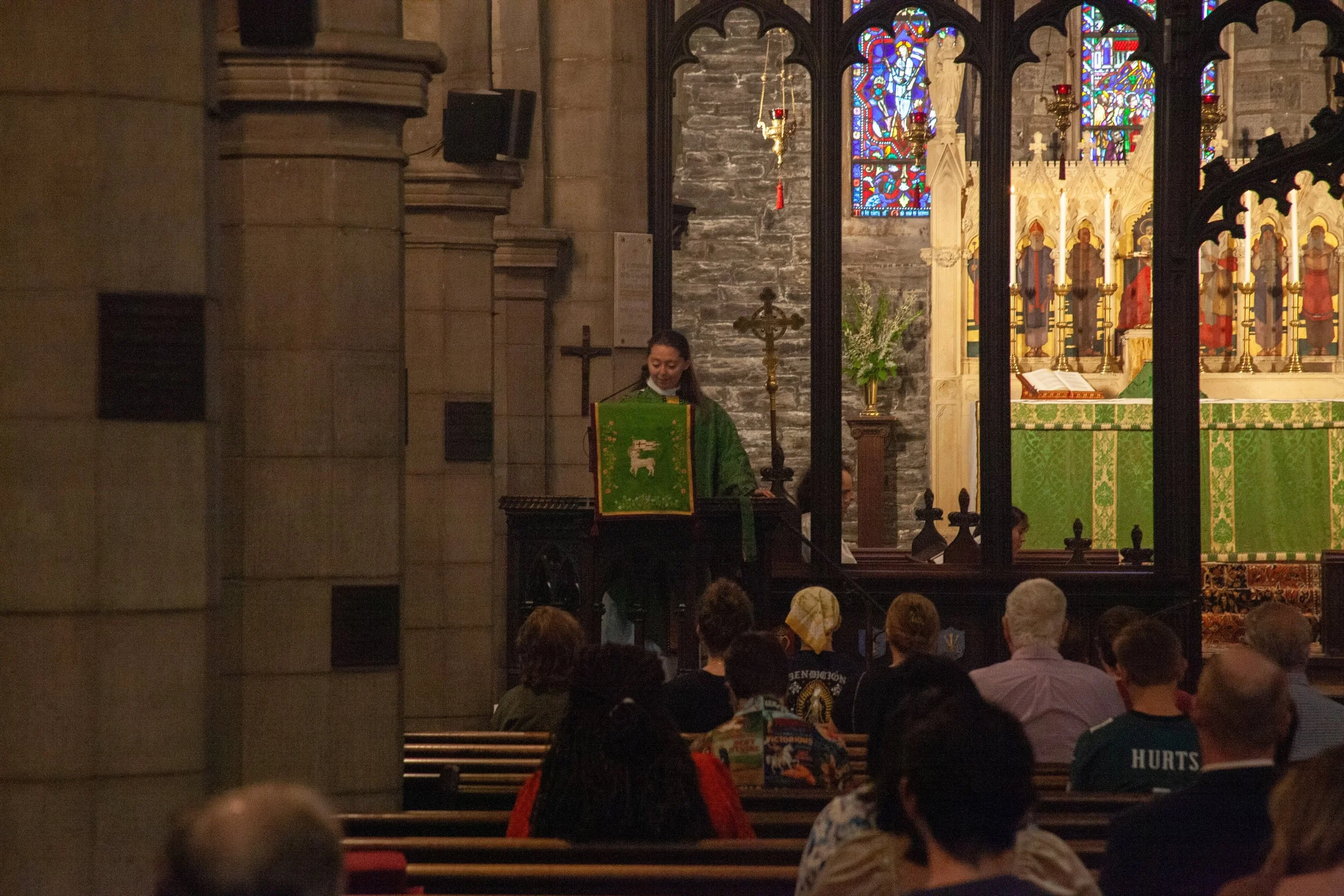
Past the Point of No Return

If you have ever taken a transatlantic voyage by ship, you will know that there comes a point, about two days into the trip, when you tip over into the land of no return. For the first couple of days, the ship is close enough to land so that in the event of a medical emergency, a helicopter can reach the ship to transport an ill passenger to a hospital. But after passing the point of no return, all bets are off. For the passenger on the ship, moving past the point of no return is disconcerting, even frightening. Having stuck with the voyage this long, passengers are now in it for the long haul.

Tonight, we will tip over into the land of no return. Each year during Holy Week, we must come back to these sacred, saving rituals and relive the discomfort and the glory. We begin on Palm Sunday with excruciating moments of betrayal, where we are the crowds acclaiming Jesus as King in one moment and then yelling “crucify him!” in the next. Palm Sunday reminds us that words are cheap. And ever since Palm Sunday, through the first part of this Holy Week, we have been waiting, waiting uncomfortably with the knowledge that there is a palpable dissonance between what we say and how we live.

Our rather superficial culture has two approaches to words. Words are either taken so literally or seriously that one can never be offered forgiveness for an instance of ill-chosen words. Or on the other hand, words are bandied about flippantly with little meaning whatsoever. We profess our undying love for something but do little to put that love into action. We say how much God and the Church mean to us, but we are unwilling to live as if it is so. We say “Amen” to Christ’s presence in the Eucharist, and then we live on the other side of the church doors as if the gift we have received has no bearing on our lives, as if Christ isn’t present in the stranger and in the enemy.

But we are fast approaching the point of no return. We are fast approaching a highly uncomfortable moment in both the Gospel story and in our shared ritual life together. St. John tells us that on the night before Jesus’s passion and death, he gathers with his disciples, having stuck with them through their fickleness and inability to understand who he truly is. Jesus loves them to the end, completely, fully, perfectly. He loves them so even as Judas goes out to betray him. He loves them so even as Peter refuses his gift, knowing that Peter will also betray him. The disciples, to their credit have waited with Christ, up to this point of no return. But more importantly, Jesus has waited with them, not moving on to do his own thing but loving them past the point of no return.

Jesus will stoop to ground level and wash their feet. He, their Master, Teacher, and Lord, will do something that is incomprehensible. But in doing so, he will invite the disciples past the point of no return. Having washed their feet and bidden them to do the same to one another, even to their enemies, there will be no going back for the disciples. This is a dangerous place into which Christ has called them. No longer can they avoid suffering and death. No longer can they flee hastily from their enemies as God’s people did when leaving Egypt in the Exodus. Now, past the point of no return, words are cheap. Words say very little about love. Past the point of no return, the disciples must move from words to action.

And so must we. As our feet are washed this evening, we will all move past the point of no return. This footwashing is far more than an embarrassing moment of exposing our calloused and worn feet. It’s a moment that pulls us firmly into the land of no return. This is the land where words mean little and actions say everything. It’s the land where we can’t profess Christ as our Savior without following him in deed, too. It’s the land where we can’t refuse to forgive our enemies. We must love them, and we must wash their feet, too.

As Jesus invites us to let him wash our feet, he also invites us to step into the place where he has been. As he has loved us and washed our feet, we must do the same. There is no going back. And we know what following Jesus demands, because we know where he will go after he washes the disciples’ feet. And there, we must go as well, to the cross. We must wait with him in his suffering, just as he waits with us in ours. We must love and not demonize those who hate us and persecute us and treat us horribly, because Jesus himself loved those who nailed him to a cross and mocked him. Once we are past the point of no return, we must love like we’ve never loved before.

And yet, despite waiting this long, despite letting Jesus wash our feet and love us, we, like Peter, do not yet understand what he has done for us. We must continue to wait for that. We must wait through this night’s celebration of the Eucharist, when we will no longer be the same people who last celebrated the Eucharist together. Tonight, that celebration is marred by the knowledge of deceit, of our own easy betrayals of Jesus, and of our cheap and careless words. And yet, we are taking one step closer to be like Christ, to become Christ for the world. We are moving past the point of no return.

We can’t yet go where Jesus has gone because it is not yet our hour. One day later in this voyage that moment will come. Past the point of no return, we are not only in a dangerous place, we are in a hopeful place, because our Lord tells us that one day, we will go to the place where he has gone, the place he has eternally prepared for us.

But for now, we must simply wait. We must wait up to and past the point of no return. We must wait with our doubts, despair, suffering, and discomfort knowing that on the other side of the point of no return, words are cheap. And because words are cheap, we have no choice as we move forward. As Jesus has commanded us, now, this night and forward, we must love like we’ve never loved before.

Sermon by Father Kyle Babin
Maundy Thursday
April 2, 2026

A Truth Worth Waiting For

We know much about how early Christians in the Holy Land commemorated the final days of Jesus’s earthly life from the fourth-century pilgrim Egeria. She wrote movingly about her experience there. And from her, we also get a glimpse of the patience and stamina of early Christians, who only recently could practice their religion openly and who had not yet lost the rigor of spiritual discipline.

Egeria tells us that over the course of Holy Week, they fasted and prayed, traveling to various sites that were associated with Jesus’s last days. Children and adults journeyed together, along with the bishop. They walked up and down hills. They waited and listened to readings from Scripture. And by Maundy Thursday, as Egeria recounts, the crowd was exhausted from keeping vigil and weak from fasting each day. They went “very slowly with hymns to Gethsemane,” and when the passage about Jesus’s arrest in the garden was read, there was “such groaning and moaning from all the people, with weeping, that the lamentation of all the people [was] heard about as far away as the city.”[1] The crowd was not yet finished. They would continue to fast and pray and walk until Easter Day.

This must seem like a strange thing to us who live in an age of immediacy, who are unwilling to wait for answers, who are uncomfortable waiting with those who suffer, who would prefer to avoid any talk of death. It must seem strange to those of us who would prefer not to wait through Palm Sunday and certainly not through the rest of Holy Week, who would rather skip ahead to the egg hunt and festivities of Easter Day.

I have recently been reminded of the impatience of our culture as I grieved the death of my mother. Well-meaning people have been quick to assure me that my mom is in a better place. I do believe that is true, but some people have also been unable to wait with me in my grief and suffering. On the other side of her death, some people treated me differently but were at the same time uncomfortable acknowledging my mother’s death. Nevertheless, a week that I will never forget because of its difficulty and many blessings was the week between my mother’s death and her funeral. I waited with my father, sharing in the joys of remembering my mother’s beautiful smile but also mourning her death far too young and sitting with the painful realization of her suffering before her death. My dad and I waited together, knowing that we could not rush to her funeral, and that at the end of the week, we would come face to face with the real loss that death brings.

On this first day of Holy Week, we are forced to wait. We wait through the charade of the Palm procession, knowing that the acclamations will soon morph into jeers. We wait through the long chanting of the Passion Gospel. We end the liturgy knowing that we will need to wait through the pain, silence, and discomfort of this week before Easter arrives.

Perhaps because of my own impatience, I had never noticed a detail in Matthew’s account of Jesus’s passion. After Judas has betrayed Jesus and after Jesus has been condemned, Judas is apparently cut to the heart. He repents and returns the thirty pieces of silver with which he had betrayed his Lord to the chief priests and elders. He acknowledges his sin. Somehow, I hadn’t paid much attention to Judas’s repentance. But even though he repents, something utterly tragic happens. He hangs himself. He gives up. He is too ashamed to wait through Jesus’s passion and death to see how forgiveness emerges from the grave.

Judas like us, is the product of an impatient and unforgiving society. This impatience plays out vividly on the pages of the Passion Gospel. The disciples can’t stay awake with Jesus in the garden because they are too bored to pray. Those who put Jesus on trial are impatient, too, impatient with Jesus’s challenges to the political and religious systems of his day. Peter is impatient with the discomfort of being associated with Jesus and denies him three times. Those who confront Jesus as he is tried want quick and easy answers to their questions. But Jesus remains silent, refusing to stoop to their superficial requests and demanding patience from those who are willing to learn what his kingship really means. Even those cruel words as Jesus hangs on the cross are impatient. If you are the Son of God, come down from the cross. They want Jesus to prove his divinity in that moment. But the perfectly patient one will not do so. He will linger patiently until death, uttering the words of suffering and abandonment from Psalm 22.

The whole trial is a charade, just like our Palm procession is. The people who supposedly want justice, but only want it on their own terms, put Jesus through a sham trial. The release of Barabbas is no real act of mercy but simply a way to ensure that Jesus dies. And surely this impatience resonates with us as we see hasty entries into violence and war, of superficial gestures at justice, at an intolerance with mercy and forgiveness.

Maybe I never noticed that Judas repented because it is an amazingly easy detail to ignore. Do any of us really want to accept that Judas was genuinely sorry for what he had done? Would we prefer quick retribution by knowing that he ended his life, deprived of God’s mercy? But is that really true? What if we sat with the painful tragedy of Judas’s despair and of waiting for a final answer from God?

If we take anything away from this day, it’s the undeniable tension of two stubborn strands in the Passion story: the violence of humanity and the mercy of God. On Palm Sunday, it appears that the violence of humanity wins out, the vengefulness of humanity wins out, the despair of humanity wins out. But patience defies that simple conclusion. Even today, as we enter into a week that demands our patience, we already see hints of that other strand, which can’t be separated from the sinfulness of humanity. Humanity’s stubbornness is matched by God’s merciful stubbornness. At the conclusion of Matthew’s passion, the graves are opened and the dead are raised, a foreshadowing of what is to come. Judas repents without waiting long enough to understand that God will forgive him. But patience proves that the stubbornness of God’s mercy really means something because God doesn’t flippantly forgive from afar but forgives even after enduring the depths of hell.

And it is so with those who keep watch with Jesus on the cross through his agony and who at the bitter end see what God is doing. After Jesus has given up his spirit, the earth shakes and the rocks are split and the tombs are opened and the dead are raised. It’s the patient centurion and those with him who understand just what is taking place, who see a vivid glimpse of God’s love and mercy. Truly this man was the Son of God. This is no mockery or charade. This is the stone-cold truth, a truth that could only come by waiting.

Sermon by Father Kyle Babin
The Sunday of the Passion: Palm Sunday
March 29, 2026

[1] Anne McGowan and Paul F. Bradshaw, The Pilgrimage of Egeria, (Collegeville, MN: Liturgical Press, 2018), p. 174.

Worthy of Exclamation

In one of my favorite episodes of the television show Seinfeld, the character Elaine decides to break up with her boyfriend because he fails to use an exclamation point in a written note to her. One of Elaine’s friends had called while Elaine was out to say that she had her baby, and Elaine’s boyfriend jotted down a note, along with other things he needed to relate to her. With typical, quirky Seinfeld humor, Elaine obsesses with this failure of her boyfriend to see an exclamation point in a piece of good news. Elaine is an editor after all, and in her opinion, someone having a baby is more than worthy of an exclamation point. Now, whether it’s worth ending a relationship is another matter altogether, but that’s for you to decide.

If you think about it, an exclamation point is a curious punctuation mark. We can tell a lot about a person’s character or emotional state by how many exclamation points they use when communicating. An ordinary, dry sentence can be enlivened by just one exclamation point. Someone who uses far too many of them might be seen as hyperactive or overly dramatic. Or maybe they just seem like they care.

Exclamation points are not rampant within the pages of holy Scripture, but they are there. And every single one of them is editorial. They don’t exist in the ancient Biblical languages. You may have noticed that one exclamation point sneaks its way into tonight’s Gospel reading, at least in the translation we heard. The angel Gabriel’s words to Mary are exclamation-point-worthy in the eyes of the translator. That is fair enough. But after reviewing some other translations, I found that not all the translations include an exclamation point after Gabriel’s words. And yet, there is one translation that has a grand total of four exclamation points. Not only is Gabriel’s initial address to Mary considered worthy of heightened emotion. So, too, is his later announcement that Mary’s cousin Elizabeth has conceived a son in her old age. This must be so surprising that it warrants an exclamation point.

Gabriel’s astounding words to Mary encapsulate the astonishing theme of this entire story, and they are worthy of an exclamation point as well. “For nothing will be impossible with God!” How can we not say those words with enthusiasm and excitement of voice? How can those words not deserve an exclamation point, even if one is editorial? How can those words not take our breath away?

The Blessed Virgin Mary’s response to the unexpected visit of Gabriel carries no exclamation point in any translation I encountered. But we could certainly imagine one there, too. “Here am I, the servant of the Lord; let it be with me according to your word!”

It’s understated, but of all the characters in Scripture, Mary undoubtedly understands the power of Gabriel’s words. Nothing is impossible with God! Mary certainly must be shocked, confused, even mildly afraid, but her incredible words and actions from thenceforth reveal that she knows the power of an exclamation point. Her question to Gabriel, “how can this be, since I am a virgin?” is a question of awe. It, too, is worthy of an editorial exclamation point.

How, indeed, can an unmarried virgin conceive a son? Why, indeed, is she, an extremely young peasant girl, chosen to be the Mother of God? How, indeed, can God be so humble as to be born as a human being, nurtured and nourished within a human womb?

Over the years, the Church has struggled to make sense of the exclamation point of the virgin birth. Rightly, the Church has insisted on believing in Mary’s virginity because it truly shows that God can do what is impossible to mere mortals. And that is the point; that is the exclamation point, we might say. But in some ways, the Church has undermined the spectacular response of Mary by making her virginity a purity test or a sign of extraordinary holiness. Mary is holy, but she is holy because of how she responds when visited by the angel Gabriel. Mary responds with humble, self-emptying, stunning words, demonstrating that she knows that Gabriel’s words are worthy of an exclamation point. She knows and trusts that God can do the impossible. Her job is not to understand, but to believe and then to live as if it’s true.

The truth is that God’s people in the centuries preceding Mary’s life frequently lived as if the impossible was not possible. They lived in a world of anxious exclamation points, of cries for help, but with amnesia of all the exclamation points of God’s saving involvement in their lives. True, they may have been delivered from Egypt into freedom, but the exclamation point of this even lost its fervor as soon as hunger and thirst appeared in the wilderness. True, misfortune happened to the people of Israel—assaults from neighboring enemies and exile into a lonely land—but, nevertheless, there was always an exclamation point of God’s care and provision. God consistently stuck with the people of Israel, to provide and nourish and bring them back ultimately into the Promised Land. In the throes of despair and forsakenness, mustn’t this have been an exclamation point?

And with Mary’s unconditional yes to God’s involvement in her own life, the seemingly impossible promise of God never to abandon the ancestors of David and to love them and care for them unconditionally is realized and fulfilled. Mary’s yes is an exclamation point of hope and of firm belief that with God, nothing is impossible. Nothing.

In our own day of social media emojis and superficial words, exclamation points have perhaps become meaningless. Or exclamation points are used only to heighten anxiety. Every news headline is an exclamation point that can make us despair over the state of the world or, at least, make us lose any hope that goodness can prevail.

But in times of spiritual malaise, when the Church needs to be restored in her faith in God’s possibilities, Mary’s yes to God, in her full humanity and full humility, is a resounding gesture of hope. With God, anything is possible. Anything! The God who raised Jesus Christ from the dead will always raise us to new life. This God constantly creates out of nothing and remakes the world to be a surprising exclamation point of goodness and wholeness. This God brings forth fruit out of barrenness and life out of death. And because Mary knew this, we should know it, too. May her witness be an inspiration to us as we navigate apathy and anxiety. May her words become ours, too, with an exclamation point of unwavering belief that we, like Mary, can be the servants of the Lord. Let it be to us according to the word of the one, true living God, for whom there is no end to possibilities. And that is worthy of an exclamation point!

Sermon by Father Kyle Babin
The Feast of the Annunciation
March 25, 2026

Confused by the Facts

My first reaction was anger, but it shouldn’t have been. It should have been sadness. Two students were snickering with each other as they eyed my exhibit at a campus ministry fair at a local college. On the table were flyers for our campus ministry Bible study. Those flyers made it clear whom we welcome at that Bible study, which is everyone, regardless of whether certain corners of the Church would do the same. Those flyers were intended to send an unequivocal message to those who had previously been hurt by the Church that they, too, could encounter Christ in the pages of Scripture, that Christ loves them unconditionally.

But those two students laughed because our campus ministry’s message of welcome surprised them. I suspect it shocked them. I suspect it unnerved them. But rather than become irritated, I should have felt compassion, because I remember what it was like to be young and arrogantly confident of own beliefs. I once was certain I knew what God condoned and what God judged, what was wrong and what was right. In my youthful immaturity, I, too, might have laughed like those students.

I don’t know the real story of those two college-aged scoffers, but I’m guessing that they entered college shaped by churches founded on easy answers to difficult questions. They had only known one version of theological clarity, and it must have brought them up short to enter a world where other Christians might think differently. When faced with that uncomfortable reality, the easiest kneejerk reaction is to laugh or to judge or to hunker down in one’s beliefs or to diligently seek out others who will confirm their own views, no matter what the facts are. Don’t confuse me with the facts, they might say.

And yet, there is a venerable and ancient tradition within Christianity that is deeply suspicious of certain knowledge of God. St. Augustine of Hippo said it incisively when he noted that if a person can comprehend something, then it is not God.[1] The Christian mystics over the ages have offered us an alternative way of coming to know God, encouraging us to empty ourselves of all pretensions about God, all definite knowledge of God, even all feelings about God so that we might truly find God. For the mystics, the most honest and crucial question might be, I don’t know.

Did you notice how often in today’s Gospel reading the man born blind says that he doesn’t know? The Pharisees repeatedly press him, trying to solicit knowledge from him. Where is Jesus? I don’t know, he says. I don’t know whether he is a sinner, he says. The Pharisees, on the other hand, know for certain that Jesus is not from God. They know, too, that the man born blind was born in sin, and so he has no authority to speak.

 Time after time, the Pharisees are unwilling to confront the evidence before them, which the man born blind consistently lays out. The man tells them exactly what happened to him, even though he doesn’t yet understand what it means. The Pharisees are convinced that one who heals on the Sabbath must be a sinner. And like Jesus’s disciples, they’re convinced that a man who is born blind must have been born blind because he or his parents sinned. God works in a cause-and-effect world, right?

The Pharisees don’t want to be confused with the facts because the facts are not comforting. The facts show that the man before them was born blind, and his parents confirm it. The facts reveal that Jesus found this man born blind, mixed his saliva with mud, put it on the man’s eyes, told him to go and wash in the pool of Siloam, and then the man gained his sight after obeying Jesus. Those are the facts, but they will confuse those whose mind is already made up. It’s much easier to turn the one who is healed into a scapegoat. It’s much easier to laugh at a few flyers advertising a Bible study that disturbs one’s understanding of who’s in and who’s out.

The convoluted questioning of the Pharisees is countered by the humble simplicity of the man who can now see. That man doesn’t question what Jesus is doing when he puts a muddy mixture on his eyes. He doesn’t question why he should go to wash in the pool of Siloam rather than be healed on the spot. He doesn’t demand Jesus’s credentials before agreeing to be healed. The man simply does what Jesus says. No more, no less.

The truth is that the man born blind doesn’t yet know who Jesus is, and he doesn’t claim to know. He thinks that he is just a prophet, which is more than others think of him. The man doesn’t know where Jesus is from or where he goes after he heals him. There is so much he doesn’t know, and he is quite comfortable admitting it. But what he does know is crystal clear, and he is unashamed of stating it: once he was blind, but now he sees! Once when he was sitting by the road, begging, this man found him, put mud on his eyes, told him to wash, and after he obeyed, he was healed. That’s what he knows, no more, no less. He knows what he has encountered. He knows how he was before, and he knows that now he can see.

For the blind man, his lack of knowledge is a gift. He meets Jesus with no preconceived notions. And this helps him encounter the beautiful simplicity of the Gospel message. But for the opponents of Jesus, what they don’t know is a stumbling block. It makes them become more entrenched in their stubborn refusal to acknowledge who Jesus is. They don’t want to be confused with the facts.

There is a blessed relief in accepting our lack of knowledge about God. We don’t have to police an understanding of God. We don’t have to decide who is in and who is out. We don’t have to determine what Christians have access to the full truth and which ones don’t. We don’t need to pronounce what denominations possess validity and which ones don’t or use fear to buttress our control of the truth. This is exactly what Jesus’s opponents do to the blind man’s parents. Scared of being ostracized by the community, they refuse to stand up for their son. Ask him, they say. He will speak for himself.

And thankfully, the son does. The son simply states the facts. Once I was blind, but now I see! I don’t know who the man was who healed me, but what I do know is that he found me and made me whole. And when even this man, the vulnerable scapegoat, has been cast out of the local community, Jesus, the Good Shepherd of the sheep, finds him once again and reveals exactly who he is, and this man who didn’t know who Jesus was, now believes that he is the Son of God. He now believes because he didn’t claim to know. His confession is simple and profound. Lord, I believe. And then he worships the Lord.

Jesus has come so that those who claim to know everything about him can lose their sight for a time. And Jesus comes to give true sight to those who claim to have no real knowledge. But our Lord doesn’t want the world to be divided between those who have spiritual sight and those who don’t. Our Lord always acts in love, and so sometimes, he darkens our eyes precisely so that we can really see who he is. Paradoxically, it’s in our willingness not to know that we come to know God most fully.

It may that some of us will be maligned and cast out because we are brave enough to state the facts, to say with real simplicity and conviction that Christ has transformed our lives. This is a lonely place when others don’t want to be confused with the facts. But amid all the things we don’t know, we do know this: when we are cast out and reviled because of the name of Jesus, the Good Shepherd himself will find us of his own accord since he knows us each by name. And in that moment, our only response will be to state the facts. Lord, I believe. And then, we fall down and worship.

Sermon by Father Kyle Babin
The Fourth Sunday in Lent
March 15, 2026

[1] “Si comprehendis non est deus.”

Waiting at the Well

A few years ago, in my previous parish, I oversaw a young adult ministry that met in an abandoned church building in south Philadelphia. The building was in a dire state, and members of the group and I spent hours cleaning up the space, preparing it for ministry. We put on respiratory masks and cleaned up the sacristy, which looked like it had been ransacked. Drawers were left open, and the entire room was covered with dust from a damaged ceiling. We painted the adjoining fellowship space to use for meetings. It was hard work.

But one day, when we ventured into an upstairs room, I saw the strangest, most pitiful site. The room was nearly empty except for a bucket of dried paint, with a paintbrush stuck in it. It was like a piece of Dada art. As I stared at that half-used bucket of paint and abandoned paintbrush, I knew there was a story behind it. I didn’t know what had really happened, but I could imagine it. Some well-meaning group of people had decided to help that flailing parish by painting a room, but halfway through the project, they suddenly realized that this church wasn’t going to survive. Why waste their efforts? So, they left the paintbrush in the bucket and fled the scene.

My mind wanted to press the imagined story further. What was so desperate and hopeless about that church’s situation? Why would a painter simply give up halfway through the job and not even take the painting materials with them? I had a theological suspicion, too. Whoever was helping at that church thought that a few coats of paint would do the trick. Then, one day, they realized the problems were far deeper. That’s when the anxiety and scarcity mindset took over, because in the skeptical eyes of those well-meaning helpers, the parish had no future. Coats of paint would do nothing. So, they vanished into the night. The image of that abandoned paintbrush and bucket have stayed with me over the years as a reminder of how easily we can give up on God’s promises, of how easily the modern Church can persist in seeing the world through eyes of scarcity rather than through eyes of abundance.

But there is a powerful image in today’s Gospel reading that acts as a lovely foil to the abandoned paintbrush and bucket in that abandoned south Philadelphia church. I’m thinking of the Samaritan woman’s water jar. Chancing upon the scene after the woman’s encounter with Jesus, one would have seen a water jar left on the ground by a well under the blazing sun. Through the lens of our anxious world, we could conjecture that the owner of the jar had to flee the scene because something horrible had happened. Maybe someone in her family was ill, and she had to return home in haste. Maybe the well was simply dry, and there was no water.

But St. John gives us one of the most beautiful scenes in all the Bible, and we know the real story behind the abandoned water jar. We know that the Samaritan woman brings her jar to the well in the middle of the day to draw water. She is physically thirsty, but she is also spiritually thirsty, too. We know that, at first, the woman seems to be a product of a world that doesn’t yet know the full power of Christ’s love. She is possessed, as we so often are, of a scarcity mindset. She is skeptical of why Jesus, a Jew, would request a drink from her, a Samaritan, an enemy of the Jews. She questions how Jesus would receive the water he asks for, since he has no bucket with him. And the well is deep, too. The conditions are not auspicious for quenching Jesus’s thirst. But Jesus has met her where she is. She is thirsty, and he is, too.

As the woman talks with Jesus, as she stays with him and responds to his questions, as she takes him seriously, she is drawn into relationship. She moves from thinking about literal water to spiritual water. The longer she stays at the well, the more vulnerable she becomes, because Jesus knows everything about her, just as he knows everything about us, too. It’s only when the disciples come back and intrude on the intimate conversation between Jesus and the woman that she leaves, dropping her water jar. She doesn’t leave in fear. She leaves as an evangelist, to go and proclaim to the whole city that she has met the Messiah. She must be the first evangelist.

This is the story behind the water jar. The water jar, left by the well in the hot Middle Eastern sun, signifies so much. The jar is a symbol for the Samaritan woman’s longing. She is physically thirst, but she is thirsty for so much more. What is it? Is it an escape from loneliness? Is it a desire to be seen as something more than a chattel or piece of property in a world run by men? Is it a hope that her life in all its complexity and sadness can be taken seriously and seen as worthy of respect?

We, like that Samaritan woman, have our own water jars. And day after day, we bring them to the wells of life, hoping to fill them to the brim. What do our jars signify? Perhaps an aching loneliness that we try to quell through human companionship? Or an insatiable need for recognition? Maybe a ravenous desire for fame or success? Or painful memories that we try to ignore through mindless chatter? Or feelings of worthlessness that we paper over by overscheduling our lives with busy activities? These days, there are far too many heavy jars being lugged around, filled with things that will continue to leave us thirsty and wanting more. And that is the sadness of our age.

But there is such hope in this story of the Samaritan woman, who reminds us that our empty water jars can only be filled by God, who meets us in Christ and invites us into relationship. We would all benefit from meditating on that poignant image of an empty water jar abandoned by a well. It was never really about the water, was it?

And yet, along with the hope in this story, there is a challenge, because our Lord demands something from us. He invites us to emerge from our hiding places of fear, since we are prone to retreat into the shadows. We are afraid that what we long for really can’t be found. We gloss over the rocky histories of our lives, our painful moments, our losses, and our wounds. But Jesus is always waiting by the well in the middle of the day. There, we must go, in full view of everyone, in full vulnerability, in full humility, to bring our lives with all their brokenness to the One who loves us unconditionally and freely despite our past.

This is what the Samaritan woman learned. Jesus knew everything about her. We have no reason to judge her marital history, and we have no proof that she led a sordid life. But we can glean that her marital life must have been heavy, complicated, and constantly in flux. It wasn’t easy. Jesus knew whatever he knew about the woman at the well, and still, rather than judging her, he simply invited her to know and love him as Messiah. Jesus knew she was a Samaritan, and nevertheless, he stayed with her by the well in full view of the entire village so that he could draw her into the love he shared with the Father and the Spirit.

Only this recognition could have caused the Samaritan woman to leave her empty jar and tell the whole city about the man she met, the man who is perfect abundance, the man who loves and forgives perfectly. And only this recognition can cause us to abandon our empty jars and do the same. We must know the joy of Christ forgiving us in love by bringing our full humanity, warts and all, to the well to meet him.

I often wonder why more people in our day—why more people in the Church—aren’t able to speak of Christ to those they meet. Maybe they aren’t coming to the well. Maybe they come to the well by night rather than by day. Maybe they aren’t honest enough in their relationship with God to know the full extent of his forgiveness. Maybe they haven’t yet learned to trust that no matter what they’ve done, Christ will forgive them. Instead of staying in conversation with Christ at the well, they run away when life gets hard, they keep their distance because it’s safer that way.

But a full and honest relationship with Christ will prompt us to drop our water jars and run to tell the good news. We must meet Christ at the well in the heat of mid-day, unashamed of who sees us there, and trusting that no matter what we have done and no matter how disordered our lives may seem, Christ loves us unconditionally. Christ forgives. Christ longs to be in relationship. This is the living water we have longed for. And even a taste of this water will send us into the cities of our day with a timeless message of hope. Come and see the one who is always waiting for us at the well. Come and see the one who will quench our thirst forever. Come and see the one who loves us unconditionally, no matter who we are and what we’ve done, and this one will never walk away.

Father Kyle Babin
The Third Sunday in Lent
March 8, 2026

The In-Between Times

In C.S. Lewis’s novel The Screwtape Letters, Screwtape is an older, more experienced devil in the so-called Lowerarchy of hell, who writes correspondence to his younger, less experienced nephew, Wormwood. Screwtape wants to teach Wormwood how to be a more effective demon. In one of Screwtape’s letters, he coaches him on how to tempt what he calls Wormwood’s patient. The patient, as it turns out, is a new Christian.

In a chilling moment, Screwtape urges Wormwood to take advantage of the patient’s inexperience as a Christian. Screwtape notes that this new Christian will initially be caught up in the honeymoon phase of his spiritual life. The patient will be zealous and passionate, expecting to feel something satisfying in being a pious person. He will bask in the emotional highs of prayer. Accordingly, he will be more vulnerable when the honeymoon is over, when a dry spell of spiritual ennui enters the picture, when he is appalled by the behavior of other Christians, and when the mere presence of other fallible humans during worship becomes a source of irritation. Screwtape exhorts Wormwood to take advantage of this vulnerability, for he knows that if the patient survives a period of spiritual malaise and discontent, all bets are off for evil to win the day.

There is a real tendency to vulnerability in the extremes of life, those places on the border between emotionalism and the ordinary constancy of daily existence. As Screwtape sees it, Wormwood’s patient is traveling through such a borderland, transitioning from being a novice Christian to a more experienced one. It’s a risky moment for the maturing follower of Christ, a moment beyond which many people never persevere. The Screwtape Letters is a clever novel because it shows the nuance of evil. Demonic activity and temptations are rarely of the sort epitomized in horror movies or the modern imagination. Temptation is far more subtle.

The extremes of life are exactly where the devil finds Jesus in order to tempt him. At one extreme, Jesus has just been baptized and proclaimed as God’s Beloved Son. Immediately after this holy moment, he is thrust into the wilderness and tested. But did you notice how the devil didn’t approach Jesus at the beginning of his time in the wilderness but at the end? The end is an entirely different sort of extreme. The forty days and forty nights that our Lord spent fasting in the wilderness were more akin to the regularity of life. Those days must have been boring and tiresome. They must have been ponderous in their banality. But as those days and nights drew to a close, Jesus found himself at another extreme.

Then, he was famished, and certainly he must have been emotionally vulnerable, too. If you’ve ever tried fasting, you will know that all kinds of feelings well up from inside. Fasting has a way of bringing to the surface all that dwells within. In such an extremity of life, the devil approaches Jesus and attempts to prey on his emotions and full humanity.

If Jesus is desperate for food, in a state of high emotion, wouldn’t he be inclined to resort to a quick supply of food by abusing his power? If he felt lonely and abandoned after so much time in the wilderness, wouldn’t he want to test God, to throw himself recklessly from a pinnacle to see if God really is with him after all? If Jesus is tired of seeing injustice in his own day and fully aware of his vocation to bring justice to God’s people, couldn’t he justify a way to gain full authority over all earthly kingdoms, even if at the devil’s hands?

But Jesus doesn’t take the bait. The devil has underestimated Jesus, who is so fortified by prayer and endurance in the desert that he passes the test. He is so intimately bound in love and prayer with the Father and the Spirit that he refuses to accept the devil’s false portrayal of God, because that is exactly what the devil presents: a distorted image of the living God.

The creepy thing about the devil is that he knows Jesus is the Son of God, and he seems to know quite a lot about the nature of God, too. When the devil tempts Jesus by saying “if you are the Son of God,” he doesn’t question Jesus’s divinity, he assumes it. He uses Jesus’s special status to try to lure him into sin. And the devil does so by slandering the reputation of God.

The Slanderer is one of the Scriptural names for Satan. If the Slanderer knows something about the nature of God, then he is trying to convince Jesus and will try to convince us, too, that God is something other than the true God. In this spiritual libel, God is portrayed as a bartering agent, who demands emotional dependency on us. The relationship is distorted from free gift to supply and demand and co-dependence. If we are in desperate circumstances, then we will test God to seek protection, because according to the Slanderer, God simply preys on our extreme emotional state. If our relationship with God is simply an unending series of transactions, then we will only worship God to gain power or success or whatever else we desire.

The devil is a slanderer because he tries to dupe us into believing in a false god who is not like the one, true, living God. Our worst temptations will find us when we are in the extremes of life: when we are anxious about an uncertain future, when we are hungry for food, when we are impatient with injustice, and when we are tired of trying to make ends meet. The temptations assault us in all the extremities of life with one bogus, slanderous message: God has abandoned you. So, the devil says, worship me. Believe me.

But even as the devil knows who Jesus is, we know how the devil operates. The devil only functions in a conditional world, and this is antithetical to the nature of God. Since God is the Giver of all good gifts, God gives freely, not conditionally. In the devil’s world, everything is transaction, everything is conditional. Perhaps we can learn a lot about who God is by what the devil does. God is not like those things. God is not impatient, nor does God rely on our impatience to foster a relationship. God doesn’t dole out gifts to receive worship.

Instead, God gives us what we need, which is not always what we want. Instead, God protects us as is best for us, not as a backup plan of rescue for our recklessness. Instead, God is to be worshipped simply because of who God is, eternal Love and perfect Giver. We don’t worship God to get something. We worship God because God is God.

And this is why perseverance through the in-between times of life is so important. These are the times between extremes of emotions. These are the ordinary times. These are the long stretches of spiritual dryness where prayer doesn’t seem to be answered and God seems silent. The devil hates nothing more than a Christian who can survive in these in-between times. That’s why Screwtape told Wormwood to press hard on the patient in the times of extremity when emotions run high. If the patient can’t survive the extreme times, he will never make it to the in-between ones.

In the in-between times, we learn that God is always with us, and so when the anxiety or the hunger or the severe impatience come, we will know that God is still with us. When the suffering comes and the misfortunes find us, we will still know that God is with us. No wonder Jesus rebuked Peter when he tried to deny his prediction of suffering and death. Jesus called Peter Satan, for it’s the Slanderer himself who will always try to convince us of a Savior who can’t bear suffering or death and who only appears to be with us in the human condition.

But we know this is false. We know, as we begin this Lenten journey, that before we arrive at Easter, we must take up our crosses and follow our Savior, who took up his own cross for our sake and that of the whole world. We know that salvation is found not only on the mountaintops but especially in the valleys. We know that our Savior’s name, Emmanuel, is true. He is God with us. And no amount of slander or libel can ever take that away.

Sermon by Father Kyle Babin
The First Sunday in Lent
February 22, 2026

As wide as the east is from the west

The summer before I entered ninth grade, I was given a list of books to read. This was nothing new. I typically spent my summers devouring books while the rest of the neighborhood played out in the southeast Texas sun. But that summer, I had to read a litany of books I didn’t really want to read, and one of them was Edith Hamilton’s Mythology. I didn’t like that book. My innate joy of reading books was sullied by having to take notes in the margins and highlight passages for the first time in my life. One of the main reasons I didn’t care for Mythology was that I didn’t like the characters. I simply couldn’t relate to them at all.

I found the behavior of the gods and goddesses to be appalling. They were immoral. They flitted to and fro between the heavens and the earth, usually interacting with the earthly realm only to wreak vengeance or to produce half-gods. There was too much violence. I had an instinctive distaste for those characters, and I found reading about them to be an exercise in irritation.

Perhaps this is why I have always been mystified by the tendency, if unrecognized, to make the one, true, living God like those mythological gods and goddesses, who spoke not and saw not, who heard not and smelled not, who felt not and walked not, who made no sound with their throats as Psalm 115 tells us. For those who make such gods are simply like them, and what an incisive observation that is.

Indeed, the picture of God with which we are often confronted from the lips of so-called Christians is a god—lower-case “g”—who is very much like the humans who have fashioned a deity in the image of fallible humankind. This god is perpetually angry and wrathful. This god is fickle and vindictive. This god holds grudges and doles out rewards and punishments according to the disposition of humanity. This god also flies to and fro between the heavens on a whim, obviously present sometimes and painfully absent at others. This god is impatient and intemperate. This god looks remarkably like a sinful, frail human person.

In an ironic twist, such a god—who is, of course, no god at all—could give us permission to excuse our own sinful proclivities. If the presumed god is like that, then we can still cling to our grudges and hope that there is an eternal hell and sit under our booths and pout like Jonah when the death row prisoner finds Jesus and all those other self-satisfying human emotions that we sometimes revel in. Such a god might look the other way from our sinfulness because that god is no more than a reflection of ourselves.

The psalmist renders a stroke of genius, then, when penning Psalm 103. Here, we come face to face with the true God, the living God, the God who fashioned us from dust and breathed life into that same dust and will one day raise that same dust from the grave. The psalmist can only speak of God in fallible human language, but in doing so, the psalmist daringly portrays God as One who is not like so many negative human qualities.

God is not quick to become angry. God is, in fact, not capable of anger at all, at least in the sense that we humans become angry. God does not chide us or accuse us, for that is the work of the Accuser, the Devil, the one who is God’s enemy. God does not cling to anger and carry resentments for all the ways in which we have sinned. God does not deal with us according to our sinful ways or consort with us as if we are wicked. It’s as if the psalmist can only speak about God in terms of what God is not. The psalmist understands that by exploring how small we humans are in our sinfulness, pettiness, and fickleness we can, in turn, recognize how vast the goodness of God is.

God is therefore full of compassion and mercy. In the goodness of God, these are not weaknesses, as they are so often interpreted in our tough world. Maybe this is why Christians sometimes resist a God who is perfectly compassionate and merciful. Such a God seems weak, even though Scripture tells us that God’s weakness is God’s power.

As high as the heaven is in comparison of the earth, so great is God’s mercy. As wide as the east is from the west, so far has God set our sins from us. Although a father may pity his own children, God is merciful a trillion times more so. And why is God so? Because God remembers how we were made. God remembers that we are the product of God’s hands. God remembers that we are but dust, not because we are lowly insects groveling on the face of the earth, but because as dust, we are God’s creation. And as dust, we can yet be shaped more into the likeness of God.

The irony of Ash Wednesday is that we look as if through a spiritual microscope at the smallness of our lives so that we can begin to grasp the staggering vastness of God. We examine carefully the minute ways in which we nurse our grievances, pour out our wrath at our enemies, withhold forgiveness to obtain power, are neglectful in our care of the earth, and in general fail to be like God in so many ways. We pore over those ways in which we have eschewed compassion, mercy, patience, forgiveness, and kindness, in which we have been lazy, slothful, greedy, lustful, proud, envious, and angry. We do all this not as a means of self-torture but as a way of trying to comprehend who God is so that we can become more like God. God is not any of those characteristics of sinful humanity, and if we see any of those things in an image of God, we can be sure that it is not God.

The psalmist’s language becomes small so that we might know just how large God is. We reflect on how tiny and constricted we have become in our sinfulness to ask for God’s grace in becoming large like God. The smallness of human ways is pitted against the vastness of God’s perfection, not as a means of putting us down but as a means of lifting us up.

The infuriating thing about the gods and goddesses of mythology is their impatience and inconstancy. They never stayed with the humans with which they interacted in a love/hate relationship. But in Christ, we see in the detail of a human life the immensity of God’s goodness. We see a God who doesn’t visit earth on a whim but comes and abides and stays with us forever.

In the smallness of our imaginations, confined in this unstable world, we may very well mistake self-examination, repentance, and penitence for ends, but of course, they are means to an end. The moment in which the smallness of our human ways is acknowledged and mourned is precisely the moment of the turn back to God, the about-face, the epiphany in which we can give thanks that God is unlike us even as God calls us to be like God.

This moment of recognition leaves no room for excusing ourselves. It doesn’t allow us to continue to be angry, wrathful, unforgiving, vengeful, negligent, or judgmental. It tells us that the dust from which we were made is the same dust that becomes a new creation in the loving hands of God. For as far as the east is from the west, so vastly different from our ways are the perfectly loving, merciful, and compassionate ways of God. But as near as Christ has come to us and as we are to the dust, so close is the God who formed us from that same dust, renews us, and will make us to be big like him.

Sermon by Father Kyle Babin
Ash Wednesday
February 18, 2026
 

With Uncovered Faces

I might as well pose the question that I’m sure is puzzling at least some of you: why did Jesus command Peter, James, and John not to tell anyone of the vision they saw on the mountain until he was raised from the dead? How was that compatible with a Gospel meant to be proclaimed to the ends of the earth? Why was the illuminating vision of Jesus as the Son of God now placed under a bushel basket of secrecy?

These are all very good questions. As I reflected on this, I spent some time before a beloved icon of mine. In this icon, Jesus stands on a rocky pinnacle, with Moses on his right and Elijah on his left. Jesus is clothed in white, and rays of light spread from him in all directions. At the foot of the stony outcrop on which Jesus stands are Peter, James, and John. Peter is the only one of the three who is left upright. Isn’t this hasty confidence typical of Peter, who only previously rebuked Jesus for predicting his suffering and death? In this icon, Peter kneels with hand outstretched as if in blessing. The Gospel tells us that he wanted to enshrine the moment of Jesus’s transfiguration for posterity. Not so fast, the voice of God the Father says from the cloud.

Meanwhile, John has fallen to the ground directly below Jesus. A ray of light beams down from Jesus to John, who is prostrate on the rocky earth. His back is toward Jesus, and he’s covering his eyes with his hand. One of his sandals has fallen almost completely off his foot. It’s holy ground after all. And then, there’s James off to the side. He has tumbled backwards. He’s facing Christ’s glory, but he, like John, is also covering his face with his hands.

According to Matthew, the disciples didn’t fall to the ground in fear until the voice from the cloud spoke to them. What was it about the voice that caused them to fall away in fear? What had they really seen? And is what they saw and heard directly related to Jesus’s command to say nothing of this vision until he had been raised from the dead?

There must have been more to the transfiguration than Jesus shining with bright light, surrounded by Moses and Elijah. There must have been something both unbelievably astounding and utterly frightening to this theophany. Why else would they cover their eyes? Why else would they collapse so abruptly on the ground? Why else would they have to withhold the luminosity of this vision until after Jesus had been raised from the dead?

It has been said by some who have had near-death experiences, that there’s a moment in which the entirety of one’s life passes before one’s eyes. This is a bridge between two worlds—between the world of the living and the world of those who have died and continue living in God. For some, it’s described as an instant of judgment. One sees everything that was good and wrong about one’s life. In this liminal experience, one experiences the pain of past sin. The past sin is felt as a sorrow because the soul is being held within the light of God. And when God’s perfect goodness and truth shine into the cold darkness of our lives, at first, it’s extraordinarily painful. But then this moment of pain passes, and the soul begins to see God face to face. And the journey of sharpening vision continues from there.

Could it be that the transfiguration of Jesus on the mountain is something like this for the disciples? Could it be a moment when the veil parts between this world and the next and the inner group of disciples are given a staggeringly beautiful and yet painful view of the face of God shining in Christ? At the beginning of this vision, the disciples are still standing upright, so much so that Peter wants to make three tents to encapsulate what he beholds. Maybe the disciples are in a state of initial shock, seeing the glory of the vision and nothing else. But something about the voice of God throws them to the ground. Listen to him, the voice says. Maybe then, they are reminded of the rigors of listening to Jesus. Maybe then, they are reminded of what the Messiah has only recently said to them but which they conveniently ignored through selective hearing. He would go to Jerusalem and experience great suffering in Jerusalem. He would be killed. And then he would be raised on the third day.

Listen to him, the voice says. Remember how the Lord said to love your enemies, to avoid retaliation, to be salt of the earth and light to the world, and to be perfect as your heavenly Father is perfect. Remember that he said the road that leads to life is hard, that you can’t serve God and wealth, that you will be sent out as sheep among wolves, that following him will mean forsaking all loyalties except the love of God, that a tree will be known by its fruit, and so many other things, things that must have been be intimidating and terrifying in their own right.

What the disciples saw on that mountain was not only the glory of Christ as the beloved Son of God, but also the Christ who would suffer and die. They somehow must have sensed that they couldn’t have one without the other. They couldn’t comprehend the glory without the cross. They couldn’t receive the gift of Christ’s own self-gift without giving of themselves, too. And perhaps this is precisely what shocked them and knocked them to the ground, causing James and John to cover their faces.

The Transfiguration focuses our eyes on who Jesus is as the unique Son of God, true man and true God. And it also harnesses our sight to who we are called to be as humans created in God’s image with the potential to be like God, to be divinized, to one day see with uncovered faces the perfect light of God in all its full glory.

But the life in which we presently journey, riddled with darkness and sin, beckons us to cover our faces. We often respond by hiding them from each other and from God. When the glory of Christ’s light breaks into this world, we can’t withstand it. It’s too glorious, too luminous, too full of judgment when our own waywardness is pitted against the luminous glory of heaven.

It’s no coincidence that we hear the story of Jesus’s transfiguration each year on the cusp of Lent. Before us is the way of the cross, a way that demands nothing less than putting God at the center of our lives. It demands nothing less than trying to see with the eyes of Christ by removing the masks from our faces before all of humanity and especially before God. Lent demands that when we come to the Eucharist, we unmask our hearts before God, from whom no secrets are hid. We can’t receive the full glory of Christ’s presence in the Eucharist without also giving of ourselves. The glory of the face of God is revealed in the Eucharist, but unless we have learned to look at the faces of others in the fullness of their being, God’s glory will be too much for us to take.

And my guess is that this is why Jesus commanded the disciples not to tell anyone of the vision until he had been raised from the dead. Before the passion and before the cross, people who were not there on the mountain would only have heard about a distorted, incomplete vision from the confused minds of the maturing disciples. They would only have been awed by an epiphany of glory, which would soon fade into the ether when the sky darkened on Good Friday and only a hearty few were left standing at a distance from Jesus as he took his last breaths.

But after that earth-shattering moment, when the body had been taken down from the cross and then when the body was not found in the tomb on the third day, then, the vision could be told with honesty and conviction. On the other side of the cross and the tomb is where we live, unlike Peter, James, and John as they descended the mountain. And Jesus’s command to us is to proclaim this vision to the whole world.

The vision is this: the one who was transfigured on the mountain is our Lord, Savior, and Messiah, and he’s one who never hides his face from us, whose face is perpetually uncovered in both glory and suffering. In the shadow of the cross, we see him when we unveil our faces before all of humanity and look into the eyes of the vulnerable, the dispossessed, the suffering, and the lonely. This vision hurts our eyes, because it demands that we respond in love. This vision stings because for too long we have concealed our faces and our eyes and turned away from those in need.

But on the other side of Easter Day, this vision is the only one that gives hope and light to our troubled world. This vision assures us that the God before whom we reveal our faces, always stands with face revealed before us, showing us that whether in feast or famine, the light of God shines through the darkness. And although we may have fallen to the ground in fear with faces covered, today and always, our Lord comes to us, touches us, and tells us to rise, and not be afraid. And then he bids us not to keep silence about the vision but to go to the ends of the earth to make it known.

Sermon by Father Kyle Babin
The Last Sunday after the Epiphany
February 15, 2026

A Little Goes a Long Way

A few years ago, on a trip to Savannah, Georgia, I picked up a cookbook that has become one of my favorites: Mrs. Wilkes’s Boarding House Cookbook. The cookbook I purchased features some of Mrs. Wilkes’s staple recipes. The cover shows a smiling Southern matron holding out a dish full of perfectly browned, plump biscuits. Even the pickiest eater would be hard-pressed not to be won over by Mrs. Wilkes’s smile and sweet demeanor. Her recipes are, quite simply, marvelous.

But as I first started to explore the cookbook, I was struck by how simple the recipes are. If one were to examine the list of ingredients, one might be skeptical about how the food would taste. They involve very few seasonings, often just salt and pepper. I admit that, upon eyeing the ingredients, I initially thought the dishes would be rather bland. For instance, Mrs. Wilkes’s pot roast recipe has only a handful of ingredients: the roast itself, water, soy sauce, carrots, potatoes, black pepper, and flour. No wine, no broth, no onions, no salt. But I’m here to tell you that it is some kind of good.

After spending a while with this gem of a cookbook, I finally realized the underlying principle of Mrs. Wilkes’s cooking. Her recipes rely primarily on the natural taste of the food. A good pot roast doesn’t demand a battery of spices; it simply requires a fine piece of meat and a little saltiness to bring out the natural flavor of the meat. Mrs. Wilkes’s style of cooking is close to the ground, and this often seems foreign to those of us whose food is loaded with preservatives and chock full of spices. Cooking with Mrs. Wilkes’s recipes has reminded me of an essential part of good cooking, which is letting the ingredients themselves shine. And to do so, sometimes all we need is a little saltiness and some loving care.

Salt does have this mysterious quality, doesn’t it? A bland green bean comes to life with a bit of salt. Even some caramel or chocolate pops a bit more with salt thrown in. Salt, among its many properties, brings out the intrinsic flavor in food, and as such, it’s a perfect image for our vocation as the body of Christ. But in a Church that has become rather insipid, we may have forgotten just how effective a bit of salt can be.

Jesus tells us in his Sermon on the Mount that, because we are his disciples, we are the salt of the earth. We have the potential to bring out the best flavors in the world around us. But salt is no good if it sits on a shelf and isn’t used. Salt is ineffective if too little is thrown in or if too much is carelessly tossed on a dish. To be salt to the world requires awareness, intention, even artistic nuance. To be salt requires passion, care, and initiative. To be salt requires letting God do the work. We are the salt, but God will do the salting.

I suspect our Lord would chuckle at the theatrics that are sometimes employed in worship to rally the congregation into action. Jesus would lament our penchant for being endlessly innovative or spectacular in ministry. Jesus, I think, would gently point out that who we are is enough if used wisely, fully, and with a sense of hope. God has made us to be salt, and salt we are to be. No more, no less.

After all, the images Jesus uses in teaching are small things like mustard seeds and yeast and, of course, salt. Small things matter. Small things make a profound difference. And in a Church that is anxious about survival and is furiously grasping at straws of relevance, Jesus’s words should inspire great confidence within us.

But these days, it feels as if we have become adept at dismissing the power of these small things. A slow whittling away of spiritual practices, discipline, and commitment is a long, slippery slope to becoming salt that has lost its saltiness. And this is why Jesus’s teaching about the Law and the Prophets is so important and so incisively convicting. For all the careless Christian attempts to think that the Law and the Prophets are irrelevant to those of us who follow Christ, Jesus’s words offer a sharp rejoinder. For until heaven and earth pass away, not one letter, not one stroke of a letter, will pass from the law until all is accomplished. Our past is our present. The teaching of ages past and of the Church over the centuries is vital to our existence and to the life of the world. The small things matter, just like tiny grains of salt.

 There are countless ways in which the modern Church can be like aged salt sitting uselessly on a shelf. In our quest to be welcoming and inviting, we have relaxed many of the commandments of old. These days, because the Church has lowered her standards, it’s all too easy to relax our commitment to worship on the Lord’s Day. Or we give ourselves permission not to get involved in ministry because we are already present for worship. Or we remain quiet in the face of injustice and wrong because it seems too political. Or we coddle one another in rather bland spiritual lives because our lives are simply too busy. Or we hide our Christianity and refrain from evangelism because we want to keep our faith private.

But the small things matter. Showing up on Sundays does matter. Participating in ministry does matter. Speaking out when cruelty is alive on our nation’s streets does matter. Letting our light shine to the world does matter, especially in a dark, troubled world. Like a little salt that enhances the natural flavor of a delicious piece of meat or delectable vegetable, the call of the Christian is nothing less than to be ubiquitous salt to a world that needs its natural goodness to shine. These days, it may seem like the world has no natural goodness, that it’s spoiled food, which is why the Church must let her saltiness bring out the flavors of a world that still retains its goodness underneath all the mess.

Perhaps the most chilling and heartbreaking aspect of the modern Church is her tendency towards malaise and apathy in some quarters. Thankfully, there are still pockets that shine vibrantly, giving hope to the wastelands. But we should all lament when the Church has lost her nerve and her bite. We should mourn that a Gospel meant for the farthest corners of the earth has been hidden under a bushel basket, that her saltiness has wasted away on a pantry shelf. We should bemoan spiritual gifts lying dormant and unused.

And yet, we should rejoice exceedingly that an answer to the Church’s present conundrum is right before our eyes. For a minute, we need to relinquish our fondness for flashiness and big schemes and corporate-style solutions. For a minute, let’s just sit with what Jesus tells us, because it’s true. We are the salt of the earth. And as such, we are not being asked to go into seclusion in fear of a world that is sinful and contaminated. We, as simple salt, are asked to go into the world, to be sprinkled in so that the world’s God-given goodness might rise to the fore. Some in our day are remarkably proficient at bringing out the worst in human nature. We as Christ’s disciples must be masters are bringing out the best.

Perhaps the most acute threat we face in these evil times is despair and hopelessness. They go along with bland food and chilling apathy and rigid complacency. In a world of gargantuan problems and systemic injustice as insidious as poison, we may be led to believe that there is nothing we can do.

But Jesus tells us that the only thing we can do is be ourselves as Christ’s living body. And as ourselves, we are salt to the earth. In a world of big problems, we are a small solution, but that smallness can make a world of difference. It’s surely true that a world into which our Lord and Savior came must be brimming with latent goodness. It’s surely true that where there seems to be nothing but darkness, light is waiting to be released. It’s surely true that even a Church that has become tasteless salt for a time, can be useful salt once again. For with God, the faithful remnant of a smaller Church is not an occasion for despair. Such a remnant is all the salt that is needed to draw out the world’s goodness, which thanks be to God, shall never perish.

Sermon by Father Kyle Babin
The Fifth Sunday after the Epiphany
February 8, 2026

A View from the Other Side

As a priest and pastor, it’s unsettling to be the recipient of pastoral care. I have been considering this reversal of roles over the past week. The instinct of the pastor is, of course, to care for others: to proactively reach out to those undergoing surgery, to check in on the sick, and to comfort those who mourn. It’s a complicated task, too. What does a grieving person need? What will bring them comfort? Would they like a phone call, or would they prefer a text message and a little space? Is a Facebook message too impersonal, or is it exactly the right gesture?

One cannot know the answers to these questions with any degree of certainty until one is in the position of the mourner. One must catch a glimpse from the other side, where one mourns rather than comforts the mourner, where one receives mercy rather than offers it, where one experiences poverty rather than provides relief.

Over the past week, all my previous assumptions as a provider of pastoral care have been scrambled. A text message in the face of grief is not too impersonal; it’s a genuine gift. An unexpected voicemail message of condolences from a colleague is a balm of comfort. When someone has lost something—when they have become poor in some way—mercy stands out in relief. The discounted rate to renew a widower’s apartment lease is extended because of the sad circumstances. The salesman in a clothing store goes out of his way to pick up a suit coat at another branch location so that the grieving one doesn’t have to do it. Rules are loosened. Flexibility takes over. When one is blessed with a view from the other side, one inhabits a different world.

In such a time as ours, hearing Jesus’s Beatitudes is both comforting and disconcerting. These days, the qualities of those who are considered blessed seem to be the exception rather than the rule. The poor are blamed for their own poverty, which is thought to be a character fault. Those mourning the unjust deaths of loved ones receive little comfort in a society that all too easily scapegoats the victim. Meekness is a negative quality, not something to be cherished. Our culture values toughness and machismo, not the gentler spirit of meekness. Most people don’t even know what meekness means.

Mercy is a rare commodity these days. To forgive someone who has wronged you is weak. To give someone the benefit of a doubt means you’re gullible. To generously offer compassion to someone is to be reckoned a fool. Purity of heart is overshadowed by mixed motives and self-preservation. Righteousness is eschewed to avoid persecution. People lose their courage and their mettle in the worst of times because they fear for their reputation or lives.

And perhaps this is why, over the centuries Jesus’s Beatitudes in Matthew’s Gospel have seemed much too vague. To be perfect as our heavenly Father is perfect appears unrealistic. Surely Matthew couldn’t have meant what he said, which is why we have tended to spiritualize Jesus’s Beatitudes, turning them into impossible ideals that we can dream about but never realize.

 In the past few days, I, too, have struggled with these Beatitudes. What is one to say about them in such a time as this? They seem straightforward enough and yet distantly out of reach. Are we to inhabit each one of the Beatitudes, as if they are a list of eight ethical action items? Or are the Beatitudes something else? If the Beatitudes are not just ethical prescriptions, then they must be a glorious view from the other side. Jesus parts the veil between this world and the next, showing us what the kingdom of heaven is like. As such, encountering even one Beatitude is enough to teach us something about the blessed state of life with God. Perhaps Jesus is giving us encouragement to persevere by letting us know that when all seems lost, the kingdom of heaven is still close at hand. All we need is a view from the other side.

Over the past week, watching world news in a state of grief from my father’s apartment, I have heard far more bad news than good news. I have seen chaos on the streets of our nation. I have seen violence play out and listened to hatred and vitriolic speech. I have heard lies uttered as truth, and I have sensed much despair. I have been aware of just how easy it is to give up on goodness, to assume the Beatitudes are just pie in the sky theology from a Messiah who has left us to our own devices on earth while he reigns in heaven.

But because grief has found me this week, because I have traded places to be in the place of one who mourns rather than gives comfort, God has offered me a blessed view from the other side. And I have been assured that even in an upside-down world, the Beatitudes are still alive and real. The kingdom of heaven is still blessedly near.

On the mountaintop where Jesus preaches his Sermon on the Mount, the air is thinner. Mountains are always holy places, more porous to God’s kingdom. On the mountaintop the veil between this world and the next is diaphanous, and fleetingly we catch glimpses of the kingdom of heaven. It’s tempting to think we must wait for our eternal reward to come in the distant future. It’s tempting to think we must simply try harder to exhibit those beatific qualities that Jesus enumerates. But the mode of Jesus’s speech when he proclaims the Beatitudes assures us that the kingdom of heaven has already come close. It’s already, in some sense, present among us. We can’t grasp at the Beatitudes and will them into existence. We can only have the courage to wait with patience for a view from the other side, even as we mourn and sigh in this valley of tears.

In the thin places of life we come face to face with the Beatitudes. When we become like the poor, when we mourn, when we find ourselves in need of mercy and compassion and food and comfort, then suddenly we realize that all those good things of the kingdom of heaven do exist, although they visit us in fits and starts in this earthly life. The Beatitudes are not ephemeral words preached by a long-dead Messiah. They’re truthful realities spoken into existence by a living Messiah, who reigns in heaven and still comes among us. The kingdom of heaven is at hand.

It’s as if on the mountain, Jesus is speaking a new creation into existence, delineating the boundaries of the kingdom of heaven. He is telling us what our values are in the household of God. Like God speaking creation into existence in the beginning, Jesus speaks into being a way of life that in this troubled world seems impossibly remote, but which is closer to us than we can imagine.

And to get a taste of it and to receive a view from the other side, we must trade places. We must know sorrow ourselves. We must give up our lust for power and control and become meek and humble. We must forsake all claims to violence and, instead, long for the peace that passes all understanding. We must let go of our tendency to judge and show mercy in its place. We must know grief and receive the comfort of others. We must value righteousness and justice over any personal security. All of this is to become poor, and when we do so, we shall receive a glorious view from the other side, even if only for a moment.

We can only know this state of blessedness when it finds us in life, when we have traded places and are in the place of the one in need. But when it comes to us, then we can see everything from the perspective of the cross, where death is the entrance into life, weakness is strength, and foolishness is wisdom. When even one Beatitude is shown to us by an unsuspecting stranger, there we see the face of Christ himself.

Over the past week, I have had a privileged view from the other side. I will never be the same, because what I have lost cannot be reclaimed in this life. But what I have gained is a treasure. I can rejoice because I have caught a glimpse of the kingdom of heaven. I can rejoice because I have seen that Jesus’s words are true, that the kingdom of heaven is close at hand. For each of us, it may be that only one Beatitude is enough to assure us that God’s kingdom is drawing nigh, is indeed already nigh. While we can’t bring this kingdom into being by our own efforts, we can wait for its glorious appearance in bursts of light. And when we have traded places with those in need, the kingdom will find us. Although the cruel and merciless world rages around us and vies for our attention, one brief view from the other side will change us forever. For even in this upside-down world, the kingdom of heaven is always close at hand.

Sermon by Father Kyle Babin
The Fourth Sunday after the Epiphany
February 1, 2026

The Day When Everything Changed

Surely each of us remembers a day in our lives where things changed forever. Before that day, our world was different. Afterwards, nothing was the same. We couldn’t look at the world in the same way. Our perspective on life changed. We became older, maybe wiser, but perhaps even more troubled.

I remember the day I came home from school to the news that the Challenger space shuttle had exploded. It may have been my first awareness of a national tragedy that affected everyone, an awareness that life could change in the blink of an eye. For some of you, maybe it was the day that President Kennedy was assassinated. Dallas, Texas, will forever have a pall cast over it. Or was it September 11, 2001? I will never forget watching, in horror, the smoking towers on my college dorm room TV. Who can look at the New York City skyline without lamenting its sparseness? Or maybe it was mid-March 2020, when this nation began to lock down for the COVID-19 pandemic. Will any of us ever hear a cough again without some measure of anxiety?

The day that changed things forever for the first disciples was a seemingly ordinary day on a lakeside in Galilee. It was business as usual at first. Simon and his brother Andrew were engaged in their usual occupation of casting nets and hoping for a decent catch. All was at it should have been until Jesus walked by and said a handful of words that would change their lives—and the world’s destiny—forever. Follow me. And without so much as a word or second thought, those two brothers followed him.

A little farther down the seashore, James and John and their father Zebedee were mending their nets, like they always did. It was just another day in Galilee until Jesus walked by and called them. And their response was as prompt and undeliberated as Simon’s and Andrew’s.

Jesus’s words, follow me, were both so simple and so profound. The lives of James, John, Simon, and Andrew would never be the same again. The world itself would never be the same again. And our own revisiting of the call of those first disciples is tinged with poignancy, even heartbreak, because we know how those disciples’ lives would change forever. We know that James would be the first to lose his life because he accepted that call. We know that Simon would be crucified, but upside down. We know that Andrew would also be nailed to a cross in the shape of an X. Neither Simon Peter nor Andrew felt worthy enough to be crucified in the same manner as their Lord. John alone of those first four disciples would die of old age, but I imagine he must have been haunted by that fact. Why me? How did I escape martyrdom, he must have asked?

We can, if we wish, get stuck on the tragic endings of those four disciples, just as we can get stuck on tragedies that have changed our own world. Those disciples’ lives changed forever because their decision to follow Jesus would upend their reality. But there is so much more. Their lives changed forever because the moment they dropped their nets and left their families to follow Christ, they had already died.

The abandoned nets on the seashore represent Simon’s and Andrew’s entire livelihood. They left their normal existence, the comfort of their ordinary lives, their means of earning a living to follow a man they had never met until then. James and John left their father because their love for a man who had just entered their lives was the primary love of their own lives.

And the world would never be the same again for them and for us because those men would be a part of that initial apostolic thrust into the far corners of the earth, witnessing to the visible signs of another kind of kingdom breaking in to right the wrongs of sinful earthly kingdoms. The sick were healed. Those enslaved by disease found freedom. Wrongs were righted even as the conveyors of wrong reacted in fury. The world would never be the same again because in a world full of bad news, good news came as a person. Good news came not just through words, but in actions.

Something about this person was different from any cultic figure or guru that had ever preceded him. This teacher and healer did not wait for his disciples to grovel before him obsequiously to establish his devoted following. This teacher and healer called them. He called them and chose them before they ever knew who he was. He called them and chose them not to bow before him or buoy his reputation. He called them and chose them to put themselves behind him, to attach themselves to himself in relationship so that they would learn just how wonderful the world could be. In following behind him, their world and our world would never be the same again.

Although the story of the call of those first disciples is poignant, there is perhaps a sadder story to my mind. Let me tell it to you. On the shores of countless lakes in our own day, people are busy. They are going about their ordinary business, laboring hard to earn their livings. Some are the recipients of a massive catch. They are making a great living for themselves. Life is good. Life is comfortable. They have their families. They have their routines. They have the comfort of financial security and a future of bliss.

And by the shores of these lakes, the Messiah still walks. With only a few words, he issues a call. Follow me, and I will make you fishers of people. It might be that he pauses for a time, to wait for a response. But in the end, he encounters cold silence. Those complacent folk along the lakesides, if they even bother to turn their heads, return to their work and their families and their amassed fortunes and their future comfort and go on with business as usual. They do not follow the one who has called them, and their worlds never change for the better.

On the shores of our lives, this one who lived, died, and was raised again still calls. Follow me. He calls us to a way that is more difficult than we would like, but he calls us so that we might die and rise to a new life, a better life, a life that is intended for our flourishing and that of the whole world. And still, we ignore him.

The sad truth of this story, the tragic reality that breaks my own heart, is that in our own day, far too many of us have found plenty of excuses not to follow the one who will change our world. We have found every reason not to give ourselves completely to him. We have thoroughly justified clinging to our material possessions and paychecks rather than liberally giving it all back to the Giver of all good things. We have been stingy with our time so that we give what benefits us and our comfort rather than the proclamation of a Gospel that the world sorely needs to hear. We have withdrawn from risking our lives to help those whose own lives are threatened by savage governments. We have smothered ourselves in our biological families without opening ourselves up to the human family that needs our care. This is a sad story precisely because we know that one has come and still comes and walks along the lakeshore of our lives to call us to something far more glorious. He calls us from our passive sitting in darkness to an active movement out of our comfort zone to follow him into a marvelous light.

What keeps you from following him? What prevents you from leaving everything behind to put yourself close to him? The call that will change your world forever, and for good, is awaiting your response. What stops you from letting go of your fear of putting yourself behind him, not just in word but also in deed?

More than anything else, this one who has chosen us before we were born and who calls us before we even know who he is, shows us exactly who God is. And God does not arrogantly wait for us to grovel in shame but instead walks before us and invites us to get up and follow. God walks like a Good Shepherd leading the sheep through danger into a place of safety and nourishment. God asks us to follow behind because God will protect us and lead us. God will show us the way to green pastures, where all will be fed and where righteousness reigns. God invites us to place ourselves behind the Son of God, because he is the one who calls us not servants or slaves but friends. And this Jesus calls us to follow behind him and to get close to him so that we may go where he goes. And although this call to follow means giving everything up for his sake, in doing so, we will find our true lives, because where he goes, we shall go, and wherever he goes, there will be the kingdom of heaven.

Sermon by Father Kyle Babin
The Third Sunday after the Epiphany
January 25, 2026
 

What Are You Looking For?

When I was in middle school, I loved a good word search. At first, the game looks like nonsense—a jumble of letters, line after line. That’s where the word key—where you’re told what words to look for—comes in handy. With the key, things start looking less messy. Maybe not all at once, maybe not right away: but once you have the key, line by line, within that mess, you start seeing words, you start making some sense of it. Now, the words have always been there; it’s not the key that makes the words. But with the key, you know what you’re looking for; and once you begin to know what you’re looking for, you start to see what you’re looking at: not just letters, but words.

         In today’s Gospel, we encounter people who have begun to know what they’re looking for, and who, as a result, have started to see what—or who— they’re looking at. We meet again with John the Baptist. Last week, we read an account of Jesus’s baptism by John. This week, the focus is less on who John baptized—we aren’t actually told here that John baptizes Jesus—but on why he baptized. John tells us that he baptized so that the Chosen One, the Lamb of God who takes away the sin of the world, the One who ranked ahead of him because he was before him, “might be revealed to Israel.” John also tells us that, through the baptizing mission, Jesus is revealed to him, John, personally. At first, John tells us, he “did not know” who the man was who ranked ahead of him because He was before him. But then, John is told to look for “He on whom the Spirit descends and remains.” And knowing what he is to look for, and seeing it, John sees, truly sees, who he is looking at in Jesus; Jesus as the Chosen One, the one in whom and through whom heaven and earth are coming together.

We also meet in today’s Gospel with Andrew, Peter, and an unnamed disciple of John’s. These men, like John, have seemingly been on the lookout too; once they hear John say that Jesus is the “Lamb of God” they know what to do: Andrew and the other disciple begin following Jesus—literally, they begin walking after him—not wanting to lose sight of Him. And having started to know and see this Lamb of God, Andrew then goes and finds his brother, Peter, and brings him to Jesus. Peter too will come to know and see Jesus for who He really is—a fact that the Church will celebrate tomorrow, on the feast of the Confession of St. Peter. Through the Spirit working through John, and then through the disciples, Jesus is thus revealed to the disciples themselves and beyond. These men have begun to know what they are looking for, and so, seeing Jesus, they have started to see what they are looking at: not just a man like any other, but “the Messiah,” true God and true man.

Now sometimes, these disciples’ vision will get blurry; sometimes, these disciples will lose sight of Jesus—Peter, for example, will deny Jesus on His way to the cross, notwithstanding his having previously confessed Him as the Messiah. But, despite their shortcomings, having seen and known Jesus, these disciples will keep following Him, and they will help others to know, and see, and follow Him too.

Now, do we know what we are looking for? When we look around us, when we look at our own lives, the lives of our families and friends, and the life of the world, what do we think we are looking at? And what do we see? God? If, more often than not, we look around us—or inside of us—and see not God but a mess, nonsense, then this season of Epiphany is full of especially good news for us.

—because our God is not a God of nonsense: our God is a God of revelation. And that is why He has shown us the key, that is, Himself; that is why He Himself has shown Himself to us through Jesus His Son, the “Word made flesh:” so that our eyes may be opened to see the world for what it really is: God’s Kingdom.

In this season of Epiphany, we celebrate that revelation. The word “epiphany” means something like “manifestation.” And so though Epiphany is often associated with the Magi, and their being led by a star to the child born to be King, Epiphany is not just about Jesus being revealed to the Magi, but about God and His purposes being made manifest.

In Epiphany, we celebrate that God chose to reveal Himself to us, in time and space, through the person of Jesus. We celebrate that He did this in the past: being born, living, dying, and then rising again to defeat the powers of sin and death. But we also celebrate that He will reveal Himself to us in the future: as Paul tells us, all we “who in every place call on the name of our Lord Jesus Christ” are yet waiting for His revealing; we are waiting for Him, as we say in the Creed, “to come again in glory;” we are waiting for Him to make final sense of this often messy world.

And in the meantime, we are yet to celebrate that God also reveals Himself to us in the present—though it may not always look this way at first. In this present, this messy present, we, like John, and like the disciples, are called to know what, and who, we are to look for, so that even in the midst of the seeming mess, of what may look like nonsense, we may know and see God.

We are invited to get to know Jesus as He truly is, so that we may truly see Him, truly follow Him, and invite others to do likewise. We are to do this, as today’s Collect prays, “illumined by [God’s] Word and Sacraments,” so that, through us, Jesus “may be known, worshipped, and obeyed to the ends of the earth.”

Many peddle counterfeit Christs and worship false Messiahs, following and inviting others to follow a Jesus-in-name-only who reflects their own sinfulness. We, however, are to get to know Jesus not by looking to these images—not, say, by to looking a Jesus who sanctions cruelty or rewards greed—but by looking to the image of Jesus as shown to us in Word and Sacrament, to the image of Jesus revealed to us in Scripture, and through the Church.

And who is this Jesus? He is a Jesus, as Paul tells us, of “grace” and “peace;” a Jesus who does not leave us in our sin, but who takes away the sin of the world; a Jesus who works through imperfect people, like Peter; a Jesus who, as Isaiah tells us, reaches His “salvation…to the end of the earth,” not reserving it for a particular people; a Jesus who offers His sanctification to all who seek to follow him, through the waters of baptism and the power of the Holy Spirit; a Jesus who is not just a teacher, but King of Kings and Lord of Lords; and, a Jesus who, thanks be to God, delights not in darkness, but in light, in seeing us, and being seen by us.

And, having come to know Jesus, that Jesus, we are then invited to find others and bring them to Him, that they too may “come and see” that in and through Jesus, God Himself is being revealed. AMEN.

Sermon by Mrs. Lorraine Mahoney, Postulant for Holy Orders
The Second Sunday after the Epiphany
January 18, 2026

By Mutual Consent

If I were a high school English teacher, I would have a bone to pick with some of St. Matthew’s writing. Of course, he was writing in a completely different language, so perhaps my pickiness is not entirely fair. It should be directed at the English language translators of Matthew’s Greek. But then again, they were simply trying to render Matthew’s Greek as carefully as possible in English.

The bone I want to pick with Matthew is that he sometimes uses vague pronoun references. Ambiguous antecedents run rampant. We must sometimes reread a particular passage to understand whom a pronoun refers to. There’s a particularly good example of this in today’s Gospel passage, although its ambiguity makes for an interesting theological discussion. It’s unlikely that St. Matthew deliberately intended this lack of clarity, but in both the English and the Greek, it is possible to read part of the passage in two different ways. Maybe Matthew’s unintended meaning is a gift of the Spirit inviting us deeper into the text.

Jesus comes to John the Baptist at the Jordan and asks John to baptize him. John objects, recognizing that he, John, is not the Messiah. Do you see how I had to clarify my own pronoun usage there lest you think I was saying something heretical about Jesus? John’s objection is that Jesus is the one who should baptize him. But Jesus answered him, “Let it be so now, for it is proper in this way to fulfill all righteousness.” Then he consented.

Who consented? Matthew could have learned a lot from my high school English teachers. I admit that when I first read this passage, I thought that he referred to Jesus. After all, Jesus had just finished speaking, so the he that follows could logically be connected to Jesus as the subject. Jesus consented to be baptized.

But this is most assuredly not what Matthew intended to say. John consented to baptize Jesus. This makes more sense in the original Greek. But we are not reading and hearing Greek, so let’s play a bit more with this possibility of an ambiguous consenter. Who consents? Jesus or John? Or do they both consent? Is it mutual consent?

 In some sense, Jesus does consent to be baptized. He has no need of baptism. He is true God and true man. He is sinless, and he certainly doesn’t need a baptism for repentance, for he has nothing of which to repent. To be baptized, Jesus must consent to be baptized, and he insists on it. On the one hand, Jesus’s baptism is completely unnecessary, and on the other hand, it is absolutely necessary. Jesus makes salvation possible precisely because he assumes human finitude with all its temptations, sorrows, joys, and frustrations. By consenting to be baptized, Jesus says to the whole human race that he will not ask us to do anything he has not already done. He goes first where he is asking us to go.

But what if John had refused to baptize Jesus? We should consider this seriously for just a moment. For the Savior of the world to be baptized, one of the many persons whom he came to save must consent to do it. John must consent to do it. John’s consent is like Mary’s response to the angel at the annunciation: let it be with me according to thy word. And at the Jordan River, Jesus’s Let it be so now must be matched by John’s let it be so. This is the moment of mutual consent. And only after both parties have consented do the heavens open in a theophany, as the visible presence of the Holy Spirit is seen, and God’s voice is heard. Jesus is manifested to the world as God’s Beloved Son.

For ages, scholars have noted St. Matthew’s discomfort with the fact that Jesus was baptized by John. If this baptism had been a mere ritual cleansing it might have been one thing. But the fact that this baptism was a baptism with water for the repentance of sins is a wholly different matter. Matthew must have been concerned with defending Jesus’s sinlessness, and so he goes out of his way to explain how Jesus requested his own baptism. And then he portrays the moment of consent when John allows it to happen and when Jesus himself consents to take on the fullness of our humanity.

But what if we pressed Matthew’s discomfort a bit further? Doesn’t it make all of us a bit uncomfortable to know that our Lord and Savior was baptized by a sinner, however holy he may have been? Put yourself in John’s shoes. Would you have consented to baptize Jesus? Isn’t there some instinctual aversion to recognizing the full humanity of our Lord? Isn’t there some visceral desire on our part to protect him from the human condition, which seems beneath him, or to keep him domesticated in a bubble that is only fully divine?

There is a startling tension that we must recognize on this Feast of the Baptism of Our Lord. Every year it recurs and challenges preachers and worshippers in the pews. Is the celebration of Jesus’s baptism about him or about us? For some, it seems blasphemous to recognize our own belovedness in God’s eyes because Jesus was recognized as beloved by his Father. It is, of course, true that only Jesus is the Beloved Son of God in that unique sense. But isn’t it also true that because Jesus went down into the Jordan River and because he identified so fully with our humanity we have the privilege of identifying with him?

This is a scandal of proximity. Jesus comes so close to us so that we might draw as close to him as possible. Jesus humbles himself so fully that we might dare to participate in the divine life. And this shocking possibility makes John the Baptist uneasy, as it may very well make us uneasy.

It's well worth exploring our own spiritual discomfort with Jesus’s baptism. In doing so, we might find that beneath our discomfort is a false humility. Our protests of allowing Christ to stoop so low among us may be more about protecting ourselves from what Jesus’s baptism, life, and death demand from us. If we are humble enough to allow Jesus to get frightfully close to us, then we will be challenged to be like Jesus. As John shows, it’s disconcerting to permit Jesus to be the one who goes into the waters of the Jordan for our sake, because we know that he will soon be thrust into the desert to be tempted by Satan for forty days and nights. We know that Jesus will come to his own people, and they will receive him not. We know that Jesus will eventually suffer and die, and even in his moment of death, he will forgive his enemies.

This is far too close for comfort. Jesus’s consent to come among us as one of us and still live without sin must be met by our own consent to follow him by forsaking sin and evil. And that is a tall order. Are we prepared for the pernicious testings by Satan, which are real and alive in our own world? Are we equipped to face rejection and persecution for following our Lord? Are we willing to love so completely that we would forgive even our most hated enemies? Can we give ourselves to Christ fully and unconditionally? Do we love him enough that we would die rather than forsake him?

On this feast, we rightly celebrate the unique status of Jesus as God’s only begotten Son. But we also must wrestle with our tendency to object to Jesus’s proximity to us. The question before us today is the question before John: will we allow it? Will we let it be? We must come face to face with all that keeps us from letting Jesus get too close to us. We must reckon with our pride, our false humility, our desire for comfort, and our pious adulation of Jesus’s divinity without also embracing his fully humanity. We must let Christ himself break down the defensive walls we build around ourselves and justify through sanctimonious language that excuses us from the mutual consent that is part of our salvation.

But once the walls come down, we will ultimately discover a gift. A door opens to a place of great freedom. We are invited to move into the place where Jesus has been so that we might take our own rightful standing there. Where Christ has interceded for the wholeness of the world, we move to pray for that same wholeness. Where Christ has groaned and sighed, we move and allow the Holy Spirit to pray within us with sighs too deep for words. Where Christ has been praying Abba to his heavenly Father, we dare to take our place as the beloved children of that same Abba. We do so with great humility but also with great joy. For the One who has called his Son Beloved, also looks on us as beloved children. This God invites us to call him Father, knowing that one day, where Christ has gone, we shall go, too. And we can only go there because he has gone there first.

Sermon by Father Kyle Babin
The First Sunday after the Epiphany: The Baptism of Our Lord Jesus Christ
January 11, 2026

Somewhere Between Jerusalem and Bethlehem

It was about this time ten years ago that I was walking the streets of Jerusalem and Bethlehem and Nazareth. We arrived in the Holy Land around the Baptism of Our Lord. Christmastide was officially over, but the streets and churches were bedecked with evergreens and lights. It was still Christmas in the land that Jesus had walked. In some sense, it’s always Christmas.

I couldn’t imagine a more mystical time to be there. Poetry was in the air. The whole land is poetic. I learned after only a handful of visits to sacred sites that the Holy Land is no place for literalists. And yet, ironically, the leader of our tour group was one such literalist. He had an uncanny ability to take the mystery out of almost every site we visited.

It’s true that some of the famous sites of pilgrimage in the Holy Land can’t be verified as the actual sites of the events they commemorate. But the historical veracity of those locations is hardly the point. What is certain is that all those places are deeply holy. They are full of God’s poetry, which transcends mere literalism.

The clash of factual accuracy and poetic mystery came to a head one day on the tour bus. Our guide had just finished a long lecture in which one more sacred site was demystified. I don’t remember what he said, but I will never forget how his words crushed the poetic world of a member of our group. Sitting across the bus aisle from me was the mother of a Presbyterian pastor traveling with my group. Suddenly, this woman burst into tears. Full of heartfelt faith, she had journeyed from her small town to accompany her daughter on the trip. Some may have called her faith a simple faith, but in the end, isn’t all faith simple? And in the tour guide’s quest for factual accuracy, the poetry of her theological world was shattered.

My own heart broke for her, but the irony of hindsight is not lost on me. I do believe that the mother of that Presbyterian pastor understood more truth about the Holy Land than any claim to historical accuracy could assert. After all, as a seminary professor of mine once said, all theology is poetry.[1]

And that may very well be the reason that St. Matthew brings the magi into this story of Jesus’s birth. I’m quite sure that the leader of our tour group ten years ago would have pointed out that we have no historical verification of the magi’s existence. Maybe the wild star was Halley’s comet or something of that order, as some have suggested in their grasping at historical straws. Science tells us that stars don’t behave like that star did.

Well, maybe they don’t, and maybe they do, we might retort. With God anything is possible, and I mean that with full sincerity. If we can’t think like poets, then we will never understand the story of the magi. It’s surely no coincidence that they came from the east with its mystical roots, and it’s surely appropriate that we don’t know the magi’s exact origins. They could have come from Persia, but who knows? I don’t think Matthew wants us to know.

And isn’t it telling that the magi only end up in Jerusalem because they happened to notice an errant star in the sky? What if they hadn’t noticed it? What if they had paid no attention to the epiphany that defies all rational explanation? What if the magi had rationalized a decision to stay put in the east? What would have happened then?

Who knows, because Matthew tells us that they get up and go west, mistaking Jerusalem for their destination. And when they arrive, there’s a significant clash between factual accuracy and poetic imagination. On the side of poetry are Gentile magi who practice astrology and are foreigners to the God of Israel, and on the side of factual accuracy are those who know the Scriptures inside and out. On the side of poetry are pagan star hunters who travel thousands of miles to visit a baby, and on the side of factual accuracy is a ruthless, insecure leader who is so scared of the baby that he cons the magi into diligently finding him.

On the side of poetic imagination are the magi who don’t yet know the king is insincere and who continue to follow a star that could be leading them on a wild goose chase. And on the side of factual accuracy is a paranoid pseudo-king who is so enraged by the birth of a baby that he would order the murder of innocent children.

But somewhere on the road between Jerusalem and Bethlehem, poetic imagination takes over. The star stops over the place where the baby was born, and the astrologers from the East are completely consumed by the poetry that has brought them from so far away. And while Herod stews in fear and unhappiness, the poets from the east are so overtaken with joy that they drop to their knees in worship of a child. They worship a true King of which their own religion knows nothing, and they give him gifts of which he has no need.

The poetry of this moment runs over in excess. While Herod’s excess is his cruelty, paranoia, obsession, fear, and rage, the excess of the magi is the genuineness and joy of their worship and the holy uselessness of the gifts they bring to a newborn child. There’s nothing to calculate here. There’s no datum to verify. There’s only a child—and a king at that—to worship and adore.

Matthew has drawn us into a poetic world because this poetry is the language of God. And the poetry of his account of the magi is duly appropriate for this Feast of the Epiphany because it’s a feast that is all about poetry. We cannot speak of the manifestation of our Lord in the flesh to the entire world without speaking in poetry. This poetry shows us that the manifestation of our Lord to the world must first happen to pagan Gentiles who read signs in the stars and who are bold and generous enough to follow a random star to find a Jewish baby king. This poetry highlights the sad irony that although Jesus came for the lost sheep of the house of Israel, the Gentiles were the first recipients of his manifestation. This poetry gently points out the sadness of an insecure man fearing a gentle child. This poetry demonstrates that those whose imagination is generous and open will find the Christ child first, whether in the extraordinariness of the ordinary or in the mystery of the stars above.

This poetry is true not because it can be quantified by data but because it opens us up to the mystery of God, whose truth transcends all ages. In our own day, tyrants still run in fear of the child whose mysterious reign will outlast them. In our own day, ruthless leaders still exact their vengeance with cold calculation. In our own day, some religious still read the Scriptures unpoetically to buttress the image of those whose favor they court. In our own day, worldly affairs are still conducted secretly while the Gospel is preached openly to the ends of the earth.

But in our own day, there are still stars that defy our human knowledge. There are still signs in the natural order from a God with whom anything is possible and whose words are true. There are still people of generous hearts from other lands and other faiths who help us see the mystery of our own faith. There is still a babe born in a manger whom we are called to worship and adore. There is still a God we worship and adore and who makes the impossible possible.

And to worship this God is why we have come here this evening, in the middle of a work week, in all its superfluousness. We have come to worship a King who needs nothing of our worship, who doesn’t need our gifts of money or time and who doesn’t even need our presence. And yet, we must continue to give him those gifts. What else can we do? Our presence here is the most acceptable gift of all, in all its poetry and excess. Our worship is poetic praise of the One before whom earthly rulers cower. Our praise is fitting for One who reigns forever while earthly rulers know their time is short. And following the example of the magi, we worship the King in the manger, and we lavishly offer him the gifts of our lives because in a world of fear and scarcity, we know that by opening our hearts to his poetic mystery, we will be filled to the brim.

Sermon by Father Kyle Babin
The Feast of the Epiphany
January 6, 2026

[1] I’m grateful to the Rev. Dr. James Farwell for this phrase.

The Christmas Story according to the Scriptures

Christmas pageants may do more harm than good. I recognize that this might be an unpopular opinion, but on this eleventh day of Christmas, let’s press the so-called Christmas story beyond the limits of a cute play presented each Christmas Eve to elicit our coos and ahhs.

The first problem with the Christmas pageant story as we know it is that is conflates two very different Gospel accounts of Jesus’s birth. The second problem is that I have yet to see a pageant that is brave enough to tackle the darkness of the Christmas story. A Christmas pageant that would dare to mention the massacre of the Holy Innocents would create a riot the likes of which no church has ever seen. In all fairness, not even today’s Gospel reading dares to mention that tragic event. In fact, it jumps right over that passage.

But having been a bit hard on Christmas pageants, I should mention that there may be some value in a pageant, if only we were to rewrite the script. By rewriting the script, we would do everyone a huge favor, if not by coddling their imaginations, at least by being honest. Sometimes the comfort and solace we need the most is found not in papering over uncomfortable stories but in diving deep within them. That’s where the gospel resides.

If we were to write a different, more honest Christmas pageant script for the ages, we could call it “The Christmas Story according to the Scriptures.” The real meat of this pageant script would draw heavily from Matthew’s Gospel. Now, this is slightly difficult because there’s no birth scene in Matthew’s Gospel. There’s just a simple line noting that Jesus was born in Bethlehem of Judea during Herod’s reign. But already we are wading into troubled waters, and we have moved well beyond the cozy stable with its eclectic menagerie. Mentioning the name of Herod is to name the one who shall not be named.

Our pageant according to the Scriptures should start after the birth of Christ, when Herod is seeking the child to destroy him. It would be a bit hard to act out Joseph’s dreams, but they would be necessary, too. In Matthew’s narrative world, dreams are important, because people actually believe that God might speak to them in dreams.

And Joseph certainly believes that God speaks in dreams, which is why he takes Mary and Jesus and flees to Egypt. This is a journey taken in haste and with great urgency. All is not well in the year of Jesus’s birth. Joseph, Mary, and the infant Christ wait things out in Egypt, that land where their ancestors had suffered oppression under Pharaoh, the Herod of his own day. And in the hard-edged world of this Christmas story, the Holy Family isn’t free until the death of Herod. Someone’s death is someone else’s freedom. It’s a harsh, bitter world. Things are not as they should be, and Christmas pageant audiences across the country are asking for their money back.

But before Herod dies, he has flown into a maniacal rage, murdering all the boys who are two years of age and younger in and around Bethlehem. This is a world in which cruel tyrants lose their minds as they lose their power. This is a world where innocent children are slain because a grown man fears a little child. This is a world full of lies and cunning and deceitful manipulation. And still, after Herod is gone, Joseph is warned yet again about the threat of Herod’s son, who has succeeded him as ruler. Only then, after much wandering and fleeing do Mary, Joseph, and Jesus settle in Nazareth.

You can see that we have already stepped beyond the bounds of a Christmas story that is child appropriate. We are well beyond the confines of the manger. There are things in this pageant that we should want to shield our children from until the last possible moment. When they are old enough, they will learn that this is the Christmas story according to the Scriptures. They will learn all this when they finally realize that they live in a bitter world just as full of evil tyrants and savage despotism as the world in which our Lord was born.

In this Christmas story according to the Scriptures, the narrator would have to be an adult, and this adult would know all too well that life is still full of paranoid Herods and hideous atrocities that we can never fully explain. But our narrator would also know that even in a world full of Herods and searing injustice, God still reigns as King, and God is still working his purpose out. Because of this and throughout the pageant, our narrator would give voice to Matthew’s consistent refrain: This was to fulfill the words spoken through the prophets.

Only an adult who has known grief and read the news headlines and gaped in horror at the way humans treat one another could say Matthew’s words with any credibility. This was to fulfill the words spoken through the prophets. This, after all, is the pageant according to the Scriptures. And the narrator of this pageant would understand that Matthew isn’t cherry picking verses from the Old Testament to justify his story. Matthew is interpreting the story of our salvation through the lens of the cross. This is the Christmas story according to the Scriptures.

This pageant shows us that Jesus’s story is Israel’s story and our story, too. This is why the Holy Family goes into Egypt from which God delivered the Israelites of old. If the Savior of the world has come, he will deliver the whole world out of Egypt and into freedom. This pageant according to the Scriptures shows that all along, throughout the epic story of God’s people, God has been preparing something wondrous for the whole world, that it might be made whole again. This pageant holds both the realism of a sinful world with the mystery of dreams and surprises. This pageant traces the persistence of a family that will follow God through thick and thin, believing that God is with them the entire time.

This pageant according to the Scriptures demonstrates that God stays with humanity for the long haul. This is a God who has persisted with a stubborn people, who for a time believed God to be angry and fickle. God waited with them until they could see that God was never angry with them. God simply wanted to be in relationship with them. This God sent messages through the prophets, which were not heeded, but God never gave up on this chosen people. This God stuck with humanity all the way into Bethlehem. And this God went with them back into Egypt, and God brought the whole world back into the Promised Land once more. And this God is still with us as we, too, struggle through a world that is unwell. God is with us even when innocent children are massacred and as refugees wander homeless. God is with us all the time, for as evil threatens and misfortune prevails, those who follow God’s dream for the world will get up and go, time and again, just like the Holy Family on the move.

The Christmas story according to the Scriptures does not offer easy answers, nor will it attempt to explain suffering and evil, but it says quite clearly that God is with us in the valley of the shadow of death. As Matthew told us, This was to fulfill the words spoken through the prophets. The Christmas story according to the Scriptures refuses to settle for a simple, romanticized pageant, because ultimately such a plot is not good news at all. Such a plot is bad news for those who can’t summon happiness on a whim. It’s bad news for those who use temporary Christmas cheer to drown out their long-term sorrow. It’s bad news for all who are grieving and who must pretend as if they shouldn’t be sorrowful this time of year.

The good news according to the Scriptures is that God is truly with us in Jesus. God is with us so intensely that God is with us even unto death on the cross. God has been with us for the long haul, and Matthew shows us this. The pageant according to the Scriptures is about a Savior who humbled himself to share our humanity so that we might share in the divine life, and this is a mystery so profound that no ordinary Christmas pageant will suffice. For without a cross, there is no Savior who humbles himself to share our humanity because the cross is what happens when divinity reveals itself in human time.

There may be a time and a place for saccharine, ordinary Christmas pageants. But one day, when our children grow old and tired, they will yearn for a pageant according to the Scriptures. And they will rejoice with us that the story of our salvation has burst the bounds of a manger in Bethlehem. They will rejoice that the God who came to us in Jesus is with us for the long haul. And that is the good news according to the Scriptures.

Sermon by Father Kyle Babin
The Second Sunday after Christmas Day
January 4, 2026

St. John's Prologue, Take Two

There is a poignancy in hearing the Prologue from John’s Gospel a second time so soon after Christmas Day. Although we are only on the fourth day of Christmas, the rest of the world seems to be moving on. Presents have been opened. Visiting loved ones have returned to their homes. Meals shared after the Christmas feast appear paltry and rather sad.

The rest of the world doesn’t seem to know how to move on. Some shops are still closed even as people take down their Christmas trees far too prematurely. The streets are quieter than they should be, and the mad rush of the secular Christmas season has faded, and those of us living in its afterglow may feel the sad denouement. It’s like a performer trying to make sense of the day after a major recital, having worked for months on a program, performed it, and then been forced to leave it behind and take up some new thing. If you are feeling a bit sad right now, you are not alone.

There is perhaps some wisdom, then, in returning to the opening words of John’s Gospel in this post-Christmas Day haze. We are better poised to hear the words afresh, even more realistically. It is meet and right that, on Christmas Day, we want to bask in the profundity of the eternal Word becoming flesh in Christ and dwelling among us. It is meet and right that we should rejoice that the God of all creation entered creation as a human, becoming like us so that we might become like God.

But today, we need to hear another side of this story. The Christmas story gives us one of the most wonderful stories imaginable, as well as one of the saddest ones. It’s very hard to hear the sorrow of the story on Christmas Eve and Day. But after the Christmas guests have gone, after the turkey has been eaten, and after the climax of weeks of preparation, we might be ready for—even needful of—spending some time with the sadness of this story.

On Christmas Eve, St. Luke portrayed something of the heartbreak in the details of Jesus’s birth because there was no room for Mary and Joseph in the inn. Jesus was born in a manger. Jesus was born to a homeless family on the move, and as we’ll find out next week, the Holy Family will travel on to Egypt before returning to Nazareth. All is not well in the local context of Jesus’s birth. But, of course, on Christmas Eve, our minds and hearts are rightly fixed on other things. We know that the baby is born, and the shepherds rejoice. And this is good news for us.

But in returning to John’s Prologue again today, our Christmas high has diminished. We have returned to the ordinariness of our lives, and we must face the heart-wrenching fact that from the beginning, the Son of Man had nowhere to lay his head. At the height of secular Christmastide, as the eggnog was lavishly poured out and the family gathered for the feast, we easily excused ourselves for turning a blind eye to the one sleeping on the streets. We chose to forget the temporary tent encampments of opioid addicts on the streets of Kensington, just miles from our door. We couldn’t bear the thought of our solitary neighbor who had no family and was warming up a frozen dinner on Christmas Day while we were popping the cork on a bottle of champagne. But days after the feast, when some of the sadness of our own lives has returned and when we can no longer ignore this harsh reality, we may want to spend some more time with John’s Prologue. Today, of all days, we need to hear it.

And John gives it to us straight. He came to his own home, and his own people received him not. These are words that should make us weep. This is far more than a family trying to find a place for a birth. This is homelessness on an epic scale. When we hear John’s version of the divine homelessness* in his Prologue, we know how the story will unfold, and that’s what makes it so sad. We know that a world that is full of lies will reject Truth himself. We know that our Savior will come among us in perfect love and will give and give and give everything he has until finally he gives his life on a cross. And yet, he doesn’t die with resentment or vowing vengeance. He dies with words of forgiveness on his lips, changing something in the energy of this world for all time.

Reflecting on John’s Prologue today, we read it with all those who have experienced rejection. We read it with those who have no homes and who have no families. We read it with those who spent Christmas alone, shivering in their cold homes, and even now are still alone. We read it with those in prison who received no visitors and with those who dread this secular season from its start just after Thanksgiving until sundown on Christmas Day. We read it with those who have lost loved ones around this time of year, and we read it with those who are depressed and on the brink of utter despair.

And suddenly, we find ourselves at the foot of the cross on Good Friday, suffering from a bit of chronological vertigo. We are looking at a man who gave everything and is now giving his life for an ungrateful people who preferred their own sin to his love. We hear him giving voice to the words he had prayed over the course of his life in the synagogue, “My God, my God, why have you forsaken me?” And we weep with him. It seems like there is an unfathomable gulf between the Father and the Son. Where is the Spirit binding them all in one?

We must stay there for a time as we recognize that this man, dying on the cross, came to his own home, and his own people, his kith and kin, received him not. He knocked on their doors, and they slammed them in his face. He still comes, knocking on the doors of the cold hearts of humankind, who prefer their own sinful comfort to the uncomfortable grace of his life-changing power.

This story is too much. It is too sad. The homelessness of the Son with nowhere to go and rest and with nowhere to lay his head is overwhelming. We are confronted with that chasm of anguish between the Son and his Father on the cross.

But today, although the words are the same ones we heard on Christmas Day, a new, surprising move is made. We are not hearing the same old story. There is some real wisdom in the choice of Scripture readings for Christmas Day and today. We hear this primal story in its fullness, with grace upon grace opening it up for us, because the story goes on. John assures us that the story does not end with a homeless Savior, wandering the earth with nowhere to rest. The story doesn’t end with the Son dying on the cross and leaving unalterable sadness behind. The story goes on because John tells us that the Son who was rejected by his own people now abides in the bosom of his Father. He always was in the bosom of the Father, and he always shall be.

This may be good news for the Son of God, but what about for us? We may be reassured that Christ has a home with the Father after all. We may be comforted that the perceived separation between Father and Son on the cross is no separation at all, because the Father, and the Son, and the Spirit were all there bound together in love in that moment of anguish.

But what about us? What about those who have no homes? What about the perpetually lonely? What about the persecuted and the poor and the starving? What about those of us in this church today who are grieving? Is there good news for us?

To find our good news, we would have to jump ahead to the Last Supper, which seems a bit odd on this day, but there we shall go. St. John himself is at the side of our Lord, resting his head close to the chest of Jesus in a moment of searing betrayal by Judas. And suddenly, we have found our good news. It has been worth waiting for. John the Beloved Disciple points the way for us. The Son of Man who had nowhere to lay his head has made the entire world his home, even the pockets of betrayal. And although the world rejected him and still rejects him, he persists in coming to us, like a shepherd going after the lost sheep. The slaughtered lamb becomes the Shepherd of the sheep. He invites us to recline next to him, to rest our head on his chest.

The story may be complete, but it is not yet over, for our Lord will continue to knock on the doors of our hearts, begging us to let him in. And when we do, all our weariness, sadness, loneliness, and forsakenness will be handed over to him because he will transform it. We will draw close to him as he has drawn close to us. We will hear his heartbeat, and in doing so, we will hear the heartbeat of God. And in that moment, we will have found our true home.

Sermon by Father Kyle Babin
The First Sunday after Christmas Day
December 28, 2025
        

*Samuel Wells speaks of the “homelessness of God” in his book A Future That’s Bigger than the Past: Catalysing Kingdom Communities (Norwich, UK: Canterbury Press, 2019), p. 114.

On and Off the Page

The late author and Episcopalian Madeleine L’Engle once explained how the characters in her novels came to life in a way that surprised her. In the process of writing, she found that the characters, which were figments of her own imagination, took on a life of their own. They were not simply marionettes held captive by the strings of her mind. Her imagination was actually prompted by the characters themselves as her writing unfolded. Characters started off as one thing and ended up as something wholly different.[1]

This may explain why some authors, when writing a series of novels, go on to write prequels. In the author’s chronological time, prequels are written later than the novels they precede in fictive time. The characters in a novel have expanded beyond the bounds of the author’s creative impulse, and so the prequels become necessary to flesh out these fictional characters who seem to have come alive and leapt off the page.

Something like this is happening on Christmas Day when we hear the Prologue from John’s Gospel, but in this case, the character is real, more real than our reality. Only last evening, we heard the birth narrative from Luke’s Gospel, which focuses on Jesus’s birth to Mary and Joseph in a stable in Bethlehem. We know that this mysterious birth happens in a historical moment in time.

But the morning after, St. John, writing after St. Luke, takes us back to the beginning. Indeed, John takes us back before the beginning. Before the beginning is eternity, when the Word was with the Father and the Spirit, before anything was. Eternity is life off the page, and it can hardly be expressed in writing. It’s as if John is compelled to give greater depth to this person called Jesus of Nazareth.

St. John takes us off the page, before there even was a page. Off the page, the eternal Word who would take on flesh in Jesus, existed in loving relationship with the Father and the Spirit. And John tells us that the Son wasn’t simply with the Father; he was towards the Father, positioned in love and relationship towards the One he would later, on the page, call Abba and who, by the power of the Spirit, we can call Abba, too.

John knows that only by understanding the Word off the page can we truly understand him on the page. On the page, we can so easily imagine the Word made flesh as a superhuman or mere ethical model for our own lives. On the page, Jesus can appear to be a mere pawn of the Father, masquerading as having true freedom but really designed to be protected from the temptations and finitude of true humanity. But John assures us that in Jesus, God’s pen hits the pages of this life as Jesus, the author of our salvation, enters human time. The mind of God plays itself out on the pages of human history. And then, John takes us off the page, because only off the page can we fully learn who Jesus is and who we are called to be.

Off the page, our true home is in the eternal heart of God. John reminds us that when there was nothing, all that exists came into being. God spoke a word, and there was light. From out of darkness, light came forth to illumine the world. Light doesn’t drown out the darkness. Light comes to us in the darkness. In the beginning, when all things came to exist from the creative heart of God, God called it good. No, God called it all very good. And for those of us who live on the pages of this world, where there often seems to be a gaping absence of this good, John reminds us of our origins. In the beginning it was good. It was very good.

But it might seem that John’s Gospel is encouraging us to jump off the page before our time. In the horrors of life on the page, it may very well be tempting to leap off the page into the goodness of eternity, to be done with this life on the page and to enter a better life off the page. But that is not John’s way. John tells us that when the eternal Word takes on human flesh, eternity hits the page. And when eternity hits the page, the perfectly creative life of God exists in human time. And when this happens, our flawed and sorrowful existence on the page is imbued with the possibility of another story, God’s story. Our story is not signed, sealed, and delivered. Our story is still being written in the mind of God.

And this changes our future forever. This makes the impossible possible, and heaven breaks into this life. When eternity hits the pages of this world, its dull edges begin to shine again, and goodness appears amid evil. When eternity hits the pages of this world, the limitations of our skeptical imaginations are shattered by the infinite possibilities of God. When eternity hits the pages of this world, our fatalistic pessimism is expanded into a hopeful story that is taking on a new, creative life of its own. In ages past, before the Word became flesh, God’s holy word came to humankind through the prophets and in the reading of the Scriptures. But when the eternal Word hit the pages of this life, our existence and our story were changed forever so that one day we could leap off the page into the eternal heart of God.

On this quiet, intimate Christmas morning, I wish all who are not here could see that their own stories are so much more than the unwrapping of presents and the fleeting comfort found in the giving and receiving of gifts. Their stories are far more than broken relationships, despair, and hopelessness. For those who cannot see the light this Christmas, there is a deeper message that St. John is offering them, too. Off the page, there is abundant life that is ours to receive, and in Jesus, that life has also touched the page. That life is here, now, available for the taking. It’s as if, in this life on the page, mere words have become eternally infused images and sounds, as if the characters and scenes are coming alive and made present in our reality. Off the page, in the mind of God there are still possibilities for our life that have not yet been realized. And on the page, those possibilities still remain for us to discover so that we may be fully alive.

The Son of God has leapt onto the pages of this life, bringing with him eternal life, and because Jesus has come to save us, because he has lived among us and died and risen for us, the story on this page is always being written. We are not victims of fate. We are carefully crafted pens in the hand of the creative author of our salvation, who enables us to find light and life in our own unfinished stories.

On this Christmas morn, rejoice with me that there is a prologue to the dreary frustration of life on the page, a prologue that shows us our origins and our destiny in goodness. Rejoice with me that even in the shadow of death on the page, true life is ready to burst forth in radiant light. Rejoice with me that the Word was made flesh and dwelt among us. His skin hit the skin of the pages of this earthly life. Rejoice with me that one day we, too, shall leap off the pages of this life and into the eternal arms of God, where our song will go on forever.

Sermon by Father Kyle Babin
The Nativity of Our Lord Jesus Christ
December 25, 2025
       

[1] In Walking on Water: Reflections on Faith and Art (New York: Bantam, 1980). This image is also taken up and developed in Seeds of Faith by Mark A. McIntosh and Frank T. Griswold (Grand Rapids, MI: Eerdmans, 2022).

The Message that Can't Remain Hidden

It may be that this year during your Christmas shopping or on the radio, you heard a less familiar song ring out.

There’s a star in the East on Christmas morn;
Rise up, shepherd, and follow;
It will lead to the place where the Christ was born;
Rise up, shepherd, and follow.

Follow, follow; Rise up, shepherd, and follow.

Follow the Star of Bethlehem;

Rise up, shepherd, and follow.

It goes on:

Leave your sheep, and leave your lambs;

Rise up, shepherd, and follow;
Leave your ewes and leave your rams;

Rise up, shepherd, and follow.

And it concludes:

If you take good heed to the angel’s words;
Rise up, shepherd, and follow;
You’ll forget your flocks, you’ll forget your herds;
Rise up, shepherd, and follow.

On the surface, these words are a beloved African American spiritual, composed and sung by enslaved Africans as they longed for freedom. But below the surface, there’s something more. Below the surface, like many of these spirituals, there’s a coded language. Those on the outside didn’t know this code, but those on the inside knew exactly what it meant. They were sound theologians, too.

Enslaved persons understood the code because they never forgot that God had freed the Israelites from Egypt. They understood that bodies of water were associated with deliverance. They knew that although the Promised Land often seemed like a pipedream in the wilderness, God didn’t forsake the promise to bring the Israelites to their true home.

So, when the spiritual says, Rise up, shepherds, and follow, it could be that the real message was for enslaved persons to shake off the shackles of bondage and escape, following the star to freedom. It could be that leaving the sheep and the ewes and the rams meant leaving the labor of oppression to discover a new home of emancipation. That freedom was well worth forgetting the flocks and the herds.

The genius of such spirituals was that on the surface, the language was straightforward theology. But for those who knew Christ, for those who knew what God had done and could do, the language was so much more. It was both a practical summons to freedom and to believe that freedom was possible.

Because we’ve heard the Christmas story so often and because well-meaning but simplistic Christmas pageants have shaped our understanding of this story, we have become immune to its depth. We know the surface of it, but according to St. Luke, there is more than meets the eye. A careful reader of Luke’s birth narrative will soon realize that this is a story that is told in code.

It’s a different kind of code than that found in African American spirituals. But there is an implied message in Luke’s Gospel to the underdogs of the ancient Roman empire. There’s a proclamation to the poor and the meek and the lowly that a King has come who is far greater than any emperor. Rise up, shepherds, and follow. Follow the Star of Bethlehem.

Our first clue is that the story features characters who often fly below the radar. An unwed mother and her betrothed from a peasant village journey not to Jerusalem for a birth but to the hamlet of Bethlehem. This is the city of David, that fallible, unpredictable king of old. And besides all this, the Savior, the Messiah, will be adopted into his lineage of all kinds of surprising and questionable characters.

But it keeps going. The angels appear to shepherds, poor field laborers who are on the outskirts of the village. The glory of the Lord shines around them. Wouldn’t those poor Jewish shepherds, despite their lack of education, have known that God’s glory led the Israelites through the wilderness with a pillar of cloud by day and a pillar of fire by night? Wouldn’t they have remembered that God’s glory was always filling the Temple in ancient times? So, the message from the angels ensconced in a surrounding cloud of glory was no mere accident. And what about a child, a Savior, being born of a virgin? Didn’t the prophet Isaiah have something to say about this so many years before? There seem to be many clues in this story, a story that appears to be written in code. Rise up, shepherds, and follow. Follow the Star of Bethlehem.

With no offense to Christmas pageants and the Hallmark channel, if we scratch the Christmas story a bit more, we are neck deep in irony. God takes on human flesh under the auspices of an imperial edict but flying well below the radar of that census. The God who can’t be contained within human time or thought is part of a worldwide registration, and yet this God can’t be imprisoned within numbers and data.

It’s as if in this marvelous and familiar story, there’s a code for those with ears to hear. For the lowly and downtrodden, like the shepherds and the Holy Family, the code makes sense. They know that God has a rich history of rescuing the oppressed. God has a long, storied history of standing up for the underdog. And so, when the lowly shepherds hear the chorus of angels, they immediately head to Bethlehem to see the thing that has taken place. They believe it’s possible. They believe it has happened, and they want to behold this mystery. Rise up, shepherds, and follow. Follow the Star of Bethlehem.     

And when Mary hears what has happened to the shepherds, she, too, understands the code. God’s words announced to her by the angel Gabriel have come true. She has been pondering them in her heart. She continues to treasure these words, cogitating on them. The mystery will live on.

We might very well ask, though, why a God who comes in Christ to reveal himself would do so in code. Why would God come among us furtively and unpredictably? But maybe that’s the point. For enslaved people of the nineteenth century, a coded spiritual was both practically necessary for their own safety and theologically necessary for their hope. But for the meek of Jesus’s day, it may have been a bit different. They, too, were sound theologians. They knew what God could do because of what God had already done. They were expectant and ready for God to do a new thing. And this made them especially receptive to God’s good news proclaimed in this surprising birth of the Messiah. The lowly were the ones who could crack the code. Among what better persons could God come to dwell?

But this is not how the story ends, for if this were all there were to it, the story would be no more than a vindictive slap in the face of oppressive powers, and God’s revelation is never vengeful. It can never remain secret and hidden like a gnostic prophecy. God’s pronouncements and good news are always meant to be shared and proclaimed to the ends of the earth, to all people, oppressed and oppressors alike. And so, the shepherds run to Bethlehem to share their encounter with the angels. And then, having seen the Christ child face to face, they go forth yet again, glorifying and praising God. The message may come in code, but it never stays hidden. It cannot remain hidden. Rise up, shepherds, and follow. Follow the Star of Bethlehem.

Even in our own day, the code is waiting to be cracked. For those of us who know the whole story, the bands of cloth shrouding the infant Child are also his grave clothes. There's much more to this story than a historical account of our Savior’s birth. If we remember the history of our God’s many deeds of old, we can break the code in our own day.

When Christ appears to us, in the poor, in the suffering, in the oppressed, in the lonely, and in our own impoverished hearts, we must rise up and follow the Star of Bethlehem to make these things known to a world that is oblivious to the code. Although God’s good news may need a code to sneak in through the chokeholds of the ungodly powers of our own day, the good news can never survive only in cryptic prophecies. It must be shared to the ends of the earth.

Those who know the scriptures will know that this Savior really is the One long expected who still comes among us and who could only come among us as one who is poor, homeless, and meek. But those in imperial power, those with armies of military might, will miss who the Savior is precisely because of his gentleness, precisely because of his poverty, precisely because he came in such an unpredicted way. It remains for those of us who know the astounding possibilities of God to break the code and tell the good news.

Which is why we might take comfort in yet one more Christmas spiritual. Go, go tell it on the mountain, over the hills and everywhere; go tell it on the mountain, that Jesus Christ is born! Down in a lowly manger the humble Christ was born, and God sent us salvation that blessed Christmas morn! Go and tell it, everywhere, that the humble Savior who came to us in code has been decoded by our joyful proclamation. And this Savior who has come, still comes among us, and he always comes to save!

 Sermon by Father Kyle Babin
The Eve of the Nativity of Our Lord Jesus Christ
December 24, 2025
        

Impossibilities Made Possible

If you were told as a child not to turn around in church, for just a moment, be rebellious and break that rule of ecclesiastical etiquette. Turn around to look at the stained-glass window on the far back wall of the church. It’s on the same side as the pulpit. If you can’t see it, then look at it after Mass. I’ll describe it for you. It’s one of the most interesting windows in this church, and there are many spectacular windows here. But this window is particularly special not because of its style or inherent beauty, but because of what it says.

The scene is Joseph’s carpenter shop in Nazareth. Try, if you can, to ignore the unrealistic portrayal of Joseph, Jesus, and Mary as white, blond-headed individuals. As I said, this window is striking not in its realism or beauty but in its theological impact. Joseph is holding a wooden cross that is in the process of being constructed. It’s not yet finished. There’s wood everywhere: blocks of wood lying around and shavings on the floor. The cross leans against a wooden worktable, and Joseph holds a hammer.

Jesus himself uses one knee to hold down another piece of wood. He holds a saw in the other hand. The piece of wood that he saws is resting on a tree stump. There’s so much wood here! Is that stump an allusion to the root of Jesse? In a move that would give most parents a real scare, Jesus saws the piece of wood with one hand while not looking at it! Jesus is, instead, gazing upon the cross. He is also wearing a red tunic. That seems symbolic, too.

The Blessed Mother watches this whole scene. She is robed in blue, her standard color, as is Joseph. But Joseph looks at the cross. And Jesus seems to be staring at the cross, too, with a sense of awe and trepidation. Joseph’s much older face appears to take in the cross with a sense of poignancy and sadness.

To one who reads the Bible as if in a straight line, this window is preposterous. To one who writes scripts for Christmas pageants, the scene is an uncomfortable distraction from Hallmark card renderings of sheep, oxen, and a family cuddling in a stable. No one wants the cross in Jesus’s childhood. But this window is theologically real and true. It doesn’t sugarcoat theology, and it expresses something true that we have lost in our obsession with historical-critical readings of the Bible and in our imposition of human time onto God’s time. This window tells us that from the earliest stages of Jesus’s life, the cross was already there.

If we can begin to accept that Scripture is not only to be read forwards but also backwards, we might begin to understand what this window is telling us. And we might begin to comprehend something of St. Matthew’s birth narrative. If we are reading Matthew’s Gospel linearly, then we might be rather cynical of the way Matthew uses Scripture from the Old Testament. Matthew tells us that Jesus’s conception by the power of the Holy Spirit and without normal marital relations is the fulfillment of the words of the prophet Isaiah, who once said that a virgin would conceive and bear a son, who would be named Emmanuel.

“Of course he would say that,” the skeptic would say, rolling their eyes. Matthew is simply misusing words from Isaiah, who had no idea that Jesus would be the Messiah and be born of a virgin. But is it that simple? Are we really able to understand the mind of God that easily? And if the story doesn’t simply go from beginning to end as we are wont to read it, could it be that Matthew’s understanding of Isaiah’s words wasn’t a retroactive imposition of a foreign meaning onto Isaiah’s words? Maybe Matthew’s interpretation of Isaiah’s prophecy could be exactly true. Maybe, in God’s mysterious providence, Isaiah, without knowing about Jesus, was able to give voice to something that God would make possible many centuries later. Why is that so difficult to believe?

And while we’re at it, what about all those other wonderful but easily overlooked details in Matthew’s birth narrative? If we’re talking about a God who gives possibility where we only see impossibility, then anything is possible! The details of this story matter. That may very well be Matthew’s interpretation, but what if Matthew’s interpretation, guided by the Holy Spirit, is precisely what is real and true?

Matthew’s emphasis on Joseph in his birth narrative is telling, as opposed to Luke’s emphasis on Mary. Matthew shows that Jesus is from the lineage of David, and that’s important because David was Israel’s king who was promised an unconditional covenant with God. He was also a deeply flawed man, and that’s significant, too, although it’s a story for another day. And Joseph, of all things, is not so stubborn and skeptical as to wake up from a dream and truly believe that God had spoken to him through an angel. Joseph is so unconditionally open and trusting that he changes the whole course of his actions based on that one dream.

And the details keep on coming. Jesus’s name is given by God, but it requires Joseph’s obedience to name him. Jesus’s name recalls Joshua, who led God’s people into the Promised Land after their exile in Egypt and wilderness wanderings. Jesus’s name means “he saves.” “Of course,” the skeptic would say with a sarcastic tone. “We know that Jesus saves, so of course, that’s his name.” Another eye roll ensues. But what if God really intended that, as Matthew suggests? What if that crucial detail of Jesus’s name is necessary to connect Jesus’s story with the entirety of Israel’s story of salvation?

And what about the virgin birth? Think of all the women before Mary who gave birth as a surprise gift from God. Think of what this idea of a miraculous birth signals about God. With God, anything is possible! But for the many skeptics who continue to scoff at Jesus’s virgin birth, Jesus’s conception is just another rejection of modern science. Or is it?

And what about that name Emmanuel, which Isaiah foretold whose very meaning expresses the ultimate hope of the Christmas story? God is with us. Yes, God has always been with us. God has always been with his people, and so why wouldn’t God choose to save humanity in the most intimate and human way possible, by taking on human flesh?

It seems that the real issue here is understanding God’s providence in tandem with our own freedom. We struggle enough with the two natures of Christ, his full divinity and full humanity, mainly because we imagine divinity as being in competition with humanity. But this is not the way it works. If divinity is something surprising and mysterious and beyond our comprehension, then indeed with God, anything is possible, and that possibility comes to fruition in human time with our cooperation.

The rational skeptic dismisses the lovely details of Matthew’s birth narrative, the fulfillments of prophecy, the specially crafted names, the surprising virgin birth, and the whole connection to the lineage of David. If these are true, the rationalist says, then God has forced the divine story upon humanity’s story. But au contraire! we might say. If God has offered all the possibilities in this birth narrative that Matthew shows have come true, it doesn’t mean that God has stifled our freedom. It means that the characters in this story are so open to God’s will that they understand how God wishes things to be. God isn’t forcing his will on people. God is offering possibilities, and it’s up to the different characters to discern those possibilities. With God, anything is possible!

What if the virgin birth is necessary for us to preserve a sense of God’s possibilities in a world of impossibilities? Sinning is so ordinary for us fallible humans that something extraordinary is necessary to save us from them. Jesus is necessary, born of a virgin, of the lineage of David, and connected intrinsically to the hope of Israel as foretold by Isaiah. And that’s why Matthew’s birth narrative seems to make so much sense while also keeping us humble in our assessment of God’s limitless possibilities.

If we were to write a Christmas pageant script in this age of demystification, we would have to write one that could never be acted out. This script would be all about the surprising details that show God’s possibilities in an age of impossibilities. This script wouldn’t be afraid to show that our God is not too ashamed to come among us in the womb of an unwed mother. This script would acknowledge that our God could make use of perfectly chosen names that convey the perfection of hope for us. This script could be equally comfortable with a stained-glass window showing a cross in Joseph’s carpenter shop, as well as believing that maybe Isaiah was inadvertently onto something that would take place centuries later. Above all, this Christmas pageant script would show us that, in a world of logic and banal malaise, God’s possibilities always exceed what we think is impossible. But the ending of this Christmas story is left in our hands: we can take a leap of faith in believing in God’s possibility, or we can choose the path of cold reason. May we, like Joseph, be so open to the unpredictability of God that even a dream can reveal the astounding possibilities of God.

Sermon by Father Kyle Babin
The Fourth Sunday of Advent
December 21, 2025

Looking for Crocuses

There’s a phrase we use when we’re not sure about the outcome of something. We’ll see, we say. Would you like to join us for dinner this weekend? you ask a friend. We’ll see, they say. Read between the lines: I’m holding out for a better offer, and if that doesn’t work out, then maybe I’ll accept your invitation. We’ll see. It’s a frustrating response, which expresses neither hope for the future nor an unqualified no. It’s aggravating in its noncommittal status. Maybe that will happen, or maybe it won’t. We’ll see.

If any phrase can sum up the season of Advent, it’s we’ll see. Every year at this time, we’re told to wait. And I don’t mean waiting for Jesus to come at Christmas. We know that will happen, and we know when that will happen. I don’t mean the waiting for Christ’s Second Coming, either. We know that will happen even if we don’t know when. It’s the daily waiting that’s the most frustrating. We’ll see. We’ll see if that job is offered to us. We’ll see if the cancer will go into remission. We’ll see if the money holds out for another month. We’ll see if those nations will actually turn their swords into ploughshares. We’ll see.

The present is the most difficult time in which to live. And so, it often helps to look back. I recently had such an experience. I was waiting with impatience and frustration for the next move in my life. And the waiting was hard. It was hard for me to give up control. It was hard for me not to know what would happen in a few months’ time. In some sense, that experience felt like an exile, a time of loneliness and separation from the comfort of knowing. I was in a wilderness of insecurity and desperately longing for security. I was confronted with a large, exasperating we’ll see.

And then, amid the barren desert through which I traveled, I spied a crocus. If I understand crocuses correctly, their stems are largely underground, and the flowers grow close to the ground. So, when crocuses blossom, they’re a surprise. This is what it was like for me recently when in my wilderness wandering, searching for some sign of hope, a violet crocus sprang up before me in a monolithic wasteland devoid of color.

It wasn’t a literal crocus, of course. It was a word passed on to me by a loved one. “I had an overwhelming sense the other night,” she said, “that everything is going to be okay. God is going to take care of you. It’s hard to wait, but if you wait, you will not be disappointed.”

It’s not that I didn’t know this before those words were uttered. I knew this deep in my heart, but it was so difficult to trust my own heart. I needed a visible sign, a crocus in the desert, telling me, “Be strong, do not fear! God will come and save you.” Those encouraging words reassured me that my time of exile had a shelf life. At some point—and only God knows when—a straight, direct highway would be paved through the lonely desert, and I would return home.

Chapter 35 of the Book of Isaiah not only mentions that the desert shall rejoice and blossom like a crocus, as if on a whim and as a surprise. Isaiah 35 is a metaphorical crocus in this vast prophetic book. You don’t need to know that chapter 35 probably dates from the time of the Babylonian exile, but it helps to know this. A chapter from centuries later is plopped down into an earlier chapter to give hope. No sooner is chapter 35 finished than we’re told that the king of Assyria, in the eight century BC, came into the land of Judah to capture them. This is long before the Babylonian exile, but it’s a blow to God’s people. God’s people are about to move into a wild desert, with little comfort and with a lot of fear. Chapter 35 is a crocus in the desert, telling God’s people not to give up.

The author of chapter 35 knows something that the people in the eighth century BC didn’t know. The author is writing from a vantage point of exile, centuries later. But the author knows that the story is not over. Not we’ll see, but you’ll see, he says. God isn’t finished with you yet. God will not leave you in exile, fear, and distress. God will bring you home. You’ll see, not we’ll see. Just wait.

Isaiah 35 is like a crocus in the desert, reiterating the promise made throughout the generations to God’s people. You’ll see God’s loving hand. It’s the promise made to Noah and his family on the ark, a promise that God would never again destroy the beloved creatures made in his image. You’ll see. It’s the promise made to Abraham and Sarah, that they would indeed see the beginning of a long line of descendants who would be a blessing to the ends of the earth. You’ll see. It’s the promise made to the Israelites in Egypt, as they labored under Pharaoh’s cruel oppression. You’ll see. It’s the promise made to them in their wilderness wanderings as they journeyed to the Promised Land. When the food ran out, manna appeared, like crocuses in the vast desert. You’ll see. And finally, it’s the promise made to God’s people as they saw their Lord hanging on a cross. On the barren wood of that cross, a crocus would spring forth in new life, a new creation, as Jesus was raised from the dead. This isn’t we’ll see, but you’ll see. It’s a definite promise. We may not know the hour it will happen, but we know it will happen because God has always been faithful.

This crocus of hope springs up before John the Baptist in his imprisonment. “Are you the one who is to come, or are we to wait for another?” he asks Jesus. In reply, Jesus urges him to look for the crocuses. See that the blind receive their sight, that the lame walk, that those with skin diseases are cleansed, that the deaf hear, that the dead are raised, and that the poor have good news brought to them. Look for the crocuses. Not we’ll see or even you’ll see but behold, now among you, the visible signs of the kingdom of heaven are springing up.

It’s only natural that amid the desert, we might long for things to be different. I have certainly asked myself, why God couldn’t let me know exactly what the plan is for my future. Surely, we continue to ask why the weapons of war haven’t been put down or the shootings don’t stop, or why refugees still wander the earth looking for safety, or why those with plenty don’t have more concern for those who constantly go without. We’ll see, seems to be the implicit answer, and it might very well anger us.

But unlike God’s people looking for crocuses in the desert of the eighth and sixth centuries BC, we know something that can change our perspective. We know that on a barren cross, new life sprang up in glory. We know that the anticipated Messiah has come, and that his coming was both unexpected and misunderstood. We know that our salvation didn’t come through military might or a heavy-handed transformation of deserts into places of rejoicing. We know that our Messiah, the One who has come, is coming, and will come again, appears in our lives in a different way, bringing hope.

We know that we can’t truly meet him except in the deserts of our lives. We must find him in the thirsty places and in the parched lands, for there we will find him in those who suffer. We must find Christ in our own loneliness and despair because Jesus knew those very places himself, and a disciple isn’t greater than the master. We must search for Christ among the homeless, for Christ was once homeless, too. We must be brave enough to go into the deep darkness, for Christ is the Light of the world that came intentionally into the world’s darkness.

God’s message is not we’ll see but you’ll see. It will happen. Christ will come again. Christ will meet us in our worst moments and loneliest exiles. The way of the cross is one of self-denial, discipline, and self-sacrifice. But God doesn’t leave us comfortless. For the Holy Spirit comes, daily, strewing crocuses along the way, signs of hope and reassurance that the story isn’t yet finished. Not only us, but all of creation will come alive when this King comes to reign. The wilderness and the dry land shall be glad; the desert shall rejoice and blossom. We shall see the glory of the Lord, the majesty of our God. And so, on the way, through the desert, we go. But for now, we must be content to wait, trust, and always keep our eyes open, constantly looking for crocuses.

Sermon by Father Kyle Babin
The Third Sunday of Advent
December 14, 2025