October 11, 2024

Over twenty years ago, I was serving as an organ scholar in an Episcopal parish in northwest Connecticut while in graduate school. My boss and mentor was a magnificent church musician who lived with his wife on a mountaintop in the middle of nowhere. One night, after a choir concert and an ensuing party, I stayed the night with my boss and his wife since there was another concert the following day and it was too far to drive back to my home nearly an hour away. After everyone had turned in for the night, I was preparing to turn in as well and noticed that the front door was unlocked. I spent a good deal of time trying to lock the door, but to no avail. I only fell sleep uneasily, knowing the front door was still unlocked. The next morning, I explained to my boss what had happened, and he laughed. He said the door was never locked; in fact, the door had to be locked with a key, but he had no clue where the key was!

I had never heard of leaving a door unlocked at night, and I suppose it was perfectly safe on a remote mountaintop in northwest Connecticut. It’s not a good idea, of course, in most places. But the sentiment is lovely. The door to that house was always unlocked, suggesting a level of trust regarding the outside world. Without literalizing unlocked doors to our peril, in what way can the Church—indeed, Good Shepherd—be a place with unlocked doors, all the time, for all people? To be such a place, we must be secure in our identity as the Church, formed and sustained by God in Christ by the power of the Holy Spirit. The Church isn’t called to lock our doors against the world as if the world is a threat. If we know who we are and understand our ecclesial vocation, then we can confidently unlock our doors to the world. That is precisely God’s call to the Church.

As a parish with a retreat house ministry based around hospitality, we claim to be a place with open doors. We leave the church doors open during weekdays for people to stop in and pray. We’re responding to St. Benedict’s encouragement to greet all guests as Christ himself. Over the past two years, the Rosemont Community Retreat House has opened its doors to visitors from across the world. Hardly a week goes by when someone or some group is not in the retreat house as a guest. I’ve been moved by the feedback we’ve received from guests. From vestries on day retreats to individuals making their own retreats, many have said how welcomed they felt here. There’s something intangibly warm and inviting about reading in the downstairs library or hearing the church bells ring the Angelus. The atmospheric qualities of being on retreat at Good Shepherd don’t go unnoticed by our guests.

When we started planning our retreat house ministry over two years ago, we took a leap of faith. It was a major undertaking for this small parish to renovate a large house with significant deferred maintenance and to build and sustain a new ministry. But it transpired through hard work and abundant generosity from the Episcopal Diocese of Pennsylvania, the Association of Anglican Musicians, and numerous organizations and people. Because of the incredible labor of Kevin Loughery, our contractor, we were able to renovate the former rectory and turn it into a beautiful place for retreat. The parish’s leadership felt quite strongly that God was calling us to this ministry of hospitality. We looked around at several thousand square feet of largely unused space and were convinced that it could be a resource for the local community and wider Church. Ministry usually begins with a dream. Rooted in prayer, people assess the resources that God has given them and the gifts present in the faithful gathered in a particular place, and then an idea for ministry ensues. It was that way with us.

Many of you have come to Good Shepherd since the Rosemont Community Retreat House opened. But perhaps some of you have not spent much time in the retreat house other than for coffee hour or a parish potluck supper. As we look towards sustaining this ministry for the long-haul, we need and welcome your input, ideas, and help. The retreat house has already touched many lives. I pray that it will continue to touch many more for years to come.

But there’s a dimension to the retreat house that I don’t believe has yet been realized. While the house is a place for prayer and respite for people from across the wider Church, I pray that it will also be used as a vital resource to address needs in our local community. It is, after all, a community retreat house. We’ve not yet fully lived into this part of the vision for our retreat house, but it’s crucial to our identity as followers of Jesus Christ and especially as a parish within the Anglo-Catholic tradition. We may be a parish that draws people from several different states, but we’re rooted in the village of Bryn Mawr in Lower Merion Township in Montgomery County. I’m convinced that God’s vision for us must emerge from our local context as well as through our connections to the wider Church.

Last week, members of the vestry and some other parishioners met with thirteen people from the local community for a Community Conversation guided by Partners for Sacred Places. We gave tours of the retreat house, church, cloister, and parish house. And then we sat down with our neighbors to ask what struck them about our buildings. In what ways could our buildings be used to partner with organizations doing life-changing work in the local community? What unmet needs are there in our community that we can address through the development of our buildings and property? Because we’re still dependent on rental income from our Parish House, perhaps we should start to answer these questions by looking at our retreat house.

We must not forget the poor, whether the materially poor or the spiritually poor. They are and always will be with us in this life, as Jesus has said. Each of us is poor in some way. We move from honoring the Real Presence of Christ in the sacrament of the altar to honoring his Real Presence in the poor. What will that look like for us at Good Shepherd? Answering this question is not the sole responsibility of the vestry. It will start there as we begin to unpack it in next week’s vestry meeting, but it must then spill over into our whole life in community. All of us need to be a part of it. What those conversations with you will look like and when they will occur are yet to be determined, but they will happen.

In the meantime, I ask you to pray for a greater understanding of how we can engage more with our local community as a natural outgrowth of our worship together. Ask God to show us how we can be with the poor more intentionally. Spend a night in our retreat house. We will all be better interpreters of God’s call to us if we can understand the potential of our buildings. As we approach All Saints’ Day and All Souls’ Day, consider spending a night in our retreat house on Friday, November 1 after our parish potluck, and then stay on campus to attend the All Souls’ Requiem Mass on November 2. Book your room here, and if you’d rather not worry about a donation, email us. The retreat house is not just for outside guests; it’s for all of us. In the coming months, you will hear more about parish conversations intended to help us all discern the specifics of the outward-looking posture to which God is calling us. I’ll look forward to seeing you in church on Sunday!

Yours in Christ,
Father Kyle

October 4, 2024

It’s easy to say things that we don’t mean, or at the very least, say things that we forget we ever said. There are several liturgies in the Book of Common Prayer in which the congregation says two very important words: “we will.” I wholeheartedly believe that the congregation, when they say these words, does mean them. But I also firmly suspect that the people in the congregation soon forget that they ever said them. You will find this congregational promise in the rites for Holy Baptism, Confirmation, Marriage, and the Ordination of Bishops, Priests, and Deacons.

We often treat the words “we will” as if they are “we do.” Everyone gathered on a particular day in a church to witness the marriage of a couple, baptism of an infant, or ordination of a priest is, presumably, there to support the person in question (i.e., we do support this person, now, in this moment in time). But to say “we will” is harder. In the response, “we will” lies the real test of Christian discipleship. Will those present at the wedding in 2024 and who blithely say, “we will,” be just as willing to support Luke and Pamela or Mark and David in 2030 when they are struggling with financial bankruptcy? Will those who smiled as little Margaret was baptized as an infant and confidently said, “we will” be just as willing to help her when she’s dropped out of college and trying to get back on her feet?

All the above-named liturgies are public rites of the Church. They aren’t meant to occur in private; they’re meant to be celebrated by the entire gathered people of God, which promises its support. In truth, nothing of our lives is really private in the Church. Of course, the sins we confess to a priest are protected by the seal of the confessional, but they have been spoken to the Church in the presence of a priest, and in that sense, they aren’t private. The point here is that when we “sign up” to be a disciple of Jesus, we are embraced by a larger family. We’re intended to know the joys and trials that our fellow companions are experiencing. We’re meant to be there in good times and in bad for those who share our life in Christ together. We see this most vividly played out on the parish level.

The parish, for better or worse, is our family, a microcosm of that larger Body of Christ. But as I said in a sermon a couple of weeks ago, although we must live in the world that thinks in lines of greatest to least, we must stand in those lines as if they’re circles, circle that aren’t closed and tribal but open, always containing room for more people. As we at Good Shepherd live out our identity found in our life in community, we say “we will” to everyone in this community, as well as to those who will eventually find their way here. We aren’t, and should never be, a closed circle.

Our promises to support and uphold one another find their roots in the Mass. The Mass isn’t the only way we worship, but Christians since the death, resurrection, and ascension of Jesus have sought their unity and deepest communion in the sacrament of the Mass. At its heart is a mystery oriented around giving and receiving. Christ gives us himself in the Mass, and we gladly receive his Real Presence, having given “our selves, our souls and bodies,” as well as our money and all the messes and joys of our lives to God to be made holy. To participate in the mystery of the Mass is to learn how to receive well, even as we give imperfectly. And so to be with other followers of Christ in this parish before God’s altar, we learn most fully how to be in loving relationship with one another, where we give of ourselves sacrificially to each other and receive that love in return. There’s no substitute for the Mass and for regular participation in it. For us Christians, it has primacy of place in our lives. Missing Mass then becomes a rare exception due to illness or extraordinary circumstances, because we are most fully human and most completely growing into who God calls us to be when we’re at Mass. If you’re still wondering why the Mass is so important, please attend Sunday’s adult formation after Sung Mass, which I’ll be leading. We’ll talk further about the theology of worship.

When any of us are absent from Sunday Mass at Good Shepherd, we’re missed. Of course, all of us will travel and be sick from time to time, but I hope that as we uphold our promises to each other—to support, love, and care for one another—we will see our faithful participation in the Sunday Mass as the center of those actions. If this is so, then when we’re away from Good Shepherd on a Sunday, we’ll probably feel incomplete in some way. I can certainly say that when any of you are missing from Sunday Mass, I miss you!

I was recently talking with a parishioner, who reminded me that in the Orthodox tradition it’s customary (perhaps more than we reserved Episcopalians care to admit!) to tell the parish priest all manner of things: when you’ll be traveling, when you’re sick, or when you’ll be away caring for an aging parent or sibling. Letting one’s priest and other parishioners know these things means that we share aspects of our lives with the community of the faithful. Importantly, it enables us to pray for one another in particular ways. But it also means that when someone misses a Sunday Mass, we know why they aren’t there. We also know whether we need to be concerned if someone doesn’t show up. So, I’m personally grateful when parishioners tell me why they’ll miss Mass the next week because they’ll be traveling, even if I’m sad that I won’t see them. It tells me that their attendance at Sunday Mass is important to them and to the parish. And on a practical level, I know not to worry when they miss church next week.

I do believe that this rigorous commitment to one another as fellow disciples has been lost in much of western Christianity. We see our attendance in church as an individual choice or decision, as one option among many. But the early Church would have had no such understanding of Christian discipleship. Our decision to be together in community is an intentional one, and we in the Church might see less falling away from the Church, fewer broken marriages, and fewer abuses of clerical power if we remembered the promises we once made in our liturgies. We will support one another. We’re in this journey of Christian discipleship together, not alone.

It’s my prayer that at Good Shepherd, we’ll come to embody this corporate journey more intentionally. I would love to know when you’ll be traveling or away, and I hope you’ll notice who is missing among us, not so we can judge them but so we can be invested in supporting them in their own lives of discipleship. This is what it means to share life in community. I’ll look forward to seeing you at Mass on Sunday.

Yours in Christ,
Father Kyle

September 27, 2024

The documentary Jasper Mall (2020) traces the struggles of a shopping mall in the small town of Jasper, Alabama. The film opens with a mall manager, who also serves as custodian and a security presence, unlocking the mall in the wee hours of the morning. Over the course of the next 90 minutes, the viewer is introduced to a florist, hairdresser, and jeweler who work in the mall, as well as to local townspeople who congregate there on a regular basis. There’s the group of four elderly men who play dominoes and the high school couple who used to frequent the mall on dates and then meet there over coffee after the relationship ended. For the residents of Jasper, Alabama, the mall is a central meeting place, a place where community forms, where retirees get their daily exercise, and where people exchange friendly greetings in true Southern form. One gets the sense that the mall has been a symbol of constancy and stability in this local community since it opened in 1981. Every day, the mall will open, and shops will unlock their gates.

But in reality, all isn’t well at Jasper Mall. Big department stores like JC Penney’s and Kmart have closed. The florist, mentioned above, ends up closing her shop, and other retailers are pulling out as well. The mall has more empty space than rented space. It’s a victim of an unstable economy and of a society that now does most of its shopping online. The ground bass of the movie is a tension between the stability of community found at the mall and the need for business owners to move on to where they can be more successful.

In watching this documentary recently, I was struck by the sense of constancy and stability that a place like Jasper Mall once provided and still provides, to some extent, for the town of Jasper. Constancy, stability, and community are all things we expect from the Church, too. There’s an ordinariness in the Church’s actions that provides some degree of comfort, although it shouldn’t breed complacency. Like the mall manager opening the doors in the wee hours of the morning alone and in the dark, each day someone opens the church doors at Good Shepherd. Usually, it’s just me doing it, and on Mondays, it’s Jim Davis, our parishioner who leads Morning Prayer. We put signs outside the doors announcing that the church is open for prayer, as well as the Daily Office and Mass.

Sometimes, this routine action feels futile. What if no one shows up? Who’s paying attention to the fact that we’re open and have daily services? In Jasper Mall, there’s an underlying anxiety about how and if the mall will survive. To paraphrase one mall frequenter, if Belk leaves the mall, then everyone is in deep trouble. But there’s also a real difference between the anxiety centered on Jasper Mall and the situation of the modern Church. It often appears as if the Church doesn’t matter to many people. We’re told that if more people leave the Church, we’ll be in deep trouble, too. And yet, the Church isn’t vulnerable to the economy or an online culture in the same way as Jasper Mall. The Church, while in the world, is not of the world. Our foundation is not an unstable market economy or the latest trends in how people find community. Our foundation is Jesus Christ, the true cornerstone.

So, in some sense, it doesn’t matter that on many days, we open the church doors and it’s just me or someone else leading Morning Prayer. The point is that prayer happens. The point is that the church is open. We’re always there as a witness to the constancy of the Gospel, to Jesus Christ, “the same, yesterday and today and forever” (Hebrews 13:8). It’s not a failure that only me and another person are present for a Wednesday or Friday daily Mass. The important thing is that the Mass is celebrated and prayer is offered for the sake of the Church and the world. This quiet witness of regularity, dependability, and constancy is the stabilitas of the Church. The Church is always there, and no matter what happens “out there,” the Church will continue to be God’s gift to the world, an abiding presence comprised of the prayerful community of the faithful centered around Christ.

This stability is what St. Benedict valued in his monastic communities. Monks are intended to be a part of one monastic community, together with a particular group of people, and they’re meant to stay in that community for the duration of their monastic lives. They don’t leave when they get bored. They don’t depart the community when someone annoys them. They don’t leave in a huff when something changes. They’re rooted in a particular community, in prayer and in fellowship with one another. As Rowan Williams describes it, the central question for monasticism is, “How good are you at stability?” (The Way of St. Benedict, London: Bloomsbury, 2020, p. 34). This monastic constancy is seen in the liturgy of the hours, the regular rhythm of prayer that simply happens, no matter what else is going on in the world. Our own parish’s rhythm of prayer is modeled on this ancient, constant way of praying.

Stability is countercultural. As the documentary Jasper Mall shows, modern culture can decide it wants to shop online or prefer a different way of doing business, and consequently, once-stable businesses must close up or move elsewhere. It’s true of other forms of community in the world in which people congregate around habits or things that are, in some sense, ephemeral. The yoga studio or the art class could cease to exist one day. But tradition tells us that the Church will endure, no matter how volatile the world is and no matter how many people leave the Church. The Church reflects the stability of Christ.

The theme of this year’s 2025 pledge campaign at Good Shepherd is “Life in Community.” This isn’t some vague notion of celebrating our happy fellowship together. Life in community is about our collective choosing of a life of stability together, with each other. It’s about answering the question, “How good are you at stability?” We live in a day of church-hopping and consumerism, which can make it difficult to settle down in a particular place. But there’s great value to settling down in one place with certain people. Choosing stability is one way in which we are formed by God in relationship with one another.

Happily, Jasper Mall is still open, despite its precarious situation. And although there was a time when it was uncertain as to whether Good Shepherd’s doors would remain open, we’re more than open. I’m so grateful for our few parishioners who stuck with the parish in its most difficult years. They’re witnesses to stabilitas. Now, Good Shepherd is not just open; it’s thriving and growing. I believe this will continue to happen, but regardless of what occurs outside the Church, we at Good Shepherd won’t stop opening our doors each day for prayer. We will show up, even if it’s just a few of us. We’ll do something that has great meaning and value no matter how many people are involved in it: we will pray. Thank you for your commitment to this place of stability, and may you be blessed by the constancy and stability that is found in our life in community.

Yours in Christ,
Father Kyle

September 20, 2024

If you’re like me, you probably have to work hard to prioritize and organize your days. I know that if I want to prepare adequately for Sunday’s sermon, I need to set aside a period of time each morning (when I’m fresh and lively) to read and study. I also know that if I have any hope of exercising on a particular day, I must do that before my workday begins, because I’ll be far too tired late in the day! In order to incorporate intentional prayer into my day, I must schedule specific times to do so, beyond the moments of spontaneous prayer; otherwise, the day will run away from me, and I’ll have prayed very little. Prioritizing is an art in which we can make the most of our time and set aside precious minutes and hours for those activities that are most important to us.

Our life together in community at Good Shepherd is a way of prioritizing our lives so that God is at the center. It’s one thing to say that we believe in God and want to make time for God, but it’s another to put God at the absolute center of our lives so that God can be the very Source and Ground of our being, animating and enlivening all that we are. To do so, we must undertake a radical reprioritization of our lives. Without knowing it, by simply existing in this rapid, technological age of ours, we’re often forced to push God to the side. Extracurricular commitments and jobs make it more and more difficult to preserve the Lord’s Day for worship. Increasing demands on our time present obstacles for volunteering in the church. The pervasive anxiety of our culture feeds us with 24/7 messages of scarcity and fear. It’s the fear that there is never enough—whether of time, love, compassion, or money. But when we put God at the center of our lives, we no longer need to be in competition with our other non-religious commitments (a point helpfully made by Rowan Williams in The Way of St. Benedict, London: Bloomsbury, 2020, p. 81). Putting God at the center ensures that there is a wholesome balance to all our commitments, whether in the Church or outside the Church. Ultimately, this prioritization of our lives moves us from fear to trust.

Perhaps the most visible expression of how fearful or unfearful we are is the way in which we steward our financial resources. While we’re often unnecessarily reluctant to talk about money in church (even though Jesus spoke quite openly about it), our own spiritual practice of giving—in particular, giving to God’s ministry in the Church—is one of the most significant spiritual disciplines we can undertake. The more we develop love for God and trust in God, the less anxious we’ll find ourselves with regard to money (and other things). But this requires work, which is why sacrificial giving is a spiritual practice. Sacrificial giving encourages us to give first to God and then work everything else out. This becomes a way of balancing our lives.

Our perpetually anxious culture, which watches the markets and gas prices with bated breath, will tell us that a sacrificial way of stewarding our finances is a profoundly foolish practice, nothing short of stupidity and naivete. But after all, we’re fools for Christ, and Christ flips all our perceived values on their heads. What’s really foolish, though, is to throw our money at things that promise us life but can’t really give us life. What is wise, life-giving, and faithful is to return to God what is already his. In doing so, our anxiety and fear begin to fade and a generous space is opened up in our hearts so that our perspective towards all of life changes.

My own personal perspective towards sacrificial giving has changed over time. I’ve not always prioritized God in my giving to the Church. At first, I would see what was hanging around after the bills were paid and after I spent money on desirable things, and then I would make my pledge to the church. But, oddly enough, I was frequently still anxious about money. While my anxiety about money is not completely gone now (will it ever be?), I feel that I’m less anxious much of the time since I’ve tried to put God at the center of my financial stewardship. I’ve learned that my life becomes simpler in some ways. I find I don’t need the extra subscription or book or meal out. I’m quite happy without them. I begin to see the marvelous ways in which what can seem impossible becomes possible precisely because putting God at the center has significantly reoriented my financial priorities.

I believe that two of the hardest things for us to let go of are resentments and money. Resentments are perversely satisfying to hold onto because holding onto them gives us a sense of control. When we’re insecure, we’re more likely to buttress our self-esteem with a litany of resentments against others. Holding onto our money is similar. It gives us the illusion of control. If I can save as much money as possible, my future will be secure. But all of this fails to recognize that all we have and are comes from God. And when we fail to remember this, we turn inwards on ourselves. The spiritual practice of giving reverses our innate solipsism by reminding us, rather painfully much of the time, that all we have (yes, even our money) belongs to God. Our returning of that gift from God back to God moves us from fear to gratitude.

The practice of selfless giving to God also has the effect of binding us to one another in community. Our life in community at Good Shepherd is one in which every person matters. Each of us has gifts that God desires for us to use for the sake of his kingdom. Our life together is rather like a Benedictine community of monks. Rowan Williams has noted that the Rule of St. Benedict, which governs monastic life in community, “presupposes that a viable working community does not permanently split into active and passive members” (The Way of St. Benedict, p. 78). It’s the same at Good Shepherd. All our gifts are needed for our corporate flourishing. And these gifts include the financial resources we contribute towards the advancing of God’s mission in this place. Our gifts of money are visible expressions of our investment in Good Shepherd and, most importantly, in the work of the Gospel.

This Sunday after Sung Mass, our Advancement Committee is hosting a lunch as we kick off the 2025 pledge campaign. If you aren’t sure what a pledge is, please come to the lunch! In short, we’re entering the season of the year when we renew our practice of spiritual giving and prayerfully consider a pledged commitment of money to support ministry at Good Shepherd. Giving and stewardship are lifelong practices; they should never stop. But at this time of year, as the vestry prepares to devise a budget for next calendar year, we’re asked to consider how our own spiritual practice of giving aligns with God’s mission on the ground in this parish.

In 1988, the Episcopal Church’s General Convention noted the tithe as the minimum standard of giving for its members. The tithe (which has a Biblical warrant) is 10% of one’s income. The point of a tithe is that it’s specific enough to require a radical reprioritizing of our financial stewardship. It’s hard to tithe without rearranging how one spends one’s money. It also levels the giving field to some extent, ensuring that every member of the community is contributing towards the good of the whole. Tithing encourages each of us to put God at the center of our lives, both in how we manage our finances and in how we see our own lives as gifts from God. As we begin this year’s 2025 pledge campaign, I’m inviting you to join me in tithing on your net income. If this is not yet possible for you, perhaps you can consider working towards a tithe over a period of time.

Be assured: the world in which we live is one of abundance, although, sadly, the resources are hardly distributed equitably and fairly for many people. It’s a broken, sinful world in which the clamoring voice of Sin has inserted a mantra of scarcity into our ears and hearts, and this is so often the root of the evil we see around abuse and misuse of money and resources. But in our own spiritual practice of giving, we have a beautiful opportunity to listen not to Sin’s voice but to God’s voice. And God’s voice tells us that we have no reason to fear because God can work miracles with very little. Five loaves of bread and two fish can feed a crowd of a thousand, and there are still crumbs left over to be gathered up. In God’s kingdom, there’s always enough, and nothing—nothing—is ever wasted. And because of this remarkable good news, there’s nothing to fear.

Yours in Christ,
Father Kyle

September 13, 2024

The rector of the Anglo-Catholic parish that sponsored me for ordination once remarked that the heartbeat of the parish is the daily Mass. When I first heard him say that, I partially understood what he meant. Over a decade later, I understand it more clearly. There’s a shadow side to Anglo-Catholicism when we become so obsessed with the intricacies of a High Mass that we want nothing to do with a Low (Said) Mass. It’s not that smells, bells, and chanting aren’t beautiful or even important. They’re simply overt, external expressions of a quiet, inward devotion to a sacramental piety that is strongly tied to the Incarnation. As Episcopalians worshipping in the Anglo-Catholic tradition, we have a special devotion to the sacramental life of the Church, where we see the hallowing of matter by God. In this sense, ordinary, small things matter. We could say that smells and bells, while apparently unnecessary, are indeed necessary in this reverential attention to detail. And yet, the glory of a High Mass can, if we’re not careful, paradoxically distract us from the quieter, more mundane expressions of our piety. I would suggest that the glory of the High Mass and the quiet dignity of a Low Mass are both necessary to an Anglo-Catholic piety. A healthy life of piety usually has a good degree of balance within it.

So, to say that the heartbeat of an Anglo-Catholic parish is the daily Mass is, oddly enough, to challenge an easy equation of Anglo-Catholicism with the visible symbols of a High Mass. It’s to say that the glory of a High Mass finds its origins in the simple, day-to-day participation in the Eucharistic action. In a time when we are the inheritors of a Catholic-influenced prayer book (the 1979 Book of Common Prayer), we may very well ask what distinguishes us as Anglo-Catholics. There’s no longer anything for Anglo-Catholics to “prove” or “fight” about, and thank goodness! But there’s a lot that we can testify to as a gift to the wider Church. Above all, we aspire to a reverence for all things—for created matter that is made holy through the Church’s sacramental life, for a particular kind of respectful presence before the altar of God, for an insistence on regular, constant public worship, and for keeping the Church’s holy days. Very few parishes mark all Major Holy Days with Masses, even though the prayer book clearly expects this will happen. Our observance of such days is one way in which we can call the wider Church to enter more deeply into God’s time.

By entering into God’s time, ordinary life is sanctified and set apart as belonging to God. You’ll notice a reverential silence before and after Masses at Good Shepherd and in the setting apart of the church interior as a sacred space, a place of reverence in an increasingly irreverent world. I was reminded of all this on Saturday as we held a refresher training for our acolytes. I explained that the attention to detail (in how to hold our hands when serving and how to comport oneself in worship) is not at all about being “fussy” or “stuffy.” Rather, such attention to detail means that we’re setting apart all that we do—our lives and our actions—so that God can make them holy. We should have a sense of humor even as we do that, but ultimately, worship is not about us, it’s about God and what God does with the brokenness of our lives. Details matter. When ordinary life is hallowed, then what the rest of the world deems unnecessary, we categorize as necessary for shaping lives of piety and holiness. As the well-known liturgist and priest Louis Weil once remarked, “God is in the details!”

To say that the heartbeat of an Anglo-Catholic parish is the daily Mass is also to make an implied connection between the seemingly unnecessary details of an acolyte training and the necessary hallowing of the ordinary in our lives. The details of our liturgical practice are not unnecessary afterthoughts; they say a great deal about how much we look upon the quotidian realities of daily life with love and grace. A Wednesday daily Mass at Good Shepherd is not inferior to a High Mass. Indeed, the daily Mass invites us to move to a more contemplative gazing upon the holy mysteries of the Eucharist. Attendance at a daily Mass is a profound statement that on a particular, ordinary day of the week, we still believe that Jesus makes himself known to us in the breaking of bread. The heartbeat of an Anglo-Catholic parish (in fact, any parish) is an ability to pray without ceasing, to mark the changes and chances of this mortal life with prayer and an entrance into God’s kairos time.

Unfortunately, the daily Mass was a casualty of the difficult recent years of Good Shepherd’s history, and I have found that once such a practice disappears, it’s very difficult to recover. But I don’t like the idea of giving up! For some, maintaining a daily Mass might seem unnecessary, but I would argue that it’s necessary to sustaining a pattern of holiness. Not everyone can fit a daily Mass into their schedule, but the point of a daily Mass is not the number of people present. The point is that at least two or three (a faithful remnant) are gathered to give thanks to God and stand in the place that Christ has prepared for us by interceding for the Church and the world. I would personally prefer not to sacrifice our hope that we can recover the tradition of the daily Mass at Good Shepherd on the false altar of a declining Church. To recover such an essential practice of Anglo-Catholicism at Good Shepherd will require a committed effort from all of us. It’s a joint effort, not a sole effort of the parish priest, because the Mass should not happen with only me present! The daily Mass is a powerful reminder of the necessary presence of the laity and is an interesting challenge to clericalism.

I would like us to seriously consider how we can support the revival of the daily Mass at Good Shepherd. We won’t do it overnight. It will take some time. But it starts with one person, and then it grows. At the moment, our Rector’s Warden, Don McCown, faithfully serves the 8 a.m. Friday morning Mass. I’m grateful for Don’s devotion to that Mass. Usually, it’s just me and Don, but it’s a powerful thirty minutes or so of deep prayer, a quiet and wonderful way to begin a new day. We have recently begun offering Mass at 12:05 p.m. on Wednesdays, although we’ve not yet had anyone show up for that Mass! But I’m optimistic, and I believe that Good Shepherd, with time, can move back to recover its Anglo-Catholic heartbeat—its heartbeat of thanksgiving—in the daily Mass.

One way to ensure that we can build a culture of the daily Mass once again in this parish is to recruit servers for the daily Masses. Would you be willing to give an hour of your time in the middle of a Wednesday to be a part of this parish’s magnificent hallowing of ordinary time? Will you consider helping us commit to increasing reverence in our world through the habit of regular prayer? Will you help this parish remain true to its roots in maintaining the venerable and beautiful tradition of the daily Mass? If so, please reach out to me.

In my four years at Good Shepherd, I have felt the power of our regular public prayer. It has helped us discern more clearly God’s call to us. I believe that it’s been essential to our growth and that it’s necessary to our vitality as a parish committed to loving the Lord and our neighbors. The ostensibly unnecessary but necessary rhythm of prayer and our perpetual stream of thanksgiving are what distinguish us Anglo-Catholics today in an Episcopal Church where the Sunday Mass is de rigueur. We are committed to extending the Sunday Mass into every day of the week, because every day is holy, every minute is holy. It’s all a gift from God, and for that, the only response is thanksgiving, which is the heart of the Mass.

Yours in Christ,
Father Kyle

September 6, 2024

In a recent book, former Archbishop of Canterbury Rowan Williams notes that there is no stasis in the spiritual life (Passions of the Soul, London: Bloomsbury, 2024, p. xviii). You’re either moving forward (growing) or moving backwards (regressing). This is a longstanding theme within the spiritual tradition. It doesn’t mean that the spiritual life can be measured or quantified in the same way that interest rates or populations rise or fall. It simply means that we are either letting God draw us more deeply into who we’re created to be or we’re resisting God’s invitation to do so. We’re never treading water. If we’re seeking to share a part of the divine life, however much we may rest in God, it is not a static rest.

Stasis in the spiritual life breeds complacency. And complacency is borne out of pride. Complacency idolizes inertia and the status quo. Anytime we imagine we have mastered prayer or that we have it all figured out or that we don’t need to stretch ourselves spiritually, then we have fallen into stasis. And this is very dangerous, because then we begin to equate what’s comfortable with what God desires for us or with our “success” or spiritual accomplishments. Our spiritual forebears were correct: you’re either moving forward or backwards in the spiritual life. As Rowan Williams puts it, we’re either growing or shrinking.

Have you noticed how much our Lord speaks of growth in the Gospels? The kingdom of God is like a mustard seed that “when it is sown. . . grows up and becomes the greatest of all shrubs, and puts forth large branches, so that the birds of the air can make nests in its shade” (Mark 4:32). And “[t]he kingdom of heaven is like leaven which a woman took and hid in three measures of flour, till it was all leavened” (Matthew 13:33). The three synoptic Gospels end with exhortations to preach the Gospel to the ends of the earth. This certainly implies a kind of growth. And do you remember the descriptions of the early Church in the Acts of the Apostles? Acts 2:41 tells us that in one day 3,000 souls were baptized, which clearly suggests that this is a mark of the Holy Spirit’s power and the expansion of the Gospel. And recall how the author of the Letter to the Ephesians connects the use of spiritual gifts with bodily growth (4:16). These are only a few examples from Scripture in which growth is viewed favorably.

Spiritual growth and Gospel growth are, of course, far more than numerical growth and the mechanical, utilitarian growth of modern progress. Spiritual and Gospel growth express vitality, creativity, and the outward thrust of mission. Each of us is created to grow more and more into the likeness of God. The Gospel is meant to be shared, not hoarded. If the old maxim is true—that there’s no such thing as stasis in the spiritual life—then we must always be stretching ourselves in some way spiritually. Again, this is quite different from the modern quest to do more and more, where nothing is ever enough. Nor is it some kind of Pelagianism. Growth in the spiritual life means deepening maturity, where our complacency is challenged by the Holy Spirit’s refining fire.

As we begin a new program year this Sunday, it’s as good a time as ever to commit ourselves anew to spiritual growth. I’d like to suggest a few ways in which we might flex our spiritual muscles. A bodily analogy is helpful because, as with exercise, spiritual growth can, at first, feel uncomfortable or painful. Spiritual inertia is rather like lazing around on the couch instead of going for a run. It takes initiative to respond to God’s graceful invitation to grow. What are some ways in which we can submit to God’s call to grow spiritually?

1) We can put God at the center of our lives by prioritizing worship. First and foremost, this means being present for public worship on a regular basis and attending Sunday Mass. The Lord’s Day re-centers our lives. God becomes the North Star to which we are always orienting ourselves. But this focus on worship can extend beyond Sundays to prioritizing Major Holy Days, attending weekday Masses, praying the Daily Office, and saying our prayers. If it feels like a stretch, then it’s probably doing us some good!

2) We can participate in Christian formation. At Good Shepherd, weekly formation is offered for children ages three and up, as well as for adults. Our new chorister program, which begins rehearsals next week, is a robust means of Christian formation in addition to Sunday classes. Pilgrims in Christ, for adults, is a heavy time commitment but also an excellent way to avoid spiritual complacency. Even if you think you know a lot about the Episcopal/Anglican tradition, there’s always more to know. And though you may have been a Christian your entire life, there’s always room for more formation.

3) We can let Christian community shape our lives. By attending Sunday coffee hour, we challenge ourselves by being in relationship with new people, our beloved friends in Christ. By showing up to church, even when we don’t feel like it, we’re molded by God in the presence of our neighbor. Our neighbor’s concerns become our concerns. Our neighbor’s sorrows are ours, too, and vice versa. (We can’t be very good Christians alone!) I believe that churches are some of the only remaining places on earth where we can agree to disagree in love, where we can find true forgiveness, and where we can be loved with no strings attached. Churches should be places of dialogue and conversation, of charitable speech and loving action.

4) We can put our faith into action. The mission field begins at the door of the church. We’re gathered into the church for worship to be sent into the world in mission and loving service. This might take the form of participation in one of our many ministries, or it might mean volunteering at another local organization. We are invited to live every minute of our lives as an extension of the Mass.

I hope that you, like I, can feel the dynamic energy in the air at Good Shepherd. The rising numbers at services reflect growing levels of spiritual commitment. Here are some examples. There are already seven persons signed up for Pilgrims in Christ. Twelve children are signed up for our new chorister program, including all the children currently in formation who are old enough to join the choir. The ranks of those serving at the altar and helping with the sacristans guild, among many ministries, are increasing in number. Financial giving has been steadily increasing, which I take to be a marker of a growing commitment to the spiritual practice of sacrificial giving. Likewise, our budget is increasing each year, reflecting the growth in ministry at Good Shepherd. In a growing church, there are no such things as static budgets either! These are only a few examples of the vitality of our shared life together.

Above all, the growth that is happening in our midst is the work of the Holy Spirit. It’s a sign of belief in the Gospel. If we believe that the Gospel is one of life and that its truth will set us free, then we should never lag in longing to spread this good news to the ends of the earth. We have to believe the good news and experience its claim on our lives before we can effectively share it. Our life together in Christian community is the primary way in which we allow the Gospel to lay claim to our lives.

This Sunday, let’s celebrate. We will start with Mass, our spiritual center, when the full choir will return at Sung Mass. And then, having feasted on the Body and Blood of our Lord, we’ll feast together at our parish picnic. You won’t want to miss it! Please bring a salad, side dish, or dessert to share. But if you can’t, come anyway! Better yet, bring a friend. Now is a time to celebrate the joy of life in community. Now is a time to give thanks and rejoice in the Gospel truth that will set us free.

Yours in Christ,
Father Kyle

August 30, 2024

As we speak, college students are moving into dorm rooms at nearby colleges. It’s obvious from the neighborhood surrounding the church that students are back in town. There’s more activity and traffic on Lancaster Avenue. Kelly’s Bar has mysteriously opened again. Good Shepherd is located within a stone’s throw of six institutions of higher learning: Villanova University, Haverford College, Bryn Mawr College, Rosemont College, Harcum College, and Eastern University. Over the past four years, and with the generous support of the Episcopal Diocese of Pennsylvania, we’ve been rebuilding campus ministry on the Main Line, where in recent years there was virtually no Episcopal presence on college campuses. Reviving campus ministry was at first a difficult task, especially at the height of the pandemic. But four years into our efforts, the fruit is visible.

During the first year, our attempts to connect with college students were frustrating because other than the Choral Scholars in our choir, we had few personal ties to local colleges and universities. I’ve learned that campus ministry is all about relationships. And ultimately it was through the fostering of relationships that our campus ministry began to grow. It started with one student at Bryn Mawr College, whom I met at an Easter celebration on campus. And from there, things began to blossom. This student began attending Masses at Good Shepherd, and soon, as a natural evangelist, she was spreading the word about both Good Shepherd and our campus ministry. It was also a great help to have the support of the interfaith chaplain at Bryn Mawr College, a rabbi, who connected me with Christian students who might find exploring Christianity/reconnecting with Christianity through the Episcopal lens to be nourishing. By year three of the campus ministry, we had established an LGBTQ+/Allies Bible Study group that met bimonthly on the campus of Bryn Mawr College. Through this regular gathering, relationships were formed, and several students found a way to reengage with Christianity in a thoughtful, prayerful way, perhaps after some time away from the Church. This Bible Study is going into its third academic year.

This program year marks year five of Good Shepherd’s renewed involvement in campus ministry, which is one of the most robust forms of outreach in which we’re engaged. We’re moving outward from our campus to meet students and bring them the presence of Christ through reflection on God’s word in Scripture and through our prayerful support of their college experience. And now, because relationships have been built and strengthened among the students themselves, student leadership is materializing. Two Bryn Mawr College students have registered the Episcopal Campus Ministry as an official student group on campus, and a Haverford College student is in the process of doing the same on his campus. As an ordained leader in ministry, it’s both exhilarating and moving to see lay leadership rise up and take charge. This is precisely what’s happening within our campus ministry.

Cristian Latorre, from Haverford College, one of our student campus ministry leaders

This week, I’ve spent a few hours on the campuses of Bryn Mawr College and Haverford College, advertising our Episcopal campus ministry to new students. It has been clear to me from the past few years that there is a deep hunger for Christ among students. Many are looking for religious engagement that offers robust spirituality and honest, intelligent conversation. As many of you are aware, several students have become involved in our own parish life. We count college students among our most dedicated volunteers. Indeed, I have very much missed their presence over the summer! I’m looking forward to seeing them again as they serve at the altar, run our Sunday Mass livestream, sing in the choir, and help out around campus. Good Shepherd is richer for the presence of these bright and thoughtful people.

Our table at Bryn Mawr College’s new student orientation week

There’s something about campus ministry that reminds me of the spirit of the early Church. Going to college campuses is rather like leaving the comfort zone of the parish campus and moving into the unfamiliar mission field. Every time I walk onto a college campus, I’m reminded that I’m venturing out among people who are not necessarily part of the Church. Some belong to other religions. Some have no religion or interest in religion. Some are even surprised that the Church wants anything to do with them. In fact, on one campus this week, a student who saw the flyers for our LGBTQ+/Allies Bible Study observed, quite frankly but curiously, “Isn’t that a contradiction?” The implication was that the Bible is off limits to a group of people that have been stigmatized and ostracized for centuries by a misappropriation of the Biblical texts. This saddened me a great deal, but I understood the observation. Our Bible study is an invitation to all, and especially to those wounded by the Church and the weaponizing of Biblical texts, to encounter God’s living word anew. Many students are hungry for God and for Christ, and when I visit college campuses, I can’t be complacent with being a Christian. My words and my actions matter. Students will sniff out any whiff of disingenuousness. It’s not my job to force others into conversion. It’s my duty to bring Christ to them in whatever way I can, and then I let the Holy Spirit do the rest.

Not only are we bringing the presence of Christ to college students through our campus ministry; we’re offering an invitation into what we call “a home away from home to gather, engage, and encounter Christ.” College is an exciting time. It’s also a lonely time for some. I pray that students in our own neighborhood will be touched by our hospitality over the coming year, just as we are touched by their presence in our own lives. Please join me in welcoming them warmly into our parish, inviting them to coffee hour, and assuring them that this parish is a safe and nurturing place where all can find a relationship with Christ. And may God continue to bless our labor in the mission field of college campuses and beyond.

Yours in Christ,
Father Kyle

August 23, 2024

I once asked a parent in the congregation what she and her husband were looking for in a parish as they sought to raise their children in the knowledge and love of Christ. She replied that she wanted her children to enjoy being at church. She longed for church to be a place that they looked forward to visiting and in which they could even have fun. One of our youngest parishioners takes this to heart. Last Saturday, she and her family attended a parish workday in the retreat house, but before they left home, this child told her parents that she needed to dress up and look nice before going to church! So, she donned a tutu (not a dress, as I once erroneously called it) and came to help. 

In my opinion, these are not just cute stories about children. Children always have something to teach us who are older and maybe a bit more jaded. It’s my profound hope that everyone at Good Shepherd, young and old, will find church to be a place where they enjoy themselves and even have fun. I don’t mean this in a superficial way, nor do I intend to suggest that going to church always seems enjoyable or fun. It’s a fallacy of our age that we should only do something if we feel like it. But I do want to suggest that if we adults have taken certain things for granted, or lost our spiritual sight, we might take a cue from children. 

Have you noticed the enthusiasm of children in the parish at the Communion rail? Until the invitation to Communion, they are usually playing in the soft space at the back of the church. And then, when it’s time to come forward, they practically run up, “like greyhounds in the slips” as one parishioner says. One toddler is insistent on receiving the Wine and will vehemently protest if he is passed over! He seems to know what a gift is and that the Gift is being offered to him.

Jesus’ welcome of the little children in the Gospels has been overly sentimentalized. Children in his day were vulnerable and often marginalized, and so his welcome of them was, in some sense, a welcome to the disenfranchised. And yet, I can’t help but think that Jesus knew as well as we do that children teach us things with purer eyes. I have found them to be much quicker to assert their love for you quite openly without restraint or to reach for your hand to hold. If we want to begin to see others through the eyes of Jesus, we would benefit from taking a cue from a child.

This past week, twelve children have gathered at church to enjoy themselves, and by all accounts, they have been doing so! Friday concludes the last day of our children’s arts and music summer camp. Each day, children have heard a Bible story (told through the Godly Play curriculum) of an important person from the Bible. They have received professional singing instruction and teaching from Robert McCormick, our Organist and Director of Music. They have listened to demonstrations on musical instruments from the guitar to the human voice to the ukulele. They have engaged in creative art projects. And of course, they have played and had fun. Playtime is usually the easiest part of leading a camp. Kids simply know how to play.

Unfortunately, I have been sorely disappointed to miss this week of camp. On Monday morning, I woke up and tested positive for COVID. It has thankfully been a mild case. But it was invigorating and heartwarming for me to watch camp leaders spring into action within a couple of hours. As a leader in ministry, it’s both humbling and deeply encouraging to watch ministry happen without your direct involvement. It’s a testament to the strength of leadership at Good Shepherd, as well as to the numerous gifts present among our parishioners, that this week’s camp has proceeded without a hitch. Indeed, the kids have had a fantastic time, from what I hear. I’m deeply grateful to our camp leaders: Kit Apostolacus, Sarah Austen, Heidi Kolberg, Gail McCown, and Robert McCormick. Thank you to Margaret and Anna Helminska for acquiring much-desired snacks, especially Welch’s fruit snacks! Campers also received assistance from a former chorister of Robert McCormick’s, Chiara Crociata, who has been a mentor to our new choristers in training. This week’s camp has acted as a kind of prep for our new children’s chorister program, which begins rehearsals in a couple of weeks.

Do you know of a child who loves to sing? If so, would you please help us spread the word about this incredible program? Registration is open online. In my experience as both a musician and parish priest, I have seen church chorister programs change lives. Not only do they teach invaluable music skills in a time where schools are often not doing so; they also form children in the faith, inculcate habits of discipline, and provide venues for deep and lasting enjoyment.

I hope you can see from the picture to the left that children at Good Shepherd are genuinely happy to be with each other and to be at church. That brings me great joy. If you know of friends and families who are looking for a loving, nurturing, safe, and spiritually-grounded place to raise their children, please direct them to Good Shepherd. The Church may be one of the few places in our world where children can know that they are loved, despite their mistakes and failures, and in which they can find a respite from the world’s unceasing demands for overachievement and competitiveness. And we at Good Shepherd will all be richer with more children in our midst, because they can help us learn where and how to find joy.

Yours in Christ,
Father Kyle

August 16, 2024

One of my favorite seminary professors opened her systematic theology class with a gorgeous explication of how doing theology is loving God with the mind. That phrase has always stuck with me. The professor who uttered those words embodied herself not just an intellectual grasp of theological concepts but a prayerful posture toward scholarship, teaching, and living. She may have loved God with her mind, but her intellectual comprehension had moved from the head into the heart. It showed in her kindness and relationships with students, as well as in the way she celebrated the Eucharist in the seminary chapel. Her lectures reminded me of patristic readings, where original thought is seamlessly tied up with quotations or paraphrases of Scripture. She had fully integrated head and heart, and that can only come about through prayer.

This is the ideal of the Christian life, for every Christian and not just “professional” theologians. I think it’s something of what St. Paul enjoins in 1 Thessalonians 5:17 when he exhorts us to “pray without ceasing.” Paul’s injunction is not to siloed prayer and disengagement with the world outside the Church. It’s to living in the world and letting one’s life be a perpetual conversation, spoken or unspoken, with God. Theology is not simply an exercise of the mind; it’s a move from head to heart and to an embodied Christianity on the ground, in the world but not of it.

In just over a month’s time, our Pilgrims in Christ formation group will begin meeting. Pilgrims is a nine-month adult formation journey that seeks to integrate head and heart. It’s not really a class or a course. It’s a deep journey into the heart of being a Christian, undertaken in community. I’m fully aware that to commit to Pilgrims requires a huge investment of time, and that is intentional. The Christian life is demanding, and I believe that our formation in that faith should also be demanding. The idea is to move from intellectual knowledge to personal and spiritual transformation. Pilgrims meets weekly on Tuesdays for nine months, from 7 to 8:30 p.m. It’s structured in four parts, modeled loosely on the ancient catechumenate, which historically prepared people for Holy Baptism. Pilgrims, as conceived at Good Shepherd, is much broader in its intention and is intended for those interested in Baptism, Confirmation, Reception into the Episcopal Church, Renewal of Baptismal Vows, or deepening their own spiritual commitments to Christ. 

The first part of Pilgrims is an introduction to the Anglican ethos and spirit. I would encourage anyone who is new to the Episcopal Church to consider attending at least the first six meetings of Pilgrims to understand the lens through which we Anglicans/Episcopalians seek knowledge of God. If you have been previously confirmed by a bishop in apostolic succession, you might desire to be received into the Episcopal Church. Participating in at least the first six weeks of Pilgrims would be appropriate formation for Reception into the Episcopal Church. And even for those of you who have been a part of the Episcopal Church for some time now, perhaps the first six weeks of Pilgrims would be instructive to you as well!

Pilgrims is not just intended for people who are new to the Christian faith or to the Episcopal Church. It is intended for anyone, even especially those who have been Christians/Episcopalians for a long time! Because Pilgrims is a journey in community, the presence of new Christians/Episcopalians and more experienced ones makes for an enriching experience. I would encourage anyone who is interested in participating in Pilgrims to try it out. At the end of each of the four parts, there is an opportunity to elect to continue to participate or not. There’s no judgment in deciding that one can’t continue.

A final word: we live in an age of flimsy commitments, and in such an age, Christianity should stand out as a voice demanding the greatest commitment of all. Long past the days of regular martyrdoms and of furtive practicing of the Christian faith, we can easily forget the claim that discipleship makes on our lives. A robust process of formation like Pilgrims is one effort towards bringing theological and spiritual rigor back to the practice of our Christian lives. Electing to participate in Pilgrims is one way in which we can begin to put God at the center of our lives.

If you’re interested in joining Pilgrims this coming year, you can now register online. You can also see the schedule of classes and topics here. If you are searching for community, Pilgrims is a great way to find it. Leading and teaching Pilgrims each year is one of the highlights of being a priest at Good Shepherd. Should you have further questions about Pilgrims, please reach out to me. I hope to see some (or many!) of you at the first Pilgrims meeting on Tuesday, September 24.

Yours in Christ,
Father Kyle

August 9, 2024

On a road trip south to visit family a few weeks ago, Robert and I took a 30-minute detour off our planned route to visit the small town of Hayneville, Alabama. Hayneville is a small town of fewer than 1,000 people, about thirty minutes from both Montgomery and Selma, in either direction. Hayneville is the kind of place you have to make a point of visiting; there’s not much there. I was there to visit the former location of Varner’s Cash Store (see the photo to the left, taken on my visit), which was where Episcopal seminarian Jonathan Myrick Daniels was shot at point blank range in 1965 at age 26.

At the time, Daniels was a student at the Episcopal Divinity School in Cambridge, Massachusetts. Reared in New Hampshire, Daniels matriculated at Harvard University in 1961, and then in 1962, felt a call to ordination after attending an Easter service at the Church of the Advent, Boston. He enrolled at Episcopal Divinity School in 1963. In 1965, he learned of Dr. Martin Luther King, Jr.’s call for students to join him in Selma, Alabama, for a march to the state capitol to advocate for civil rights. During Evening Prayer at the seminary chapel, Daniels felt inspired by the words of Mary’s song, the Magnificat (one of the traditional Evening Prayer canticles), and he decided to go to Selma. In his words,

"I had come to Evening Prayer as usual that evening, and as usual I was singing the Magnificat with the special love and reverence I have always felt for Mary's glad song. ‘He hath showed strength with his arm.’ As the lovely hymn of the God-bearer continued, I found myself peculiarly alert, suddenly straining toward the decisive, luminous, Spirit-filled “moment” that would, in retrospect, remind me of others--particularly one at Easter three years ago. Then it came. ‘He hath put down the mighty from their seat, and hath exalted the humble and meek. He hath filled the hungry with good things.’ I knew then that I must go to Selma. The Virgin's song was to grow more and more dear in the weeks ahead.” (http://justus.anglican.org/resources/bio/228.html)

After responding to that call, and while in Selma, Daniels worked towards integration in the Episcopal church there, but he was met with much resistance by the congregation. On August 14, Jonathan and his companions (a white Roman Catholic priest and two black female activists) were jailed in Hayneville after picketing whites-only stores. They were later released on August 20. Immediately afterwards, they went to Varner’s Cash Store for soft drinks. As they approached the store, a white man, Tom Coleman, blocked the entrance holding a shotgun and cursing sixteen-year-old Ruby Sales, one of Daniels’s companions. As Coleman aimed his gun at Sales, Daniels pushed her out of the way, took the bullet himself, and was killed instantly. Coleman was later acquitted by an all-white jury and eventually served as an engineer for the state highway department, dying in 1997.

Jonathan Myrick Daniels is commemorated on the Episcopal church’s calendar of lesser feasts and fasts on August 14, the day of his arrest (Bernard of Clairvaux was already commemorated on August 20, the day of Daniels’s martyrdom). I have always been deeply moved by Daniels’s witness because his bravery in the face of the sin of racial injustice was enacted so quietly but with such great conviction. Although there’s a historical marker at the site of his martyrdom, you have to seek it out. There’s a poignancy to this understated site, nearly forgotten despite the powerful witness of a true Christian who shed his blood on that site. Few people know about this modern-day martyr who followed Jesus’s call to lose one’s life for his sake. And he was one of our own, a part of our own Episcopal Church within the lifetime of many of you reading this message.

It’s a beautiful gift of the liturgical calendar that Daniels’s feast day is celebrated just a day before Our Lady’s on August 15. It was, after all, Our Lady’s words, recounted in Luke’s Gospel, that first motivated Jonathan Myrick Daniels to leave the comfort of a New England seminary to wade into the minefield of civil rights activism in the South. The words of the Church’s liturgies have meaning, and there may be times, such as in the life of Jonathan Myrick Daniels, when a phrase from Scripture or an incisive prayer compels us to action. As Daniels himself said, he was praying in the “usual place” and saying the “usual” words of the Magnificat when an unusual call from God came to him. Nearly every day at Good Shepherd, we pray Mary’s words at Evening Prayer, and we’re reminded of the topsy-turvy justice of the Gospel, where the meek and lowly are lifted up and the proud are “scattered . . . in the imagination of their hearts,” where the mighty are “put down,” and the “humble and meek” are exalted. The hungry are “filled with good things,” and the rich are “sent empty away.” It’s not that God enacts revenge on the wealthy, mighty, and powerful, or that God’s “preferential option for the poor” excludes the rich. It’s just that, as God brings his justice to reign, those who have stomped on the powerless inevitably find themselves lowered and humbled. For justice to happen, that’s the way it must pan out. None of us can escape the power of God’s transforming love and formation without being humbled in some sense. Every failure or embarrassment of our lives is a small death. But some, like Jonathan Myrick Daniels, have paid the ultimate price by giving up even their physical lives for their neighbors and for the sake of their Christian beliefs. And in doing so, they have found eternal life. The witness of Jonathan Myrick Daniels challenges my own commitment to Christ. Could I have done what Daniels did? Would I have had that kind of courage? I certainly hope so, but it’s modern-day martyrs like Daniels who pose those questions of devotion to Christ most vividly to us.

As we continue to navigate one of the most polarized times in our nation’s history, we are daily confronted with the need to make our own moral decisions about how we will speak and how we will act and about whom we will follow. The witnes of Jonathan Myrick Daniels calls us to, first, believe in God’s unending justice, and second, to let our words and actions be true to the One we follow as Lord, the One who calls us to lay down our lives for our neighbors, to gain our lives by losing them, to become rich by becoming poor. This is the cost of discipleship. Many of the racial issues that Daniels faced in 1965 are still as salient in our own day, and we, too, are called to make brave decisions to give our own testimony to Mary’s Song. On the feast of St. Mary the Virgin, we celebrate our Lord’s salvific solution to the world’s sklerokardia (hardness of heart). God saves humankind by calling one of us to be the Mother of God. This is a topsy-turvy world indeed.

I hope to see you this Thursday at 7 p.m. for Solemn High Mass on the Feast of St. Mary the Virgin (commonly called the Assumption), when we’ll join with our friends from Saint Mark’s Church, Locust Street. A potluck supper will follow. Come and celebrate the great inverting power of God’s justice, which sets us all free.

Yours in Christ,
Father Kyle

August 2, 2024

In this week’s e-newsletter, you will notice a different format, which I hope will more effectively draw your attention to what is happening at Good Shepherd. A lot is happening! But the e-newsletter is also organized intentionally. Pay attention to the headings: worship, formation, music, outreach, and community and fellowship. These headings represent defining characteristics of our parish life, which visibly rose to the surface in a vestry conversation in late May. Worship is where it all starts, because worship is the most important thing we do. If worship is not the foundation of all that we do as Christians, then we will be misguided in everything else. Prayer is what enables us to maturely discern the shape of ministry to which God is calling us. It’s also what sends us outward from this parish to serve in love. In some sense, outreach/community and fellowship are reciprocally related. On the one hand, we need an identifiable sense of community and fellowship in order to be outward looking. On the other hand, our ability as a parish to engage in outreach is strengthened as community and fellowship grow.

At the end of August, I will have served as your rector for four years. It has taken nearly four years of being and serving together for the defining characteristics of our shared life to crystallize. The categories of worship, formation, music, outreach, and community/fellowship seem rather obvious. They are, in my mind, the marks of a healthy parish. And yet, four years ago, when we began our journey together, I would argue that worship and music were evident in the parish’s life, but other areas, which are now central to parish life, were lacking. So, in four years, we have grown through God’s grace and in working together. There is robust formation for children and adults, worship and music remain strong, community and fellowship have become more cohesive, and we have begun to establish thoughtful outreach.

Consequently, this point in our shared life together seems like the right time to go one step further. It’s one thing to establish an outreach ministry such as our retreat house—which is our primary outreach ministry at the moment—but it’s another to make an active, coordinated effort to invite the local and wider community onto our campus. Until now, our retreat house ministry has been principally directed to the wider Church (beyond the local community). And yet, if we call the retreat house the Rosemont Community Retreat House, we need to let the community know that we are here and what we have to offer. Additionally, our Parish House once again has available space for rental partnerships, and it can and should be an asset to the local community. As we begin August, a local therapist will begin renting out three rooms on the first floor of the Parish House to use for her work in the mental health profession, specializing in healing from trauma. Although her practice is not explicitly religious, the vestry and I believe that her work is consonant with the Christian call to healing. This is the aim of renting space in our Parish House. While it does provide the church with crucial rental income for our operating expenses, it also witnesses to an alignment of values between the Church and those outside the Church.

In last Sunday’s sermon, I noted that the world force feeds us fear by capitalizing on a scarcity mentality. But we in the Church are invited into an abundance mentality, vividly portrayed in Jesus’s feeding of the 5,000. Strangely enough, the Church too often operates with a scarcity mentality. Look around, and you will see desperate parishes impetuously selling their property just to hoard more bucks in the bank. You will see parishes slashing budgets, eviscerating music programs, and getting rid of staff members, all while expecting the remaining smaller staff to do more work for the same amount of pay. This, however, is not the case at Good Shepherd, and I’m grateful to our vestry and parish leadership for believing, time and again, in God’s abundance. We should not take for granted a marvelous opportunity before us: as God continues to rebuild this parish from the ground up, we can actively cooperate with God in letting a spirit of abundance and trust permeate all that we do.

At Good Shepherd, we see our buildings and property as magnificent gifts from God to be used for his kingdom and for the flourishing of our local community. Here, we are expanding financial support of music because music supports our worship (the most important thing we do), draws people into our common life, transforms lives, and will now be a source of formation for children. Here, we are investing more in our staff so that they are justly compensated and also valued as essential partners in ministry.

As we continue to trust in God’s abundance, our vestry has engaged Partners for Sacred Places to lead us in more effectively connecting with our local community as we seek to maximize use of our buildings and property. In their own words, Partners for Sacred Places “brings people together to find creative ways to maintain and make the most of America’s older and historic houses of worship.” Partners has a proven track record of guiding congregations in everything from space assessment to capital campaigns. For our purposes at Good Shepherd, Partners has already conducted a space assessment of all our buildings (the Parish House, the church, the rectory, the education building, which is rented out to Play & Learn, and the retreat house). Partners has presented us with physical dimensions on all those spaces, as well as recommendations for potential use in the future.

Partners is now helping the vestry plan for a Community Conversation to be held in early October. This conversation is intended to invite selected members of the local community into our buildings for a tour and brief presentation so that we can “show off” what we have to offer. We pray that a natural fruit of this conversation will be a greater awareness among our neighbors of who we are at Good Shepherd, what we do, and what we hope to do in the future.

While the Community Conversation is intended to be a focused, relatively small event led by a handful of parishioners, we welcome your input in connecting with people in the local community who are involved in the musical, dramatic, and visual arts as well as mental health and wellness work, all of which are consonant with the importance of the arts in our worship and with the healing ministry already happening in our retreat house. If you have suggestions for individuals that we might invite to the October Community Conversation, please let me know.

As planning for this conversation proceeds and in its aftermath, I will keep you posted on insights and future plans. Please pray for our work in the coming months, and as we do each day in our public prayer, pray for those, yet unknown to us, whom God will draw to this parish to be fed and to be a part of the feeding that happens so abundantly here.

Yours in Christ,
Father Kyle

The Week of July 7, 2024

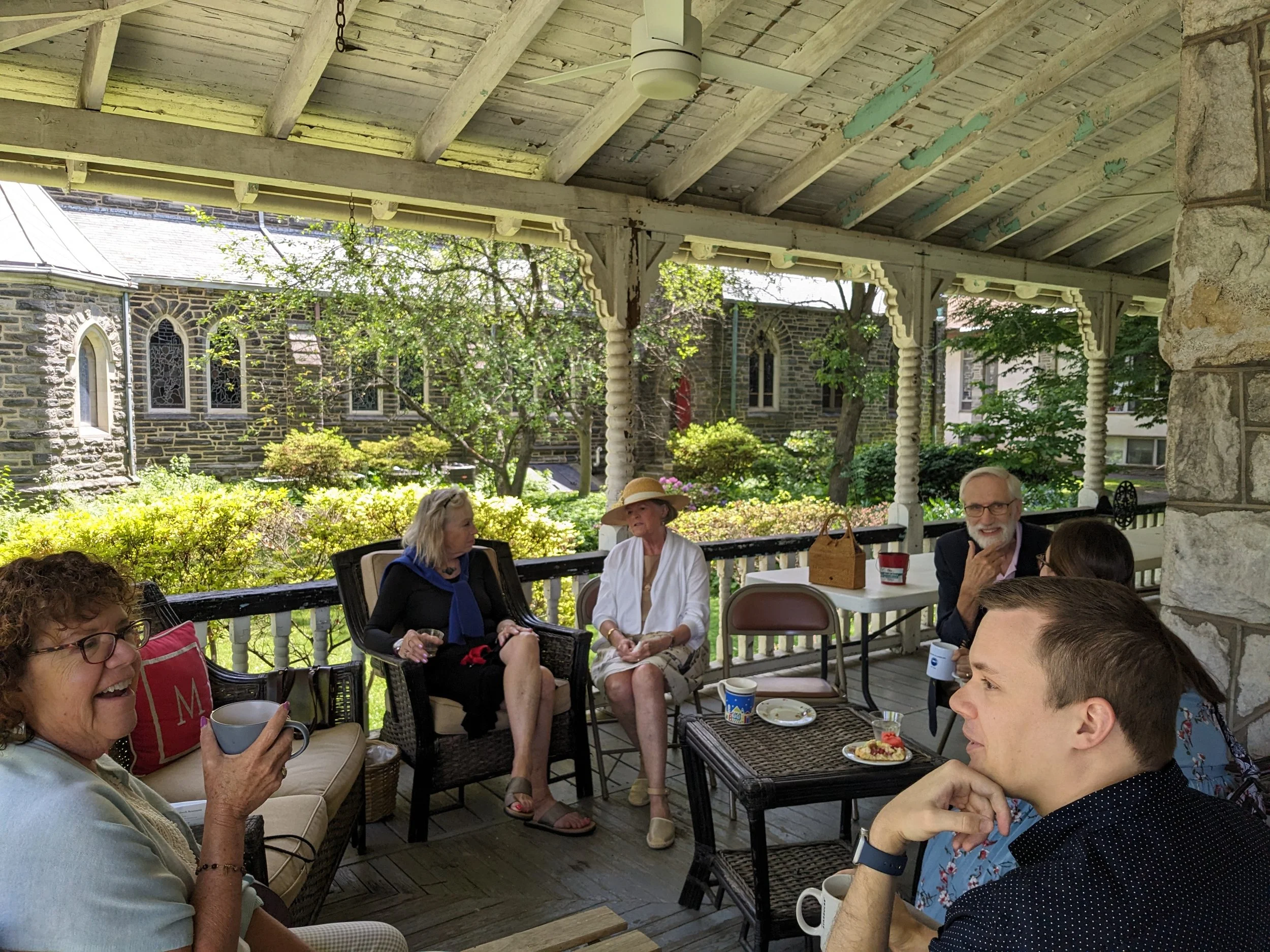
The pictures included in this message emblemize something of the spirit of Good Shepherd, Rosemont. They were taken at a recent coffee hour following Mass. Notice how “at home” everyone seems. Notice the joy on people’s faces. Note how people seem to be so comfortable conversing with one another. Pay attention to the variety of ages represented.

Parish fellowship, lived out most acutely at Sunday coffee hours, is a natural outgrowth of what we share each week at Mass. We gather weekly, not for coffee hour, but for Mass. And yet, having gone through the drama and transformation of the Mass, it seems fitting to spend additional time together as a community of believers. In the Mass, we share in the “breaking of bread and the prayers,” as well as in “the apostles’ teaching.” After Mass, we share in their “fellowship.”

My weekly messages over the past two weeks reflected on how we find our identity as Christians in community in the Mass and how our shared fellowship together in this particular parish is representative of a Benedictine commitment to stability in community. As we look ahead to the 2024-2025 program year (and yes, it’s that time!), we will be focusing, as a parish, on our common life together. What does it mean to say that we are a part of this specific parish? What does being a member mean? What responsibilities do we have to God and each other by being at Good Shepherd? How is ministry here truly shared, and how can we share that ministry more? How do we experience the demands of being a committed Christian by being a part of life at Good Shepherd? These are only some of the questions we can ask.

You can now find the 2024-2025 parish events calendar published on our website. Intentionality in community together means that we plan ahead of time to ensure that everyone can prioritize significant events in our shared life together. As we would do in our lives outside the Church, consider reviewing the parish events calendar now and marking key events in your own personal calendars. What would it mean to give precedence to some of these events (especially holy days, special Masses, and other notable occasions) so as to let the rhythm of God’s sacred time break into our quotidian time?

I would like to highlight just a few items of particular note.

1) Please join us for a festive parish picnic on Sunday, September 8, following Sung Mass as we kick off the new program year. More details will follow, but we expect to have games for children, lots of fantastic food, and fun for all ages.

2) If you’re new to Good Shepherd in recent months, consider attending the newcomers class after Sung Mass on September 15. This is an opportunity to learn more about official membership, as well as about Good Shepherd, the Episcopal Church, and Anglicanism.

3) Note that our 2025 pledge campaign will ramp up on September 22, with a presentation by our parish Advancement Committee. Please plan to attend and learn how you can make a difference in supporting God’s ministry at Good Shepherd.

4) You will note the Sundays on which our new choristers will be singing throughout the program year. What an exciting new phase this will be in the life of the parish!

5) As in the past, the Choir will lead us Choral Evensong and Benediction of the Blessed Sacrament throughout the year. On these Sundays, plan to hang around after coffee hour, have brunch with fellow parishioners, and come back for worship in the beauty of holiness.

6) You will see that most evening feast day Masses are followed by potluck suppers in the retreat house. I hope you will try to attend some or all of these!

7) Sunday adult formation is intentionally structured around the theme of our common life together, beginning with a theology of worship and moving into outreach and service in the world. All Sunday adult formation discussions will occur on the first Sunday of the month. Please recall that Sunday adult formation is not the only formation happening in the parish. Stay tuned for more information on registering for Pilgrims in Christ, an intensive adult formation class scheduled to begin in the early fall.

8) Main Line Early Music concerts are now usually on the last Sunday of each month, with occasional exceptions.

As we look towards next program year, I encourage you to find ways to put our parish life at the center of your life as you make God the center. If you’re looking for ways to become more involved at Good Shepherd, I hope you will reach out to me. If you’re just wanting to dip your toe into the water of parish life a bit more, consider this year as an opportunity to do so, and I hope you’ll avail yourself of a rich series of parish events and formation classes.

I will be away on vacation until July 13, and then I return for Mass on July 14, leaving again the next day for further vacation until the end of the month. I will miss all of you. Should you have any pastoral concerns or emergencies, please call the parish office (610-525-7070), and you will be directed to someone who can help. I’ll look forward to seeing you upon my return!

Yours in Christ,
Father Kyle

The Week of June 30, 2024

Last week, I made my annual retreat to Holy Cross Monastery in West Park, New York. Holy Cross Monastery is an Anglican Benedictine community of men who have taken vows of obedience, chastity, and poverty. Each year, my annual retreat is a moment to press restart on my spiritual life. As I drove up through the densely-packed metropolitan area surrounding New York City, with wild drivers racing past me, I was reminded of what I was leaving behind in order to be on retreat. By the time I entered the winding driveway down the hill to the monastery, which sits on the west bank of the Hudson River, I was ready for a freer schedule and a great deal of silence.

When I go on retreat, I usually do nothing more than structure my days around the brothers’ rhythm of prayer and engage in prayerful reading and contemplative prayer, with daily naps and moments spent on the porch, gazing at the gently flowing Hudson River. At Holy Cross, the daily rhythm of prayer includes Matins at 7 a.m., Eucharist at 9 a.m., Diurnum at Noon, Vespers at 5 p.m., and Compline at 7:30 p.m. I attend all the services, and indeed, in my time there, I find myself longing for those definite markers of public prayer. Within a few hours of arriving at the monastery, I found my mind, heart, and body slowing down from ninety miles an hour to about five. The monks at Holy Cross recite and sing the liturgies and the words of the psalms much more slowly than we would at Morning or Evening Prayer at Good Shepherd, and I quite like it. One must move at a different tempo than ordinary life. Silence is savored. The point is for everyone to listen to one another and speak at the same pace. The very practice of praying reenforces the brothers’ sense of fellowship and community. No one is intended to stand out or dominate; all keep pace together.

Holy Cross Monastery is one of many monasteries across the world rooted in the Benedictine tradition, following in the pattern of hospitality, communal living, and prayer modeled by St. Benedict of Nursia (480-547). Benedict’s famous “Rule,” by which monks abide, holds balance as its operating principle. Nothing is either too harsh or too lenient. It’s a beautiful way of shaping one’s life. As I mentioned to our parish vestry in my rector’s report this week, on my recent visit to Holy Cross, I was struck by the way in which ministry is shared among the brothers. I would usually arrive early to each service to sit in silent prayer, and I’d notice that one brother would be responsible for arriving early, too, in order to set out the readings and turn lights on. Another brother would be responsible for tolling the warning bell ten minutes before each service, and then he would ring the bell as we prayed the Angelus. Yet another brother would brew coffee each morning at 6 a.m. and set up for breakfast. Brothers would rotate through dish duty after meals. Everything was shared. Indeed, every brother was essential to the life of that community.

I was struck by the shared ministry of the Holy Cross brothers because I have been actively pondering shared ministry in the parish. Life is more balanced, from a Benedictine perspective, when duties are collectively owned. This is no different in the parish than in the monastery. But it’s more than just a practical aspect of communal life; it’s theological. When we’re baptized, we belong to each other in a different way. When one is sad, we all are sad. When one rejoices, we all rejoice. When one of us is away from Sunday Mass, we miss that person. One can technically be a Christian on one’s own, but one can’t be a very good one!

The main ministry of the Holy Cross brothers is hospitality. St. Benedict’s Rule famously says that “[a]ll guests who present themselves are to be welcomed as Christ” (ch. 53). I believe that one of the charisms of Good Shepherd, Rosemont, is hospitality. Our retreat house ministry has become a visible manifestation of this charism. Countless people who’ve stayed in our retreat house have commented on the warmth of the building, as well as the warmth of the welcome. In a fairly inhospitable age (and sometimes inhospitable Church), our charism of hospitality is a great gift to the world.

There is a final attribute of Benedictine living that I find inspiring. On the website of Holy Cross Monastery, the monks note that “Benedictines take a vow that includes stability, which has traditionally been understood as stability of place. We seek to be rooted and through that rootedness to grow deeply in this home God has given us.” This is similar to our understanding of a parish. While we have parishioners who travel from three different states to worship at Good Shepherd, the point is that our own parish church is intended to be a place of stability for its members. There is something quite valuable in not flitting from parish church to parish church but in finding one’s own home in a particular parish. Yes, sometimes things might seem stale or boring, but the point is that in taking root in one location as a place of prayer, we are molded and shaped by the community found there. Ultimately, we’re shaped by God. Our identity as members of Good Shepherd, Rosemont, is not tied to the whim of the moment or our feelings; it’s tied to a sense of rootedness in this place, which is rooted in the larger Episcopal Church, which is rooted in the worldwide Anglican Communion, which is rooted in the worldwide Church catholic. Such an understanding of rootedness and stability is a gift in an age of restlessness and consumerism, where people are constantly seeking greater fulfillment or changing jobs or trying out the latest fad.

My experience at Holy Cross Monastery made me grateful for the monastic witness in the Church. It also made me profoundly grateful to be at Good Shepherd, where there is much stability, given chiefly in our constant pattern of prayer. If you can, find time in your own busy lives to go on retreat. Or if you can’t go away, spend some time at our own retreat house. I hope that you will find times of intentional quiet and prayer to root you ever more deeply in the love of God, which is never changing and which sustains and nourishes us eternally.

Yours in Christ,
Father Kyle

The Week of June 23, 2024

Of all the things my parents taught me for which I’m grateful, I may be most grateful for their teaching me to go to church. We went every Sunday, unless we were sick. Admittedly, my feelings about going to church have developed and deepened since I was twelve years old. I enjoy church much more now than I did then, but this demonstrates the point I’m trying to make. I’m thankful that my parents taught me to go to church even when I didn’t want to go or “get something out of it.”

This summer, I’m leading a book study between Sunday Masses, from 9:30 to 10:15 a.m., and we’re reading Why Go to Church?: The Drama of the Eucharist by Timothy Radcliffe. Fr. Radcliffe is a Roman Catholic Dominican brother who lives in England. The book we’re reading was selected by former Archbishop of Canterbury Rowan Williams as a 2009 Lent Book. I admit that there is direct intentionality in reading this particular book during the summer. The summer is when attendance at church drops rapidly. Some of that is understandable, as people travel more during the summer months. But it seems that there’s a growing sense in our culture that summer is a time for “breaks,” including breaks from church. Summer is rightly a time for breaks from work and the busyness of life that typically drags us down and that often is not lifegiving. Summer, however, is not a time for breaks from church! In reading Fr. Radcliffe’s book this summer, during what can seem the most desultory ecclesial months, I want to explore the reason why going to church is so important.

This past Sunday, we held our first meeting of the book study. But don’t worry, it’s not too late to join! You can sign up here or simply show up. Even if you can’t attend all meetings due to travel, please come when you can. During last Sunday’s meeting, participants shared why attending church is so important to them. We agreed that going to church is an obligation in the best sense of the word, rather than in a mere perfunctory, legalistic sense. Going to church is an obligation to God so that we can experience, in a salutary, salvific way, the joy of God’s love, mercy, and compassion, and so we can be fed by God. It’s also an obligation, in the best sense of the word, to one another as member’s of Christ’s Body. We’re accountable to one another. We need one another. By being before God in person in worship, we hold each other in love and prayer and we’re visibly reminded of St. Paul’s theology of the Body of Christ: all of us matter, all of our gifts matter, we are needed in the Church, and we need God and one another.

We also touched on another profound reason for going to church, something that Fr. Radcliffe highlights effectively in his book. Going to church, even when and especially when we don’t “feel like it,” are tired, or “want a break,” is crucial to our spiritual growth. Indeed, it’s bound up with the very way in which the Eucharist is transformative. Radcliffe says that “the Eucharist works in our lives in ways that are profound but often barely noticeable and hardly register as experiences at all” (p. 6). This is the meaning of the Mass, and this is a direct counter to modern sensibilities. We inhabit an age in which we are consumers. We buy what we want. We do what we want to do, and we opt out of what we don’t want to do. Obligations and honoring commitments are shallow. But the Mass doesn’t work through immediate gratification. The Mass works on our lives and hearts in ways that are rarely perceptible in the moment. Of course, we may delight in the music or feel a sense of peace in a church building (and I hope you do!), but our reason for being at Mass is not because “we feel like it” or because we think our prayer will be instantly answered or that we’ll even feel changed after Mass. Our reason for being there is because it’s the most natural and appropriate response of our lives to the infinitely loving and creative act of the God who made us and continues to give us life.

Fr. Radcliffe suggests that at the most unexpected moments and in the most subtle ways, the Mass will work on our lives. By faithful attendance, and particularly in those moments when we’d prefer to sleep in on a Sunday, the healing power of the Eucharist rubs away our rough edges and shapes us into the people God is calling us to be. While God is always present with us and while we encounter God in a myriad of places, there’s no place like the Eucharist for us to be molded more and more into the likeness of God. There we are accountable to one another and to God. In the pews, we’re not let off the hook for bad behavior. At the Communion rail, we learn to relinquish control and receive God’s sublime gifts of the Body and Blood of Christ. Going to church is what it means to be a Christian, honoring our baptismal promises in which we said we would devote ourselves to the apostles’ teaching and fellowship, to the breaking of bread and the prayers (Acts 2:42).

So, this summer, if you’re in town, come to church. Even if you “don’t feel like it,” you will find, over time, I suspect, that being in church is a great joy. But even if it doesn’t seem so, it’s good for you. If you’re out of town traveling, go to church. Find a nearby Episcopal Church. It’s essential that we are occasionally reminded that we are not “Good Shepherd, Rosemont, Christians” but simply Christians. Worshipping in other parishes when we’re out of town reminds us of the catholicity of the Church. We are accountable to something much larger than ourselves.

Our Rector’s Warden, Don McCown, has told me of a pithy saying by our former rector Fr. Andrew Mead. He used to say, “run to Mass.” In the vein of Fr. Mead, I’d like to suggest the following. When you feel like you don’t have enough time in your day for anything, run to Mass. When you’re flustered, upset, and worried, run to Mass. When your job is eating you alive, run to Mass. When you have family or friends in town, run to Mass and take them! When you’re filled with joy and when you’re deeply sad, run to Mass. This is not cheap obligation. It’s a recognition that the Mass gives us something far greater than we can imagine. Putting the Eucharist at the center of our lives means an intentional, sometimes taxing, reprioritization of our lives.

This Sunday, I hope to see you running to Mass! Following Sung Mass, we will have a reception welcoming our new parish administrator, Renee Barrick. Run to Mass this Sunday, and then stop by the retreat house to introduce yourself to Renee and welcome her to Good Shepherd.

Yours in Christ,
Father Kyle

The Week of June 9, 2024

A few weekends ago, the parish vestry and I engaged in our annual mutual ministry review. This year it was led by Fr. Peter Stube, a priest in our diocese, and it had two main purposes: aiding the vestry and rector in gently and prayerfully assessing their shared ministry (holding one another accountable), and helping the vestry and rector take stock of where the parish is and where we hope to go in the future. As part of this mutual ministry review. Fr. Stube reflected on St. Paul’s theology of shared gifts within the Body of Christ. In 1 Corinthians 12:12 - 13:13, Paul explains that none of us has all the spiritual gifts. In fact, a blessing of this unequal distribution of spiritual gifts is that we must learn to rely on the grace of God, who gives us every good gift, and then on one another.

Our mutual ministry review was quite encouraging. I saw more clearly how much we are doing in ministry. The vestry and I named perceived strengths of the parish (i.e., worship/liturgy/music, formation, hospitality, and outreach). But we also discussed quite honestly what is needed in order to further enhance those strengths. And I was pleased that no one named money as the primary need to strengthen existing ministry in the parish or even to expand ministry, which I took as a sign of health in the parish. What do we need, then? We don’t need talent, because there’s already a profuse amount of talent within this parish. I would say that time is our greatest need.

It should be obvious that we inhabit an over-scheduled culture, which makes it increasingly difficult to give time to God and the Church. Many of us would say that it’s hard enough to give time to our families and selves. But what would it look like to reprioritize our lives, gently and thoughtfully, so that our families are valued, as well as our jobs and other commitments, while we began to shift more time to God and the Church? The question here is not where we can get more time. Remember, that in God’s abundant provision, we already have exactly what we need to do the work God is calling us to do right now. The time is there, but it’s our task to figure out how to claim it and redistribute it.

Fr. Stube invited us to be patient as we wait for God to send us the right people with the right gifts for ministry in this parish as we live into a growing vision for the parish. In my nearly four years as your rector, I’ve already seen this happen. In the moment, we need to focus on sustaining the large amount of ministry that God has helped us build here. We can still dream about our future and even name those dreams, but it’s perfectly acceptable (and sensible) to wait to act on some of those dreams until we have sufficient gifts and people to realize them.

Building ministry is an exercise in patience. God has loads of time, even though we operate with a scarcity mindset about time. And yet, I know that there are still many untapped gifts within our parish. Perhaps you are new to the parish and want to take some time to find your place here; I fully support that. Maybe you’ve been here for a while and are shy about offering your gifts. Or are you uncertain about what gifts you have to offer? I’m always happy to discuss this further with you.

As we slow down a bit for the summer months, it’s an ideal moment to begin praying about using gifts for ministry at Good Shepherd. In fact, the summer may be the most crucial time to recruit new volunteers to share in ministry, especially as people travel. By sharing the burden together, we ensure that none of us risks burnout, and that this parish remains strong and healthy. Below are some particular areas where we could use more helping hands. I ask you to read through these and consider whether the Holy Spirit is stirring your heart to participate. If so, please email me directly, and we’ll talk about what this might look like for you. Training is provided for all ministries!

Sacristans Guild (formerly Altar Guild): preparing for Sunday and other Masses by setting up vestments and vessels and keeping the sacristies tidy

Laundering Altar Linens: washing and ironing altar linens, which can be done at home

Buildings and Grounds Committee: attending monthly meetings to discuss the careful and responsible stewardship of our wonderful property, and making other contributions as needed 

Daily Office: leading Morning and Evening Prayer on an occasional or regular basis, especially during the summer months when I travel 

Retreat House: support includes donations of money and time, cooking meals, stopping by to change bed linens, publicizing our offerings, and inviting friends to “like” us on Facebook

As I’ve said before, Good Shepherd is not what it can fully be unless every single one of us is sharing our gifts for ministry. Imagine what we could be doing if that were the case. Would you prayerfully reflect on whether the summer months can be, for you, an opportunity to reorient your life by giving more to God and the Church and saying no to the incessant (and often unhealthy) ways in which our culture demands more and more of us? A significant difference between giving time to “the world/cosmos” and time to the Church is that when we’re using our own spiritual gifts, we are fulfilled in such a way as to avoid burnout. Using our God-given gifts leads to life; feeding the grind of an over-functioning world very easily leads to death. This summer, I invite you to try out the way of life.

Yours in Christ,
Father Kyle

The Week of June 2, 2024

In 1923, thousands of the Anglo-Catholic faithful assembled in the Royal Albert Hall in London for an Anglo-Catholic Congress. Mind you, these were the days when Anglo-Catholics were seen as peculiar (perhaps we still are!), and Eucharistic vestments and tabernacles were still somewhat rare in the Anglican Communion. So, Anglo-Catholics, it seemed, were always having to advocate for their “rights” within Anglicanism: to use incense, wear Mass vestments, and reserve the Blessed Sacrament. These battles seem rather tired these days, especially when, in the American Episcopal Church, we are used to a relatively Catholic way of functioning (just look at our Book of Common Prayer). But in any event, those former days of Anglo-Catholicism were the context of a concluding address by Bishop Frank Weston, then Bishop of Zanzibar, at the 1923 Anglo-Catholic Congress. Mark his words:

“I say to you, and I say it to you with all the earnestness that I have, that if you are prepared to fight for the right of adoring Jesus in his Blessed Sacrament, then you have got to come out from before your Tabernacle and walk, with Christ mystically present in you, out into the streets of this country, and find the same Jesus in the people of your cities and your villages. You cannot claim to worship Jesus in the Tabernacle, if you do not pity Jesus in the slum. Now mark that — this is the Gospel truth. If you are prepared to say that the Anglo-Catholic is at perfect liberty to rake in all the money he can get no matter what the wages are that are paid, no matter what the conditions are under which people work; if you say that the Anglo-Catholic has a right to hold his peace while his fellow citizens are living in hovels below the levels of the streets, this I say to you, that you do not yet know the Lord Jesus in his Sacrament. … And it is folly — it is madness — to suppose that you can worship Jesus in the Sacraments and Jesus on the Throne of glory, when you are sweating him in the souls and bodies of his children. It cannot be done.” (quoted in http://anglicanhistory.org/bios/kindly/weston.html).

Bishop Weston was saying that adoration of the Blessed Sacrament has everything to do with mission. Indeed, the truest mission springs from a reverence of Christ in the Blessed Sacrament, for to start with mission and then add prayer or worship on top is to get the order wrong. If one can’t fall in awe before Christ’s presence in the Blessed Sacrament, then one will struggle to fall in awe before Christ’s image in other humans. And the risk is that mission will become distorted, either as a placation of privileged guilt or as a means of using other people in a well-meaning, but inevitably warped, quest to “do good” in the world.

Bishop Weston was echoing in more modern language the theology of St. Augustine of Hippo in his Sermon 227 on the Eucharist. We, as the Body of Christ, are what we receive, which is the Body of Christ. After the bread and wine are consecrated during Mass, it is we who are on the altar! What an amazing thought. And again, to paraphrase Augustine, we are to become what we have received.

This should give pause to anyone who deigns to receive Holy Communion frequently and regularly attend Mass and not behave as a changed person outside of the Church. When we fail to treat other bodies in the world as the Body of Christ, we, in some sense, show disrespect to the Sacrament, and we eat and drink judgment on ourselves (to use words of St. Paul).

This Sunday, we will observe the Feast of Corpus Christi (transferred from Thursday) by permission of our bishop. This great feast follows quickly on the heals of Trinity Sunday, when we’re reminded of how God as Trinity is mission itself and how we’re called into that mission. And so, as we transition to the “green” Season after Pentecost, Corpus Christi compels us to see our participation in mission as coming to have a reverence for all that God gives us: the company of other people and all of creation. We learn such reverence, first and foremost, in our adoration of the Eucharist. This is only one of many reasons why going to Mass matters!

We will conclude Sung Mass with Benediction of the Blessed Sacrament. This beautiful service of devotion can’t be properly divorced from our frequent reception of Communion itself, nor should it be divorced from our call to live faithfully as the Body of Christ in the world. “Behold who you are; become what you receive” is essentially what Augustine tells us. In an increasingly irreverent world, it’s not a bad thing that we spend a bit more time in loving adoration during Benediction in order to refresh our awareness of the glory of everything and everyone around us. We, as a Eucharistic people, need to play our part in showing the world how to be better, more reverent, more life-giving, more respectful, more loving. I’ll look forward to seeing you in church this Sunday, as we worship, adore, and then learn to be who we are.

Yours in Christ,
Father Kyle

The Week of May 26, 2024

Four years ago, as this parish was making a challenging transition to calling a new rector, a remarkable gift was sent by God. That gift was Chris Wittrock. Good Shepherd was seeking a new parish administrator, and Chris was one of the applicants. As the newly-called rector, I was invited to be part of the interviews for candidates, and it became quite clear to me after meeting with Chris that she was the right person for the job. Not only was she abundantly qualified, but she was deeply interested in Good Shepherd and seemed to have a real heart for ministry. That ended up being an understatement!

Part of my deep affection for Chris as a person stems from our shared experienced in ministry. Chris came into the parish administrator position just as Good Shepherd was trying to find a new lease on life, after years of struggles and turnover in staff. Chris was handed a job description that included almost everything you can imagine! She was staring down significant deferred maintenance on our property. But working closely with me and other staff, Chris weathered all these challenges with enormous grace and aplomb.

Because Chris has engaged in ministry so quietly and effectively, it might be easy to overlook all that she has done in her four years as parish administrator. Working closely with Don McCown, our Rector’s Warden, she has helped us stabilize the care of our vast amount of buildings and property. She has patiently stuck with us as we moved the parish office first from the Choir Room (where it was located before I arrived) to the first floor of the retreat house and then to the second floor and now to its original location in the Parish House. When Chris was hired, we had no vision yet for a retreat house, but when we discerned that God was calling us to open one, Chris was fully on board. She and her husband, Bob, participated in campus cleanup days and painting days in the retreat house, and they’ve recently graciously donated a new refrigerator to our retreat house. Chris and Bob are truly generous people, and I can only begin to enumerate the ways in which Good Shepherd has benefited from their gracious spirit.

In short, Chris has all the right gifts we’ve needed over the past four years to enable ministry to expand and flourish at Good Shepherd. While Chris’s many gifts made this possible by God’s grace, Chris’s own personal faith and love of Christ allowed everything she did here to shine with love and care. Chris and I frequently laugh at moments in ministry early on in our time here. In those moments, perhaps things were not quite so funny, but in hindsight, we can rejoice that we endured rocky moments for the sake of the Gospel. I really don’t know what I would have done as rector without Chris’s can-do, entrepreneurial spirit.

This Sunday, after Sung Mass, we will celebrate Chris’s time with us before she and her husband, Bob, relocate to upstate New York. Our new parish administrator, Renee Barrick, began work this past week, and Chris will continue to work with her and train her in the coming week. (We will officially welcome Renee on Sunday, June 23 after Sung Mass.) Chris and Bob are also staying in the retreat house for a few more weeks before their move to New York, so, they aren’t leaving the area quite yet! But after Mass on Sunday, we will officially thank Chris for her dedicated and faithful service to the life of this parish. I know that Chris and Bob will remain Friends of Good Shepherd, and I’m grateful for that.

Sunday is also Trinity Sunday, a Principal Feast of the Church. It’s fitting that we honor Chris on Trinity Sunday, because an encounter with God as Father, Son, and Holy Spirit inevitably brings us to an encounter with God’s mission in the world. God the Father has sent his Son into the world for its salvation, and the Son has breathed the Spirit upon the Church for her to be sent into the world. To worship a Triune God is to be implicated and incorporated into God’s mission. Appropriately, this Sunday, as we recognize Chris’s enormous contributions to life at Good Shepherd, we will send her and Bob into the next phase of their lives with our blessing and love. I will look forward to seeing you at Mass on Sunday!

Yours in Christ,
Father Kyle

The Week of May 19, 2024

If someone didn’t know anything about the Holy Trinity, could they gain some insight into God: Father, Son, and Holy Spirit by our speech? Would they get some picture of God as Trinity, or would they think we worshipped only God the Father, or—in the case of many Christians—only Jesus? I suspect that in our speech, and perhaps even in our theological ruminations, we don’t quite know what to do with the Holy Spirit.

When is the last time you spoke openly about the Holy Spirit’s presence in your life? Do you have any sense of how the Spirit might be active in your daily existence or in the lives of those dear to you? Are you scared to speak about the Holy Spirit for fear of being labeled as a fanatic or charismatic? Or does the Holy Spirit frighten you because the Spirit blows where the Spirit will and has a tendency to disrupt our complacency?

I have written before of how palpably I’ve felt the presence of the Holy Spirit in my time at Good Shepherd. Maybe it’s because, as I get older, I’m more attuned to the need to let go of control, and letting go of control, from a Christian perspective, is partly about submitting to the Spirit’s ability and proclivity to blow unpredictably throughout my life. But it could also be that Good Shepherd has felt like such an open place for the past several years. I mean “open” in the sense of being a tabula rasa, a blank slate. When a place is not crowded by old ways of doing things and lots of parishioners being set in their rigid ways, the Holy Spirit’s invigorating and refreshing power has a way of coming to light.

It was by the Holy Spirit’s power that I was nudged, through the urging of a former staff member, to consider coming to Good Shepherd. It was by the Holy Spirit’s power that some of us began to recognize the potential latent in physical space on this campus, as well as the unique gifts of some parishioners, all of which led us to start our retreat house ministry. It was by the Holy Spirit’s power that many of you found yourselves on our doorstep, and we, in turn, discovered—rather surprisingly—that you had exactly the right gifts we needed to sustain the ministry to which we felt called. These are only some examples of the Holy Spirit’s work among us.

But the Holy Spirit, of course, can’t be controlled by the Church. In the Church, we learn how the Holy Spirit is shaping our lives and pushing us outside our comfort zones. But in the world (the kosmos as St. John puts it in his Gospel), we are called to witness to the Spirit’s power. We observe the Spirit moving and breathing among our friends and loved ones. We detect, through the Spirit’s provocations, that our voice is needed to speak to justice in the face of injustice. We discern that we’re called to a particular workplace, or school, or geographical region in order to live as fully as God desires for us to live. By the Spirit’s power, our hard-hearted ways are judged, and we are cut to the heart, and we seek repentance. By the Spirit’s power, we follow not a whim but a distinct feeling that moves us to be in the right place at the right time.

And above all, the Spirit is there to comfort us (for the Spirit is the Comforter, Advocate, Paraclete—one who “comes alongside us”) when we are in the valley of the shadow of death, enabling us to pray “with sighs too deep for words” as St. Paul tells us. The Holy Spirit gives voice to our prayer. The Holy Spirit reassures us that in our loneliest moments, we are not alone. It’s because of the Holy Spirit’s living, breathing presence in our lives that we are able even to pray at all. And it’s because God has given us the Holy Spirit that the Church is able to do “to do even greater things than these [works of Jesus in his earthly life]” (John 14:12).

This Sunday is the Day of Pentecost, the day when the Church marks the outpouring of God’s Spirit on the earliest disciples as they were gathered together, fifty days after the celebration Passover. The disciples would, of course, never be the same after this palpable manifestation of the Holy Spirit’s presence, and they would be propelled to the very ends of the earth, telling the story of God’s good news as known in Christ and engaging in God’s work of mission.

Does our current malaise within the Church mean that we’re ripe for another Pentecostal moment? Or rather, is it that every minute of our Christian existence is a moment for Pentecostal dynamism? I’ve often wondered why the fervor and spiritual fire of the Church’s earliest days (as particularly conveyed in the Acts of the Apostles) seems so far removed from sleep-in Sundays, “dying” churches, and financially anxious parish meetings, where budgets are slashed to “keep order” and ministry is whittled away. I’m thankful that this isn’t the case at Good Shepherd, where I see ambitious reaching for new ministry and an overwhelming sense of God’s abundance. And thank goodness for that. The Holy Spirit is no less alive now than two thousand years ago. Perhaps it’s that we have tuned our antennae to other frequencies: busyness, consumerism, fear, predictability, and normalcy.

The question when speaking about the Holy Spirit is how we know whether we’re following the Spirit’s voice or not? That’s not an easy question to answer. But we have some guideposts to help us along the way. If the nudges we’re following restrict our capacity for abundant living, they’re probably not of the Spirit. If something actively creates divisions and has no impulse to restore people to one another and God, then it’s probably not of the Spirit. If an urging provokes fear and shame, it’s likely not of the Spirit. But if we’re faithful in our prayers—that is, making prayer a regular part of our lives—then I’m convinced that we can trust the nudges we feel because they probably stem from the openness that God creates within us when we’re actively at prayer. Heeding those nudges, the voices of others in our lives, and the circumstances in which we find ourselves are all part of tuning our own antenna to the frequency of the Holy Spirit.

On Day of Pentecost, a principal feast of the Church, we will welcome a child, Douglas Joseph Backman, III, into the Body of Christ through the sacrament of Baptism. He will rise to new life in Christ through the water of Baptism and be sealed by the Holy Spirit and marked as Christ’s own forever. Every Baptism is a reminder that each moment of our lives is an opportunity for Pentecostal living. Let us take that Pentecostal fire into a world that needs its cleansing power and its refreshing potential for newness. I’ll look forward to seeing you in church on Sunday.

Yours in Christ,
Father Kyle

The Week of May 12, 2024

There are eighty names on the list: the oldest was 74 and the youngest 12. They are the names of the victims of gun violence in Montgomery County over the past five years. Many of the victims are in their twenties and thirties. Tomorrow, at Good Shepherd, members of our campus ministry and young adult ministry will install a Memorial to the Lost in front of the church on Lancaster and Montrose Avenues. The Memorial will include T-shirts with the names of all eighty victims of gun violence in Montgomery County over the past five years. The Memorial is sponsored by Heeding God’s Call to End Gun Violence, a local organization that “seeks to energize the American faith community and actively seek an end to gun violence through public witness and policy advocacy.” Heeding God’s Call is not a partisan organization; it’s an organization that tries to encourage people of different viewpoints to work together for commonsense advocacy to ensure that the streets of our communities can be safer places.

Barry Levis, one of our parishioners, serves on our diocese’s Anti-Gun Violence Commission, and Barry has helped us connect with Heeding God’s Call to host the Memorial to the Lost on our lawn for two weeks. I’m grateful to Barry for his work on this commission. Bishop Gutiérrez is also a co-convener of Bishops against Gun Violence, a group of more than 100 Episcopal bishops working to address the gun violence epidemic in the United States.

I see the installation of the Memorial to the Lost at Good Shepherd as a witness to the local community of our Christian commitment to peace. When people walk by our church and see the Memorial on our lawn, I hope they will know that we are doing our best, with God’s help, to be a place of reconciliation, hope, and peace. True peace is not simply the absence of conflict; it’s a state of being in a state of harmony and unity with one another. As Christians, we believe that only Christ can give the world the peace it so desperately needs. When we exchange the peace of Christ at Mass, it’s not social hour. It’s a holy offering to each other of the peace that comes, first and foremost, from Christ himself.

For the installation of this Memorial at Good Shepherd to be more than a shallow gesture of goodwill, we must see it as sacramental in some way: effecting what it says. For it to effect what it says, it must move us to be a different kind of people, a people united in the peace of Christ. We, as a Christian community, are called to be together, to work together, to receive Eucharist together in spite of our different viewpoints, personal whims, or political beliefs. The Church is not a monolith but a living organism of diverse peoples with a variety of gifts. The point of being a Christian is to die to self to rise to a larger life, a life in shared fellowship with one another. Our own grievances, stubbornness, and ideologies are smaller than Christ’s call to honor one another as children of God.

Our Lord showed us another way than that of violence. When Peter unsheathed his sword to cut off the ear of one of Jesus’s persecutors during his Passion, Jesus rebuked him. Jesus’s death is the defeat of all cycles of vengeance and violence. If we are his followers, we will ask for his grace to refuse to be a part of such vicious cycles. The violence that we renounce as Christians is not just physical violence; it’s the violence of hateful speech and rhetoric, of passive-aggressive anger, of unkind words, and of factional infighting. Even today, the universal Church is rife with dissension and petty arguments. To be a sacramental witness of peace, we must rise above such behavior, even as we are in disagreement with one another. Perhaps the Church is the only place left on earth that is intentionally organized around such a premise.

After Sung Mass on Sunday, I ask you to join me and the acolytes on the lawn following the organ voluntary for a brief dedication and blessing of the Memorial to the Lost. I pray that this Memorial will be not only a public witness on behalf of Christian values but also spur each of us to witness to Christ’s peace, in whatever way we can, in a world that can only be healed by the hand of almighty God and his peace which passes all understanding.

Yours in Christ,
Father Kyle

In memoriam:
Ja'vein Brown
Jeremiah Hawkins
Tyrell Brown
Nathaniel Harris
Mary Meister
Wanda Deshong
Adam Deshong
Ziyir Wright
Joshua Gonzalez
Michael Gillins
Derek Mayo
Ryshid Simpson
Arthur Thomas
Alhaji Koroma
Shafeeq Robbins
Jordan Hayward
Wesley Smith
Rachel King
Nevaughn Beasley
Frank Acosta
Daniel Hawkins
Anthony Pinckney
Daquan Tucker
Anthony Johnson
Emilio Alvarado
Reid Beck
Miriam Beck
Keishla Arroyo
Sean Robbins
Willie Peterson
James Hunt
Harvey Harris
Chrisian Chambers
Ruben Simon
Steve Green
Simon Jacob
Angel Vazquez
Nahmer Baird
Stephan Bates
Irving Harris
Armand Hayes
Donald Forsythe
Aaron Richardson
William Edney
Dakari Rome
Skyler Fox
Jami Lee
Brandon Bacote-Byer
Tyrek Bpgle
Trey Bartholomew
Frank Wade
Jasiyah Vasquez
Junior Pinnock
Henry Palmen
Layth Evans
Michael Paone
Barry Fields
Carla Forde
Chediaz Thomas
Darrius Waller
Adrionne Reaves
Robert Pollock
Wendell Allison-Haucey
Jonathan Adams
Mekenda Saunders
Latiya Clea
Nadege St. Preux
Nahray Crisden
Rebecca Evans
Jerry White
Ebony Pack
Rasheed Bundy
Jeanne Edwards
Otis Harris
Sun Won
Joshua Smith
James Madison
Alonzo Anthony
Keith Robinson
Ralph Williams

The Week of May 5, 2024

One of the most moving moments of the Mass is the Communion of the faithful. From my perspective near the altar, I see pew by pew of people approaching the Communion rail, kneeling, crossing themselves, and stretching out their hands. It’s significant that we don’t grab the host or the chalice. We open our hands, and then we bring our hands directly to our mouths, consuming the host. Likewise, we guide the chalice (being offered by the minister) to our lips. These liturgical movements are a theological expression of the Christian life. We approach the altar of God, offering “our selves, our souls and bodies,” to use the prayer book’s language, and then we receive the gifts of God, the Body and Blood of his Son Jesus Christ our Lord.

The Eucharistic action is countercultural, for we live in a consumerist age. We buy whatever we want, assuming we have the means to purchase it. Those who don’t have the means go without. We control gifts as we please, and we attach strings to our money. We deny love and mercy to those we dislike. We refuse gifts, perhaps, from those we want to hurt. But the Eucharist cuts right through all this as an expression of the infinite generosity of God. God doesn’t withhold gifts from us. What God has to offer is always on offer. We, of course, can refuse to receive those gifts but at the peril of our souls. We can’t control God’s gifts, nor should the Church use them as a form of spiritual manipulation (although this is sometimes done). The Eucharist is the purest form of the offering and reception of a gift.

And for this reason, we need the Eucharist to live most fully. It is “food for the journey” (viaticum) in our lives of discipleship. It’s the sustenance for our lives in Christ and the means by which we are healed, particularly from selfishness and ingratitude. For this reason, and for so many more, we go to church. We go to church not to earn an eternal reward, for that would simply be to perpetuate a culture of transaction. We go to church first and foremost to praise and adore God. True worship is the most selfless of actions. In adoration, we hope for nothing in return; we simply offer our worship. But when we do so freely, we find that we are changed. We find that we have, in fact, received something priceless in return. It’s not why we go to church; it’s simply a fruit of that action.

When we go to church, we are also reminded that we need one another. Going to church isn’t a vague humanist enterprise (we can engage in good works without the Church). But in going to church, we find that we are incomplete without others, indeed our own salvation is incomplete without others. The Mass embodies Paul’s theology of the Body of Christ. In the ritual of the Mass, each of us contributes something through our presence. In the Anglican tradition, there can be no Mass without the faithful. We need each other, and above all, we need God.

As we look towards the summer months, when many of us travel and when there might be a temptation to take a vacation from church, I suggest that we hold the opposite view. When you travel, find the nearest Episcopal church and go to Mass. And if you’re in town, come to Mass! This summer, I’ll be leading a book study before the 10:30 a.m. Sung Mass, beginning at 9:30 a.m. We will be reading Timothy Radcliffe’s book Why Go to Church?: The Drama of the Eucharist. This book was the Archbishop of Canterbury’s 2009 Lent book, and it’s a wonderful explanation of the Eucharistic action. It can help us explore the meaning behind something that can become just another mindless ritual. I hope you will consider joining me this summer for this book study, even if you will be away for some Sundays due to travel; come when you can. Our first meeting will be on Sunday, June 16, so you have plenty of time to order the book from Barnes and Noble, Amazon, or the book seller of your choice. If purchasing the book is a hardship, please contact me privately, and the church will buy you a copy. Stay tuned for a more detailed schedule and reading assignments.

And above all, I hope to see you in church this Sunday! Before then, consider attending the retreat house benefit concert this evening (Friday) at 7 p.m., performed by Ruth Cunningham. You won’t be disappointed. As usual, this Sunday, the Sixth Sunday of Easter, we will end Mass with a procession to the gardens and bless them in honor of the traditional Rogation days this week, when we give thanks for the fruitfulness of God’s creation and ask his blessing on creation and the fruits of our own labor. Our guest preacher at Sung Mass will be Bishop Geralyn Wolf, former Bishop of Rhode Island, and now Assistant Bishop in the Diocese of Long Island. Until Sunday. . .

Yours in Christ,
Father Kyle